Why does my car overheat when I turn on the air conditioning? Causes and solutions
Table Of Contents:
|
Rising engine temperature when the AC is on can turn a simple drive into constant stress. Understanding the hidden causes behind this issue helps prevent serious damage and maintain reliable vehicle performance.
What signs indicate that the AC is causing the temperature to rise?
- The temperature gauge climbs immediately after turning on the AC.
- AC cooling becomes weak while the engine temperature increases.
- A burning smell or steam appears from the front of the vehicle.
- A squealing or rattling noise comes from the compressor or cooling fan.
What are the risks of ignoring high engine temperature?
- Damage to the cylinder head or head gasket due to excessive heat.
- Increased fuel consumption because the engine works under higher load.
- Decreased AC performance and reduced cooling efficiency.
- The possibility of the car stalling suddenly on the road.
Does running the AC put extra load on the engine?
- Turning on the AC places a clear mechanical load on the engine because the compressor draws power from it.
- This additional load forces the engine to work harder, especially in small or older vehicles, causing temperature to rise gradually.
- The problem worsens in city driving or traffic jams where airflow to the radiator is reduced.
Is a weak cooling system the main cause of overheating?
- Any malfunction in the cooling system prevents the engine from dissipating the extra heat generated when the AC is running.
- Low coolant level or poor‑quality coolant reduces the system’s ability to absorb heat.
- A failing or weak water pump leads to insufficient coolant circulation inside the engine.
Can a clogged radiator or AC condenser cause overheating?
- Dirt buildup on the radiator or AC condenser blocks airflow and reduces cooling efficiency.
- Internal clogging in the radiator due to deposits restricts coolant flow and causes rapid temperature rise.
- Cleaning the radiator and condenser—inside and out—is one of the most effective solutions.
Is the cooling fan working properly when the AC is on?
- When the AC is activated, the electric cooling fan should start immediately and run at higher speed.
- Any delay or weakness in the fan causes the temperature to rise within minutes.
- The issue may be due to a blown fuse, faulty relay, or a weak fan motor.
Could the thermostat be stuck?
- The thermostat regulates coolant flow inside the engine.
- If it gets stuck in the closed position, coolant circulation stops and the temperature rises instantly when the AC is turned on.
- Replacing it is a simple but very important fix.
Does AC refrigerant pressure affect engine temperature?
- Excessive pressure inside the AC system forces the compressor to work harder.
- This extra effort directly increases engine temperature.
- Checking and adjusting refrigerant pressure solves the issue in many cases.
What are the most effective solutions to fix the problem?
- Check coolant level and replace it if old or low.
- Clean the radiator and condenser thoroughly, inside and outside.
- Inspect the electric cooling fan and ensure it activates when the AC is on.
- Check and adjust AC refrigerant pressure.
- Replace the thermostat if it is stuck.
- Ensure the water pump and coolant hoses are in good condition.
How can you prevent overheating in the future?
- Perform cooling system maintenance every 6 months.
- Clean the radiator and condenser before summer.
- Avoid running the AC during long stops in extreme heat.
- Always monitor the temperature gauge when using the AC.
FAQs
Related Blogs
When to Replace Car Tyres: Tread, Cracks and Warning Signs
Table Of Contents:
|
If you are asking when to replace car tyres, the short answer is: replace a tyre when the surface of the tread reaches the level of the raised wear indicators inside the grooves, when a bulge, a deep cut or clear cracks appear in its sidewall, or when the rubber has aged to the point at which the tyre or car manufacturer recommends replacement, even if the tread looks good. In this guide we explain how to check your tyres, what the wear pattern reveals, and how to choose the right replacement.
When should you replace car tyres? The key signs in brief
Replacement is not tied to a single distance for every car, but to the tyre's condition and its maker's recommendations. The main signs are:
- The tread surface has reached the level of the wear indicators in any part of the tyre, not just on average.
- A bulge or bubble in the sidewall, a deep cut, or exposed cords or internal fabric.
- Clear cracks in the sidewall or between the tread blocks, showing that the rubber has aged and hardened.
- Uneven wear that has left part of the tyre smooth even though the rest of its surface is sound.
- A persistent vibration that does not go away after balancing, or repeated pressure loss in the same tyre with no visible cause.
How do you check tread depth using the TWI wear indicators?
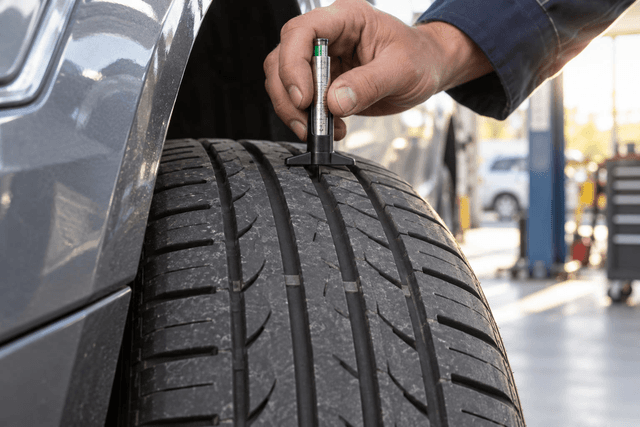
Inside the grooves are small raised bars called wear indicators, whose location is marked by the letters TWI or a small triangle on the tyre's shoulder, and when the tread surface is level with them, the tyre has reached the end of its usable life. To check:
- Park the car on level ground and turn the steering wheel to one side so you can see the front tyres clearly.
- Look for the TWI mark or triangle on the tyre's shoulder, then look into the groove next to it to find the raised bar.
- Compare the level of the tread surface with the bar; the closer they are to level, the closer the replacement date.
- Repeat the check on the inner edge, the centre and the outer edge, and at several points around the tyre's circumference.
- For a more precise reading, use a tread depth gauge, available at tyre shops, and record the reading for each tyre.
- Some drivers use a coin as a rough gauge, but it is no substitute for a proper gauge or a look by a qualified technician.
Do not wait until they are exactly level if you travel often or drive in the rain, as water clearance and grip weaken gradually as the tread gets shallower.
What do tyre cracks and sidewall bulges mean?
The sidewall flexes with every turn of the wheel and carries the car's weight, so any damage to it is more dangerous than tread wear:
- Fine surface cracks: an early sign of rubber ageing caused by heat and sun, which calls for the tyre to be inspected by a specialist and monitored.
- Deep cracks: if they widen or reach the tyre's inner layers, it is time to replace it.
- A bulge or bubble: damage to the tyre's internal structure, usually after hitting a pothole or kerb, which requires immediate replacement and no travelling on it.
- Cuts and gashes: a deep cut in the sidewall weakens the tyre even if no air is leaking from it yet.
What does the tyre wear pattern reveal?
The wear pattern reveals the cause of the problem, and if you do not fix it, new tyres will wear the same way:
| Wear pattern | Likely cause | What to do |
| Both edges more than the centre | Pressure lower than recommended | Set the pressure according to the driver's door sticker and check it regularly |
| Centre more than the edges | Pressure higher than recommended | Set the recommended pressure, not the maximum pressure printed on the tyre |
| One inner or outer edge | Wheel alignment or suspension fault | Check the alignment and suspension parts |
| Diagonal, feather-like wear | Incorrect toe between the two wheels | Have the alignment set at an equipped workshop |
| Repeated patches or scallops | Unbalanced wheels or worn shock absorbers | Balance the wheels and check the shock absorbers |
| A single flat spot | Hard braking with a locked wheel, or standing a long time without moving | Have a specialist assess the tyre |
If you see wear on both edges, start by reviewing the causes, signs and solutions for low tyre pressure, and if the wear is on one edge or comes with the car pulling to one side, read about the difference between wheel balancing and alignment.
How do Saudi heat and sand affect tyre life?
Rubber ages over time even if the car is used little, and you will find how to tell a tyre's age from the DOT code in our article on how to read tyre size and manufacture date. There is no single lifespan for all tyres, so refer to the tyre and car makers' recommendations. In the Kingdom's climate, some factors speed up deterioration:
- Direct sun and high heat speed up the hardening and cracking of rubber, especially for cars standing for long periods in open car parks, so park in the shade whenever possible.
- Hot asphalt raises tyre temperature, and the effect grows with low pressure or overloading on long trips.
- Sandy, gravel and desert tracks expose the tread and sidewall to cuts from sharp stones, so inspect the tyres after every desert trip.
- If you lower tyre pressure (deflating) to drive on sand, restore it to the recommended value before returning to asphalt, because highway driving at low pressure raises tyre temperature.
Should you replace tyres in pairs or all four together?
Ideally all four tyres match, but replacing them all together is not always necessary:
- Replace both tyres on the same axle together at least, so grip does not differ between the two sides when braking or cornering.
- When replacing only one pair, many tyre makers recommend fitting the newer pair on the rear axle for better stability, unless the owner's manual says otherwise.
- In four-wheel-drive or all-wheel-drive cars, the owner's manual may require the four tyres to be close in size and degree of wear to protect the drive system, so check it before replacing only two.
What about the spare tyre?
The spare forgotten in the boot ages just like the other tyres, even if it is never used:
- Check its pressure regularly and before every trip, because a flat spare will not help you when you get a puncture.
- Read its manufacture date and inspect its sidewall, as it may be older than the tyres on the car.
- A small temporary spare is designed for a limited distance and speed stated in the owner's manual or on the tyre's side, so use it only to reach the nearest tyre shop.
- If your car comes with a repair kit instead of a spare, check its expiry and how to use it.
How do you choose the right replacement tyre: size, load and speed?
Choose what your car was designed for, not just what the shop has in stock, and check the following:
- Size: copy it from the sticker on the driver's door frame or from the owner's manual, not from the tyre currently fitted, which may be different.
- Load index and speed symbol: choose values equal to or higher than the car manufacturer's recommendation, never lower.
- Manufacture date: ask for recently made tyres with close dates, especially on the same axle.
- Type of use: a driver who often travels on highways has different needs from one who drives in the desert or carries heavy loads, so ask about the tyre designed for your use.
- Changing the size: do not change the size of your tyres or rims without consulting a specialist; to learn the effect, read our article on whether the wrong rims make your car use more fuel.
- After fitting: balance the wheels, set the pressure according to the driver's door sticker, and check the alignment if the old tyres were worn unevenly.
What is the tyre energy efficiency label in Saudi Arabia?
The Saudi Standards, Metrology and Quality Organization offers the Energy Efficiency Label for Tires service, and explains that the label serves as a guide for consumers before purchasing the product to increase their awareness of its energy efficiency before buying it.
The organization lists tyres among the products subject to the efficiency label regulations, and the aims of these labels include reducing energy consumption for the consumer, enabling the consumer to know a product's efficiency before buying, and protecting consumer safety and health and the environment. In practice:
- When comparing tyres of the same size, ask to see the energy efficiency label for each one and read its details.
- Do not make the label your only criterion; size, load index, speed symbol, manufacture date and the tyre's suitability for your use come first.
- Requirements and procedures may be updated from time to time, so check the latest information on the organization's website.
Frequently asked questions about replacing car tyres
- Should I replace a tyre that is old even if its tread is good? Tread depth alone is not enough, as rubber hardens over time; have it checked by a specialist and follow the tyre maker's recommendation.
- Can a puncture in the side of the tyre be repaired? Repairing holes in the sidewall or shoulder is not usually recommended, while for a hole in the tread area the technician decides whether it can be repaired based on its size and position.
- Can I fit two tyres of different types? This is not recommended on the same axle, and it is best for all four tyres to match in type and tread pattern, especially in four-wheel-drive cars.
- Are small cracks between the tread blocks dangerous? They are a sign of ageing that may not require immediate replacement, but have a specialist monitor them, and if they deepen, replace the tyre.
- How often should I check my tyres? Check their pressure and appearance regularly, for example when refuelling, before every trip, and after hitting a pothole or kerb or after a desert trip.
Checking your tyres takes only minutes: look at the wear indicators, inspect the sidewall, notice the wear pattern and read the manufacture date. If a danger sign appears, do not postpone the change; choose a replacement with the recommended size, load and speed ratings, then fix the cause of any uneven wear.

Vehicle Ownership Transfer on Absher: Steps and Conditions
Table Of Contents:
|
Vehicle ownership transfer in Saudi Arabia is done electronically through the vehicle sale service on the Absher platform, without visiting traffic offices: the seller enters the buyer's ID number and date of birth, the agreed sale price and the seller's bank account; the buyer then receives a notification of the request within one hour and accepts or declines it, transfers the price through Absher's secure payment system, insures the vehicle and pays the fees, and once the car is received, checked and the delivery is confirmed on Absher, ownership is officially transferred. Both parties must be registered on Absher, the vehicle registration (istimara), periodic inspection and insurance must be valid, and there must be no violations on the buyer or the vehicle.
What is the vehicle ownership transfer service on Absher?
The Ministry of Interior offers the vehicle sale service through the Absher platform, and the National Platform describes it as a service that enables individuals to sell their private vehicles and transfer ownership electronically after its dues are cleared, after reaching an agreement with the buyer and completing all required procedures, including vehicle inspection to ensure compliance with conditions, registering the vehicle under the buyer's identity, and issuing the vehicle registration license.
- Target audience: individuals, both citizens and residents.
- Service channels: the Absher website and its mobile app.
- Service duration according to the National Platform: immediate.
- Payment method: the car's price is transferred through Absher's secure payment system, and the service page on Absher explains that payment goes to an intermediary account dedicated to the service, which ensures the amounts are documented and the vehicle is received.
Procedures and conditions may be updated from time to time, so confirm the latest steps on the Absher platform or the National Platform before you start.
What are the conditions for selling a vehicle on Absher?
Before the seller starts the request, both parties should review the conditions listed on the service page on Absher, as failing to meet any of them may stop the sale:
- Both the seller and the buyer must be registered on the Absher platform.
- The vehicle must be in sound condition and not suspended, lost, wanted or impounded.
- The vehicle registration license (istimara) must be valid.
- The vehicle must have a valid periodic inspection.
- The vehicle must have valid insurance.
- There must be no violations on the buyer or on the vehicle.
- The agreed price must fall within the limits set by the service, and the vehicle must be of a type the service allows to be sold.
- Government fees are paid through the government payment system (SADAD).
The page also mentions limits on the number of vehicles of certain types that a resident may own, so review them on Absher if the buyer is a resident. If the periodic inspection is close to expiring, prepare the car early using the checklist on how to prepare your car for the periodic inspection.
What are the seller's steps to transfer car ownership on Absher?
After agreeing with the buyer on the price and other terms, the seller starts the request with these steps, as set out by the National Platform:
- Log in to the Absher platform.
- Go to vehicle services, then choose the vehicle sale service.
- Select the vehicle you want to transfer from the list displayed.
- Enter the buyer's information: ID number and date of birth.
- Enter the agreed-upon sale price.
- Add the seller's bank account details where the proceeds of the sale will be deposited.
- Carefully review the entered information, then confirm the request.
- Wait for the buyer's response: the buyer receives a notification of the transfer request within one hour and can accept or decline it.
- Once the buyer accepts the sale, both parties complete the delivery of the vehicle and the payment through Absher's secure payment system before the transfer is confirmed.
What does the buyer do to complete the sale?
Ownership does not pass to the buyer until they complete their steps on the platform, which according to the National Platform are:
- Review the Absher notification about the vehicle transfer request, and accept it within one hour if you agree.
- Carefully review the vehicle information and sale price before confirming your acceptance.
- Transfer the agreed amount to the seller's account through Absher's secure payment system.
- Insure the vehicle before the ownership transfer is completed.
- Pay the government fees and the Absher fees.
- Receive the vehicle and check it, then confirm delivery through Absher.
- Upon confirmation, the vehicle ownership is officially transferred from the seller to the buyer.
How do the seller's and buyer's tasks differ?
The table below summarises the role of each party at every stage of the sale:
| Stage | Seller | Buyer |
| Before starting | Agree on the price and terms, and check the istimara, periodic inspection and insurance are valid | Register on Absher and make sure there are no violations on them |
| Creating the request | Enter the buyer's ID, date of birth, price and bank account, then confirm | Wait for the Absher notification |
| Responding | Wait for acceptance or refusal | Review the details and accept or decline the request within one hour |
| Payment | Receive the price in the bank account entered in the request | Transfer the price through Absher's secure payment system |
| Insurance and fees | The platform lists no step for the seller at this stage | Insure the vehicle and pay the government fees and Absher fees |
| Delivery | Hand the vehicle over to the buyer after they accept the sale | Receive and check the vehicle, then confirm delivery on Absher |
How do you transfer car ownership between family members?
If you are handing your car over to a family member, Absher has a separate service called vehicle ownership transfer between family members, which allows vehicle ownership to be waived between family members electronically once the current owner and the new owner agree. The National Platform lists its steps as follows:
- Log in to the Absher platform, then select the required vehicle and the service dedicated to this.
- Select a first-degree family member: father, mother, brother, sister, husband, wife, son or daughter.
- Enter the confirmation code sent to the new owner's phone.
- Pay the service fees.
- The vehicle ownership is transferred to the new owner in the traffic systems after all requirements are met.
What practical checks protect the seller and buyer before the sale?
The platform organises the procedure, but it does not replace inspecting the car yourself; the service page on Absher states that the sale takes place after the vehicle has been viewed and inspected and the seller and buyer have agreed. Here are practical tips before accepting the request:
- Match the chassis number (VIN) on the car with the istimara and the vehicle details shown in the request; the article on what the VIN characters mean explains where to find it.
- Inspect the car in daylight and try the engine, transmission, air conditioning and tyres, or ask for a pre-purchase inspection at an independent inspection centre; you will find a wider list in vehicle inspection tips before buying a used car.
- Look for signs of accidents and differences in paint shade between panels, and read what it means when a car has been repaired before you decide.
- Check for violations through official channels such as Absher before starting the request, because the service requires no violations on the buyer or the vehicle.
- Agree in advance on what the sale includes, such as the spare key, accessories and the service record if there is one.
- Keep a private record of the agreement for yourself: the agreed price, the request date and screenshots of the request, and do not share these details publicly.
What are the common mistakes in car ownership transfer?
- Starting the request before clearly agreeing on the price and other terms.
- Entering the buyer's ID number, date of birth or the sale price without careful review before confirming.
- Creating the request at a time when the buyer is not available, although the steps ask the buyer to review and accept it within one hour.
- Overlooking the expiry date of the istimara, periodic inspection or insurance until the request stalls after the deal is agreed.
- Transferring the price outside Absher's secure payment system, although the service steps state that payment is made through it.
- Confirming delivery on Absher before actually receiving and checking the car.
Frequently asked questions about car ownership transfer
- Do I need to visit the traffic department to transfer car ownership? According to the National Platform, the vehicle sale service is completed electronically through Absher without the need to visit General Traffic Department offices.
- How long does the ownership transfer take? The National Platform describes the service duration as immediate; the buyer receives the request notification within one hour, and the sale is complete once both parties finish their steps and the buyer confirms delivery.
- Who pays the ownership transfer fees? The National Platform lists paying the government fees and Absher fees among the buyer's steps; check their current amount on the platform before you start.
- Can the sale be cancelled after the request is created? The buyer can decline the request when the notification arrives, and the service page on Absher states that in case of disagreement or unwillingness to continue, the sale can be cancelled before it is completed, according to the stage set by the platform.
- Does the buyer need insurance for the car? Yes. One of the buyer's steps is to insure the vehicle before the ownership transfer is completed.
Transferring car ownership through Absher is a clear process if you prepare for it: check the conditions, agree on the price, inspect the car before accepting, pay through the platform's secure payment system, and do not confirm delivery before checking the car. If you are looking for your next car, you can browse the cars available at Saleh Cars Group.

Driving License Renewal on Absher: Requirements and Steps
Table of Contents:
|
Driving license renewal in Saudi Arabia is done electronically through the Absher platform under traffic services, without visiting traffic offices, provided you complete the regulatory requirements such as paying the fees and completing a medical examination. This electronic service covers private driving licenses and motorcycle licenses only, and the remaining validity of the license must be less than 365 days. This guide explains the requirements as shown on the official service page at the time of writing, the renewal and delivery steps, why a request may not proceed, and how it differs from renewing the vehicle registration (Istimara).
What Is the Driving License Renewal Service on Absher and Who Can Use It?
The driving license renewal page on the National Portal describes a service that lets individuals renew their driving license electronically, easily and efficiently, without visiting traffic offices. It lists the service duration as immediate and the delivery channels as the website portal and smartphone apps. The Absher service guide defines the beneficiary as a citizen or resident who is registered and activated on the Absher platform.
So first make sure your Absher account is active and that you can log in, then check your license type. According to the prerequisites tab, the service covers renewing private driving licenses and motorcycle licenses only. If your license is of another type, do not assume this service will accept it; ask the official traffic channels about the right procedure for your case.
What Are the Published Driving License Renewal Requirements?
The official service page lists the following requirements. Use the table as a checklist before logging in to Absher, while following what the service displays for your case when you apply. Requirements may be updated, and the service page at the time you apply is the reference.
| Requirement as Shown on the Service Page | What to Check Before Starting |
| A private or motorcycle driving license | The license type recorded in your details |
| Payment of license renewal fees through government payments via banks | That payment was actually made for the correct service, not just that a payment screen was opened |
| Payment of traffic violations, if any | The status of any violations recorded against you before applying |
| Remaining license validity of less than 365 days | Your expiry date, using the driving license information service |
| A medical examination through a certified medical center | That the examination was done at a certified center |
The required documents tab repeats payment of any violations, payment of the renewal fees and the medical examination, and does not mention uploading photos or extra papers. Do not rely on circulated lists that add unpublished documents. If you have violations, review how to check and pay traffic violations before starting the renewal.
What Are the Steps for Driving License Renewal on Absher?
The following steps are taken from the service page on the National Portal. If the menus look different in your interface, look for the driving license renewal service under traffic services, and do not choose a similarly named service such as vehicle registration renewal.
- Log in to the Absher platform.
- Select “My Services”.
- Choose “Traffic” from the services list.
- Select the “Renew Driving License” service.
- Read the service description, terms and conditions, then select “Next”.
- Review your personal information, specify the renewal period (2 years, 5 years or 10 years), then select “Confirm Renewal”.
- Fill in your National Address details for license delivery.
- Review the entered data.
- Pay the delivery fees using a card (Visa, Mada, Mastercard).
- A message confirms that the driving license renewal is completed.
Note that the payment inside these steps is for delivery. For the renewal fees themselves, the prerequisites tab says they are paid through government payments via banks. This guide does not state amounts for any period; follow what the service shows for your case. Before filling in the address, make sure your National Address is correct, because it is used for the license delivery request.
Closing the screen or completing a payment alone does not prove the renewal is complete. Check for the success message, then review your license details before repeating any step if your session was interrupted.
Why Can License Renewal Fail to Proceed, and What Should You Check?
The service page does not publish a list of error messages, but the published requirements help you identify which item to review. Always start with the text of the message shown in your account, then compare it with the following possibilities:
- The remaining validity of the license is not less than 365 days; check the expiry date through the driving license information service.
- The renewal fees have not been paid or the payment has not appeared yet; review the transaction status and receipt before paying again.
- There are unpaid traffic violations; do not assume that filing a dispute replaces this requirement before its outcome is clear.
- There is no medical examination from a certified medical center.
- The license type is not covered, because the service is limited to private and motorcycle licenses.
- The account is not registered or activated on Absher, since the service guide defines the beneficiary as a registered and activated user.
If the message is unclear, note its text, the time of the attempt and the stage where you stopped, then contact the official support channels shown on the service page. Never share your password or verification code with anyone, and do not treat a failed attempt as a final rejection without confirmation from the competent authority.
How Does Driving License Renewal Differ From Istimara Renewal?
The two documents are often confused because both are called a license. The driving license belongs to the driver, while the Istimara is the vehicle registration and relates to the car itself. Each therefore has its own Absher service and its own requirements, so do not apply the conditions of one to the other.
The medical examination and the remaining license validity are published requirements for driving license renewal and have nothing to do with the condition of your car. If what you need to renew is the vehicle document, follow the guide to vehicle registration renewal on Absher and why it may fail, which explains that service’s requirements and steps.
Likewise, vehicle insurance does not appear among the driving license renewal requirements on the service page. If you are reviewing your car insurance at the same time for other reasons, read about comprehensive versus third-party car insurance to choose a suitable policy.
Frequently Asked Questions About Driving License Renewal
Can I renew my driving license without visiting a traffic office?
Yes, according to the official service page: the service is electronic through Absher without the need to visit traffic offices, provided the regulatory requirements are completed. If your case cannot proceed, follow the service message and the competent authority’s guidance.
How early can I renew my license before it expires?
The prerequisites tab requires the remaining validity of the license to be less than 365 days. You can check your license validity electronically through the driving license information service listed among the related services.
Is a medical examination required for driving license renewal?
Yes. The official page lists a medical examination through a certified medical center among both the prerequisites and the required documents. Complete the examination at a certified center before starting the service.
What renewal periods are available?
The service steps mention choosing the renewal period of 2 years, 5 years or 10 years while reviewing your details. Choose from the options shown to you and review what applies to each option as displayed in the service.
How do I receive my license after renewal?
The steps include filling in your National Address details for license delivery and then paying the delivery fees by card. The National Portal also lists a digital driving license display service among the related services, which is separate from renewal.
Conclusion
Prepare the driving license renewal requirements first: pay the fees and any violations, complete the medical examination at a certified center, and confirm that the remaining validity meets the published condition. Then follow the steps on Absher and check for the success message. If the request cannot proceed, address the item identified in the message or request clarification through the official channels.
Vehicle Registration Renewal on Absher: Steps and Requirements
Table of Contents:
|
Vehicle registration renewal is available electronically through Absher vehicle services once the service requirements are met and the automated eligibility check is passed. Start by reviewing insurance, technical inspection and any required payments, then select the vehicle, choose registration renewal and confirm the transaction. Istimara means the vehicle registration here, not the person’s driving licence. This guide explains what to prepare and how to handle a renewal that cannot proceed, without confusing renewal with ownership transfer or an inspection booking.
What Is Vehicle Registration Renewal on Absher?
Renewal extends the registration of a previously registered vehicle. The official vehicle registration renewal page on the National Portal explains that the service is available electronically through Absher without visiting traffic offices, and that eligibility is checked automatically against the service requirements. Reaching the vehicle screen therefore does not establish that renewal is complete.
When checking an expiry date, first identify the document: a driving licence relates to the driver, while vehicle registration relates to the vehicle. This distinction matters when researching requirements; do not apply driving licence renewal conditions to registration renewal. Follow the service name shown in your account rather than an old screenshot of a different menu.
What Are the Vehicle Registration Renewal Requirements?
The official service page lists the following requirements. Use them as a checklist before starting, while also referring to what the service displays for your vehicle when you apply. A receipt or an old copy of a document is not a substitute for checking its validity and that it relates to the intended vehicle.
- Valid vehicle insurance: check the coverage dates and vehicle details, not just the purchase notification.
- A valid technical inspection certificate: distinguish an inspection appointment from an existing valid certificate.
- Payment of renewal fees and any late-renewal penalty, as required by the service, rather than relying on a widely quoted amount.
- Payment of any traffic violations: check the payment status rather than assuming that starting a bank transaction completes the process.
The required-documents tab also specifies an existing vehicle registration. This guide does not add requirements to upload photographs or other documents simply because somebody else encountered them; follow what the service actually requests. Because renewal eligibility is checked automatically, verify availability in your account rather than deciding based on a date quoted in an unofficial explanation.
How Should You Check Insurance, Inspection and Violations?
Start with insurance: open the policy details and check that the policy is valid and covers the same vehicle. To distinguish the type of cover from the validity of a policy, read about comprehensive versus third-party car insurance. Choosing cover that fits your needs is different from checking a renewal requirement; the name of the cover alone does not establish that an application will be accepted.
Next, review the inspection certificate. If you need to prepare for an appointment, use the periodic vehicle inspection preparation checklist to organise technical checks, not as proof of passing. Inspection is a separate process with its own result, not a renewal-screen button that substitutes for a valid certificate.
Then review violations and any payment requirements displayed. The guide to checking, paying and disputing traffic violations explains the related services. Do not confuse filing a dispute with satisfying the renewal payment requirement; rely on the displayed status and the relevant authority’s instructions rather than assuming another action removed the obstacle.
What Are the Steps to Renew Registration on Absher?
The following route follows the official service instructions. Read the details on each screen before moving on. If the menus appear in a different order in your interface, look for vehicle registration renewal under vehicle services rather than selecting another service because its name is similar.
- Log in to Absher through its official channel, then select Vehicles.
- Select Manage Vehicles from the services menu and review the vehicles shown in your account.
- Choose the vehicle whose registration you want to renew and check its details before proceeding.
- Select Renew Vehicle Registration; the system automatically checks eligibility against the service conditions and requirements.
- Review the information displayed, complete any requirements and select Confirm Renewal.
- Check for the successful renewal message, review the updated registration details and retain any transaction reference displayed.
Payment alone, or closing the screen, does not prove successful renewal. If your session ends before the result appears, return to the vehicle details and check what actually happened before repeating the steps. The aim is to confirm that the correct vehicle’s registration was updated, not simply to complete a sequence of clicks.
How Do Renewal, Ownership Transfer and Inspection Differ?
These services may relate to the same vehicle, but each serves a different purpose. Use the table to identify your starting point, then review the relevant service conditions separately. Do not assume completing one also completes another.
| Procedure | Purpose | What Does Not Prove Completion? |
| Registration renewal | Renew the vehicle registration | Buying insurance or booking an inspection alone |
| Ownership transfer | Transfer the vehicle to another owner | Registration renewal alone |
| Technical inspection | Inspect the vehicle and obtain its result | An appointment without the inspection taking place |
If your aim is to sell or buy the vehicle, review the Absher ownership transfer steps and sale conditions instead of treating renewal as a substitute for transfer. Organise your notes under separate headings: registration status, insurance status, inspection result and transfer transaction status when relevant. This helps avoid confusing different documents.
Why Can Renewal Fail to Proceed, and What Should You Do?
An unmet published requirement is a possible reason renewal cannot proceed, but it does not explain every message. Start with the text displayed in your account and review the item it identifies, rather than repeating the request or changing several things without understanding the issue.
- If the message concerns insurance or inspection, match the vehicle and validity dates against the relevant document and contact its issuer if the information conflicts.
- If it concerns payment, review the requirement, transaction status and receipt before paying again. Do not assume an amount or reason that the screen does not state.
- If eligibility is unclear or the renewal option is missing, review the current service conditions and vehicle details, then ask official support for clarification.
- If a technical message appears without explanation, note its text, the time and the stage reached. Reopen the service to check the result; do not describe it as a final rejection without confirmation.
When contacting support, explain where the process stopped and which documents you checked. Never share your password or verification code, and hide personal details in any screenshot you post. This is a way to organise follow-up, not a guarantee of processing time or acceptance.
Frequently Asked Questions About Vehicle Registration Renewal
- Is registration renewal the same as driving licence renewal? No. Registration, or Istimara, relates to the vehicle, while the driving licence relates to the driver. Check the service name before reviewing its requirements or using it.
- Is valid insurance enough to renew registration? No. Insurance is one requirement; the official page also lists a valid inspection certificate and payment requirements. Automated eligibility verification remains part of the renewal process.
- Is booking a periodic inspection enough? The published requirement is a valid technical inspection certificate. A booking is not that certificate and does not show that the vehicle passed the inspection.
- Must I visit a traffic office to renew? The official page describes electronic renewal through Absher without visiting traffic offices. If your case cannot proceed, follow the service message and support guidance rather than assuming a particular in-person procedure.
- How can I tell that renewal is complete? Check the successful renewal message and then review the registration details. The National Portal lists digital registration display and registration printing as related services; do not confuse accessing the document with carrying out renewal itself.
In short, prepare the vehicle requirements, renew the registration through Absher and verify the result. If the process cannot proceed, address the item identified in the message or request official clarification, without assuming fees, deadlines or exceptions that the service does not show.

Saudi Traffic Violations: How to Check, Pay and Dispute
Table Of Contents:
|
To check traffic violations in Saudi Arabia, open the Query Traffic Violations page on the Absher platform and enter your ID number together with the violation number or your date of birth. To pay, sign in to the Efaa platform through the National Single Sign-On, choose the violations you want to pay, then pay through the SADAD system, a mada card or a credit card. To object, use the Dispute Traffic Violations service that the Ministry of Interior provides online. These procedures may be updated from time to time, so confirm the latest steps on the official platform before you act.
What are traffic violations and who issues them?
Traffic violations are violations related to the Traffic Law and its implementing regulations. As the description of the dispute service on the National Platform explains, they are issued by the General Department of Traffic or by any other authority authorised to apply the Traffic Law and its implementing regulations. In practice, you deal with them through three main services:
- Inquiry: to find out which violations are registered against you, through the Query Traffic Violations page on the Absher platform.
- Payment: through the Efaa platform, as part of a Ministry of Finance service for paying government violations registered against individuals.
- Dispute: through the Dispute Traffic Violations service provided by the Ministry of Interior, if you have something showing that the violation is incorrect.
It helps to distinguish traffic violations from other government violations, such as Ministry of Transport violations or municipal violations, because each authority has its own services; you will find a summary in the table below.
How do you check traffic violations on Absher?
The Absher platform provides a dedicated page called Query Traffic Violations, which asks for specific search details. The steps usually go as follows:
- Open the Query Traffic Violations page from the official Absher website.
- Enter your ID number in its field.
- Choose the search type: by violation number or by date of birth.
- Enter the violation number or the date of birth, depending on the type you chose.
- Complete the verification code shown on the page, then display the result.
If you want to see the violations registered against you by different government entities in one place, the Efaa platform steps start with signing in through the National Single Sign-On (Nafath) and then viewing the registered violations, which we explain in the next section.
How do you pay traffic violations through the Efaa platform?
The service for paying government violations registered against individuals enables citizens, residents and visitors to view and pay all the violations registered against them by government entities, including traffic, smoking, government fines and other violations. The service page on the National Platform lists the payment steps as follows:
- Go to the Efaa platform.
- Choose to sign in through the National Single Sign-On.
- View the violations registered against you.
- Select the violations you want to pay.
- Continue to the electronic payment page.
- Complete the payment through the SADAD system, a mada card or a credit card.
According to the service description, the platform aims to unify and simplify violation procedures through a single digital platform that the relevant entities are linked to, so violations are issued and managed centrally. The National Platform also states that the service itself is free, meaning there is no charge for using it; this does not mean the violation amount is waived.
How do you dispute a traffic violation?
The Dispute Traffic Violations service provided by the Ministry of Interior allows you to dispute traffic violations issued by the General Department of Traffic and any other authority authorised to apply the Traffic Law and its implementing regulations. The service is provided online through the web portal and the mobile apps, and its path as shown on the service page is:
- Go to My Services.
- Choose Traffic.
- Choose Dispute Traffic Violations, then follow the instructions shown to complete the request.
We have not listed deadlines or detailed conditions for disputes here because they do not appear in the service description on the National Platform; read the conditions and instructions shown to you inside the service before submitting, and do not delay your dispute if you believe the violation is incorrect. Before you start, the following helps:
- Make sure the violation really concerns your vehicle or your licence, and that its details match what happened.
- Write the reason for your dispute clearly and briefly, stating facts rather than impressions.
- If you have documents that support your position, prepare them in advance, and provide the details the service asks for.
- Keep proof that you submitted the request until you receive the decision.
What is the difference between violation services on the official platforms?
Several entities register violations, and each service has a specific purpose. The table below summarises the services listed in the official sources we relied on:
| Service | Entity or platform | What it lets you do |
| Query Traffic Violations | Absher platform | Search by ID number with the violation number or date of birth |
| Payment of government violations registered against individuals | Ministry of Finance through the Efaa platform | View violations registered by government entities and choose which to pay |
| Dispute Traffic Violations | Ministry of Interior | Dispute violations from the traffic department and authorities authorised to apply the Traffic Law |
| Violations inquiry at the Ministry of Transport | Ministry of Transport and Logistic Services | Display violation details by searching with the violation number or the identification number |
| Municipal violations inquiry | Qassim Region Municipality as an example | View registered violations and the details of each one after signing in through the National Single Sign-On |
If a violation is registered with an entity other than the traffic department, look for that entity's inquiry service on the National Platform; for example, the Ministry of Transport and Logistic Services offers an inquiry through its web portal via the Ministry Services link and then the Violations Inquiry service in the list of inquiry services.
What are the most common causes of traffic violations you can avoid?
The best way to deal with violations is not to commit them in the first place, and most of their common causes can be avoided with simple habits that protect you and others on the road:
- Exceeding the speed limit: watch the road signs, because the limit changes between highways, inner streets and school areas, and cruise control helps you hold a steady speed on long roads.
- Not wearing a seat belt: make it a habit before moving off, for you and all passengers, however short the trip.
- Using the phone while driving: set navigation and calls before moving off, and leave messages until you stop in a safe, permitted place.
- Expired documents: track the expiry dates of your driving licence, the vehicle registration (istimara) and the insurance policy, and renew them before they are due.
- An expired periodic inspection: note its date in your phone calendar, and prepare the car beforehand with this checklist for preparing your car for the periodic inspection.
- Running a red light or stopping in prohibited places: slow down when approaching a signal, be ready to stop when it changes, and park only in permitted spaces.
- Neglecting the car's condition: make sure the lights and indicators work, and do not ignore warning lights; read about dashboard warning light meanings to know when to stop immediately.
Remember that driver assistance systems such as lane departure warning and adaptive cruise control help you, but they do not replace your attention, and they do not take over your responsibility to follow the rules.
What practical tips should you follow before paying or disputing?
- Check your violations regularly so they do not pile up without your knowledge.
- Read the details of each violation before deciding, then choose whether to pay it or dispute it.
- Reach the official platforms by typing their address yourself or through their official apps, and do not pay through links sent to you in messages from unknown sources.
- Do not share your verification code, login details or card details with anyone.
- Keep proof of payment until you are sure the violation status has been updated.
- If you face a technical problem, contact the entity that provides the service through its official channels.
Frequently asked questions about traffic violations
- Do I need to visit a government office to settle a violation? Usually not; the inquiry, payment and dispute services mentioned are provided online through the official portals and apps, and the dispute service page shows a branches link for anyone who needs it.
- Can I pay more than one violation at the same time? The Efaa platform steps include viewing the registered violations and then selecting the violations you want to pay before continuing to payment, so you decide what to pay.
- Does the Efaa platform include non-traffic violations? Yes. The service description states that it covers traffic, smoking, government fines and other violations registered by government entities.
- Can I dispute a traffic violation registered by an entity other than the traffic department? According to the service description, disputes cover traffic violations issued by the General Department of Traffic and any other authority authorised to apply the Traffic Law and its implementing regulations.
- Who do I call if I face a problem? The service pages on the National Platform list the Ministry of Finance number 19990 for the payment service and the Ministry of Interior number 966114011111 for the dispute service, as well as each entity's official email address.
Dealing with traffic violations is easier than it looks: check them on Absher, pay them on the Efaa platform, dispute them through the Ministry of Interior service if you have a clear reason, and always review the updated steps on the official platforms. Most importantly, avoid their common causes from the start: keep to the speed limit, fasten your seat belt, keep your phone out of your hand, and renew your documents before they expire.
Choosing a Car Battery: Size, Capacity, Type and Installation
Table of Contents:
|
Choosing a car battery starts with confirming that the battery really is the cause of the problem, then matching what the owner’s manual or the current battery label specifies: size and mounting, terminal orientation, capacity in Ah, cold cranking amps (CCA) and battery technology. After that, check the manufacture date and warranty terms, and make sure installation is done properly, which may include registering the battery in the car’s system. This guide explains each step in general terms; your owner’s manual and a qualified technician remain the reference for your car’s specifications.
When Should You Start Choosing a Car Battery?
Do not buy a battery just because the car failed to start once. Weak starting can be linked to the battery, but also to the starter motor, the connections or the charging system. Ask a specialist to test the battery and charging system with suitable equipment, and review the car battery failure symptoms and how to test them to recognise signs worth checking.
If the engine cranks normally but does not start, the battery may not be the cause; see the guide on an engine that cranks but will not start. If the battery keeps going flat, there may be a hidden electrical drain in the car, and fitting a new battery without fixing the cause may simply pass the problem on to it. Once testing confirms the battery, prepare the following before visiting the seller:
- A clear photo of the current battery label showing all printed details.
- The battery specification page in the owner’s manual, if available.
- Whether the car has an automatic engine stop-start system.
- Where the battery sits: engine bay, boot or under a seat.
Which Specifications Should Match the Manual or Label?
The first reference is the owner’s manual, then the label of the original battery if it is still fitted. The table below summarises what to compare before paying and where to find it.
| Item | Where to find it | Why it matters |
| Size or group | Owner’s manual or current battery label | Defines overall dimensions and fit on the tray |
| Mounting dimensions | Battery tray and hold-down clamp | A poorly secured battery vibrates and can be damaged |
| Terminal orientation | Position of the positive and negative terminals on the current battery | A different layout may stop cables reaching or strain them |
| Capacity (Ah) | Label or owner’s manual | Indicates the energy stored in the battery |
| Cold cranking amps (CCA) | Label | Indicates the battery’s ability to deliver starting current |
| Technology type | Label and owner’s manual | Must suit the charging system and any stop-start system |
Two batteries can look alike yet differ in terminal orientation, height or mounting lip. Ask the seller to compare the new battery directly with the old one. If the current label differs from the manual, the previous battery may not have matched in the first place; rely on the manual or ask the dealer or a qualified technician.
What Do Capacity (Ah) and Cold Cranking Amps (CCA) Mean?
Capacity in Ah describes how much energy the battery stores, which matters when the battery powers the car’s systems with the engine off. Cold cranking amps (CCA) describe the battery’s ability to deliver a high current at the moment of starting in cold conditions, according to a specific test standard.
A label may state CCA according to a different standard from another battery, so only compare two figures measured to the same standard, and ask the seller to clarify. The general rule is not to go below the car’s specified capacity or current.
On the other hand, a higher figure is not automatically better; what matters is that the battery keeps the correct size and technology. In cars that record battery data in their system, the actual capacity of the new battery may need to be entered during registration, so tell the technician about any difference from the original.
What Is the Difference Between Flooded, EFB and AGM Batteries?
The general idea of each type is as follows, while the manual decides what your car needs:
- Conventional flooded battery: common in cars without an automatic stop-start system; some serviceable types need the electrolyte level checked.
- EFB battery: an enhanced flooded battery built to withstand repeated starting and discharge cycles better than a conventional one, used in many cars with stop-start systems.
- AGM battery: the electrolyte is absorbed in glass fibre mats and the battery is sealed; it copes better with electrical loads and repeated discharge, and is used in cars with higher electrical demands.
In a car with automatic stop-start, the battery handles frequent engine restarts and powers systems while the engine is stopped. Fitting a lower technology than specified, such as a conventional flooded battery instead of EFB or EFB instead of AGM, may weaken system performance, shorten battery life and trigger warning messages. Moving to a higher technology should only happen if the owner’s manual or the dealer allows it.
If the battery sits inside the cabin or boot, the manufacturer may specify a sealed type or a particular vent outlet; do not fit a different battery in that location without confirming that it matches.
How Do You Read the Manufacture Date and Warranty Terms?
The manufacture date usually appears as a code printed on the lid or case or on a small sticker, and the code format differs between manufacturers, so ask the seller to explain the code on the battery itself, and prefer the most recently made battery among the matching options.
A battery stored for a long time may lose some charge, so ask whether the seller tested it before sale. For the warranty, read the written terms on the invoice or warranty card rather than relying on a verbal promise, and pay attention to the following:
- What the warranty covers, how a fault is proven, and whether the battery must be tested by the seller.
- Whether installation elsewhere, or fitting the battery to a car it does not match, affects the warranty.
- Which documents are needed for a claim; keep the invoice somewhere easy to find.
How Does Saudi Heat Affect Your Battery Choice?
High temperatures speed up the reactions inside a battery and may increase fluid loss and ageing of the internal plates. This does not mean choosing a battery simply because it is marketed for heat; it means sticking to the correct specification and technology and choosing a recently made battery.
After installation, help the battery by parking in the shade where possible, keeping the terminals clean and checking the battery and charging system during routine maintenance. For more on how heat affects the car in general, read the summer car care guide for Saudi heat.
What Should You Consider When Installing the New Battery?
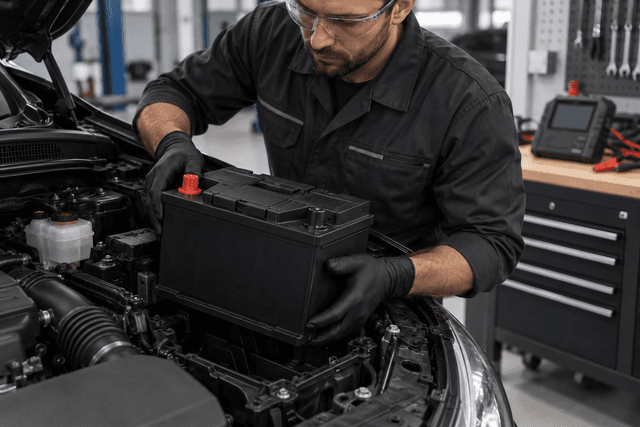
If you are not confident about the steps, leave the installation to a qualified technician. If you fit it yourself, wear eye protection and gloves, switch the engine off and keep the key away, disconnect and reconnect the terminals in the order given in the owner’s manual, avoid letting a metal tool touch both terminals, and keep any sparks or flames away from the battery.
- Battery registration: some cars require the new battery to be registered in the energy management system with a diagnostic tool so that charging is adjusted for a new battery. Ask the technician whether your car needs this.
- Saving settings: disconnecting the battery may erase settings such as the clock and radio, and some systems may need resetting according to the manual. Some technicians use a memory saver during the swap.
- Clean terminals: remove corrosion from the terminals and cable ends, and check that the clamps are sound before connecting.
- Secure mounting: fix the battery with its hold-down clamp so it cannot move, tighten the terminals without excessive force, and refit the protective covers.
After installation, start the car and watch for any warning message. If one appears, return to the technician to check the installation and registration rather than trying to clear the warning yourself.
How Do You Dispose of the Old Battery Safely?
A battery contains acid and lead, so do not open it, drain it or put it in household waste. Keep it upright, protect its terminals from contact, and hand it to the seller, a workshop or a party that accepts used batteries for recycling. If it is cracked or leaking, do not touch it with bare hands and ask the workshop to handle it.
Frequently Asked Questions About Choosing a Car Battery
How can I tell a battery fault from a starter fault?
Slow cranking with dim lights may point to the battery, while a click with bright lights may point to the starter motor. These are indications, not a diagnosis, so have the battery and charging system tested and review the signs of a failing starter motor before buying.
Can I fit a battery with a higher capacity than the original?
It may be possible in some cases if the size and technology still match, but the decision rests with the owner’s manual and the technician, especially in cars that record battery data in their system.
Can I fit a conventional battery to a car with stop-start?
This is not recommended; use the technology specified in the manual, such as EFB or AGM, because a lower technology may not withstand the frequent restart pattern.
Do all cars need the new battery to be registered?
No, but some cars require it using a diagnostic tool. Ask the technician or check the manual before installation, and do not assume the swap is complete once the terminals are connected.
What should I do with the old battery after replacing it?
Do not open it or throw it away with household waste. Keep it upright and hand it to the seller, a workshop or a party that accepts used batteries for recycling.
Conclusion
First confirm that the battery is the problem, then match size, terminals, capacity, CCA and technology to the owner’s manual, and check the manufacture date and warranty terms. Leave installation and registration to a technician if you are unsure, and dispose of the old battery safely.