Car Recalls in Saudi Arabia: VIN Checks and Next Steps
Table of Contents:
|
To check car recalls in Saudi Arabia, enter the VIN on the official recall platform, then read the campaign details and follow the instructions for your vehicle. A matching model name or model year alone does not establish inclusion, and no result does not mean the car is defect-free. If a campaign applies, contact the responsible party named in it, ask about driving instructions and an appointment, and retain confirmation of the completed repair.
What are car recalls in Saudi Arabia?
A recall is an action to address an announced defect, not a general description of every problem a car develops. The Ministry of Commerce explains that its enquiry service checks whether products or vehicles are included in campaigns announced in cooperation with manufacturers and local agents. Start with the official source rather than a shared image or a message of unknown origin.
Refer to the Ministry of Commerce defective products enquiry service (in Arabic) for the service sequence: access the platform, enter the VIN or search for the product, then follow the campaign details and required actions. Do not assume a recall means replacing the car; the relevant action is the one specified for the campaign once its applicability to your vehicle is confirmed.
What should you prepare before a VIN recall check?
Have the vehicle identification number, or VIN, ready. Read it from a reliable document for the car or from the location identified in the owner’s manual. Do not substitute the registration plate number or another identifier simply because its name sounds similar. For help identifying it, see the guide to your vehicle identification number, then match the details to the actual car.
- Copy the complete number exactly and check the letters and digits before searching, especially when copying from an image or message.
- Keep the basic vehicle details and any recall notice you received so you can explain your enquiry clearly when making contact.
- If the number on a document differs from the one on the car, have a qualified party clarify the discrepancy before relying on the search result.
Do not send full images of your documents to untrusted accounts to make an enquiry. Start through the official channel and provide what the responsible party requests through its authorised contact method, without posting your details in public comments.
How do you search the recall platform?
- Open the official defective products recall platform and find the vehicle or product checking field rather than only browsing the latest announcements.
- Enter the VIN you checked and run the search. If the field rejects the entry, review the number and field instructions rather than guessing a replacement character.
- Read the full result and open the details of any associated campaign. Note its reference if shown, the defect description and the required action.
- Review the instructions, then contact the specified party to confirm VIN inclusion and arrange the next step, rather than choosing a contact from an unofficial advertisement.
Searching by product or brand name helps you find announcements, but it does not replace matching the individual car. Keep the date of your enquiry and a copy of the details for reference. Do not treat an old screenshot as a permanent answer about recalls, particularly when a new notice arrives.
How should you interpret the search result?
Distinguish finding an announcement from confirming that your vehicle is included, and distinguish inclusion from actual completion of the required action. This table helps you choose the next step; it does not represent fixed status labels used by the platform:
| What did you find? | What should you do? |
| An announcement naming your car model | Match the VIN and check the campaign scope before assuming it applies to your car. |
| A result indicating that the vehicle is included | Read the campaign instructions and contact the party responsible for carrying out the action. |
| No result, or a search that could not be completed | Check the entry; if you have a notice or a specific concern, seek confirmation from the relevant party. |
| The seller says the repair was completed | Request the completion document and match it to the VIN and the relevant campaign. |
The absence of a recall result does not guarantee safety or replace an inspection when there are unusual symptoms. Likewise, do not attribute a noise or vibration to a campaign simply because its description seems similar. Diagnosing a fault requires a professional, while the enquiry answers a different question: whether the car is included in the campaign.
What should you do if your car is included?
Read the full defect description, risk and instructions before planning a trip to a service centre. There is no single driving recommendation for every campaign. If the announcement specifies instructions about use or stopping, follow them. If anything remains unclear, ask the responsible party how to handle and transport the car before moving it.
- Provide the VIN and campaign reference, and ask for confirmation that the discussion concerns this specific car and action.
- Ask where the work takes place, how to book and what to bring, and confirm the instructions to follow until the appointment.
- Keep the contact and appointment details, and ask how to obtain written confirmation when the work is finished.
Do not deliberately try to reproduce the defect, dismantle a suspected component or cancel a warning to continue driving. If the action requires a part or technical work, do not assume that buying a replacement yourself closes the campaign. To understand parts choices outside this process, read the guide to genuine, aftermarket and used car parts; follow up recall work with the party responsible for it.
How do you follow up and keep proof of repair?
When collecting the car, request a document showing the work performed and its date, linked to the VIN and campaign. Check that the details concern your car, and ask whether the action is complete or another step remains. An appointment confirmation or service-centre visit alone does not necessarily show that the recall work is finished.
Keep the document with the vehicle records, a copy of the announcement and important correspondence. If a later search seems inconsistent with the completion document, show both to the responsible party and request clarification instead of assuming one overrides the other. If symptoms remain or a concern appears after the work, report it and request a technical assessment. Proof of campaign repair is not a certificate that the car has no other faults.
What should you check before buying a used car?
Add a check for open recalls, meaning those whose required action is not yet complete, to your pre-purchase checklist. Request the VIN, match it to the car and search for yourself rather than relying on a verbal assurance or an image for a similar vehicle. If the seller mentions a completed earlier campaign, request its document and review the VIN and work details.
If a campaign applies and completion is unclear, ask the responsible party what remains before deciding to buy or use the vehicle. Do not make a recall result a substitute for a technical inspection or a review of the car’s condition; combine it with these used car inspection tips before purchase. The aim is to establish what has been verified and what needs follow-up, not to obtain a comprehensive guarantee from one search result.
Frequently asked questions about car recalls
- Is the car name enough to establish inclusion? Do not rely on it alone. Identify the vehicle using its VIN, then confirm campaign applicability with the responsible party if the result remains unclear.
- Does no result mean the car is completely safe? No. The enquiry is not a comprehensive technical inspection and does not justify ignoring symptoms or warnings that need professional assessment.
- Should I wait for a fault before making contact? Once inclusion is confirmed, follow the campaign instructions and contact the responsible party about the action without waiting for a noticeable symptom or trying to produce one.
- Can I book any workshop to close the recall? Start with the party identified in the announcement and ask it to direct you to the place of service and explain completion confirmation, rather than assuming any independent repair is enough.
- What should I keep after the action is completed? Retain confirmation linked to the VIN and campaign, the work date and important correspondence to make follow-up or explaining the car’s history when selling it easier.
Start with the correct VIN, read the full announcement and follow up with the responsible party until completion and documentation are clear. Make the enquiry part of caring for a car and checking it before purchase, not a replacement for a technical inspection or its specific safety instructions.
Choosing a Car Battery: Size, Capacity, Type and Installation
Table of Contents:
|
Choosing a car battery starts with confirming that the battery really is the cause of the problem, then matching what the owner’s manual or the current battery label specifies: size and mounting, terminal orientation, capacity in Ah, cold cranking amps (CCA) and battery technology. After that, check the manufacture date and warranty terms, and make sure installation is done properly, which may include registering the battery in the car’s system. This guide explains each step in general terms; your owner’s manual and a qualified technician remain the reference for your car’s specifications.
When Should You Start Choosing a Car Battery?
Do not buy a battery just because the car failed to start once. Weak starting can be linked to the battery, but also to the starter motor, the connections or the charging system. Ask a specialist to test the battery and charging system with suitable equipment, and review the car battery failure symptoms and how to test them to recognise signs worth checking.
If the engine cranks normally but does not start, the battery may not be the cause; see the guide on an engine that cranks but will not start. If the battery keeps going flat, there may be a hidden electrical drain in the car, and fitting a new battery without fixing the cause may simply pass the problem on to it. Once testing confirms the battery, prepare the following before visiting the seller:
- A clear photo of the current battery label showing all printed details.
- The battery specification page in the owner’s manual, if available.
- Whether the car has an automatic engine stop-start system.
- Where the battery sits: engine bay, boot or under a seat.
Which Specifications Should Match the Manual or Label?
The first reference is the owner’s manual, then the label of the original battery if it is still fitted. The table below summarises what to compare before paying and where to find it.
| Item | Where to find it | Why it matters |
| Size or group | Owner’s manual or current battery label | Defines overall dimensions and fit on the tray |
| Mounting dimensions | Battery tray and hold-down clamp | A poorly secured battery vibrates and can be damaged |
| Terminal orientation | Position of the positive and negative terminals on the current battery | A different layout may stop cables reaching or strain them |
| Capacity (Ah) | Label or owner’s manual | Indicates the energy stored in the battery |
| Cold cranking amps (CCA) | Label | Indicates the battery’s ability to deliver starting current |
| Technology type | Label and owner’s manual | Must suit the charging system and any stop-start system |
Two batteries can look alike yet differ in terminal orientation, height or mounting lip. Ask the seller to compare the new battery directly with the old one. If the current label differs from the manual, the previous battery may not have matched in the first place; rely on the manual or ask the dealer or a qualified technician.
What Do Capacity (Ah) and Cold Cranking Amps (CCA) Mean?
Capacity in Ah describes how much energy the battery stores, which matters when the battery powers the car’s systems with the engine off. Cold cranking amps (CCA) describe the battery’s ability to deliver a high current at the moment of starting in cold conditions, according to a specific test standard.
A label may state CCA according to a different standard from another battery, so only compare two figures measured to the same standard, and ask the seller to clarify. The general rule is not to go below the car’s specified capacity or current.
On the other hand, a higher figure is not automatically better; what matters is that the battery keeps the correct size and technology. In cars that record battery data in their system, the actual capacity of the new battery may need to be entered during registration, so tell the technician about any difference from the original.
What Is the Difference Between Flooded, EFB and AGM Batteries?
The general idea of each type is as follows, while the manual decides what your car needs:
- Conventional flooded battery: common in cars without an automatic stop-start system; some serviceable types need the electrolyte level checked.
- EFB battery: an enhanced flooded battery built to withstand repeated starting and discharge cycles better than a conventional one, used in many cars with stop-start systems.
- AGM battery: the electrolyte is absorbed in glass fibre mats and the battery is sealed; it copes better with electrical loads and repeated discharge, and is used in cars with higher electrical demands.
In a car with automatic stop-start, the battery handles frequent engine restarts and powers systems while the engine is stopped. Fitting a lower technology than specified, such as a conventional flooded battery instead of EFB or EFB instead of AGM, may weaken system performance, shorten battery life and trigger warning messages. Moving to a higher technology should only happen if the owner’s manual or the dealer allows it.
If the battery sits inside the cabin or boot, the manufacturer may specify a sealed type or a particular vent outlet; do not fit a different battery in that location without confirming that it matches.
How Do You Read the Manufacture Date and Warranty Terms?
The manufacture date usually appears as a code printed on the lid or case or on a small sticker, and the code format differs between manufacturers, so ask the seller to explain the code on the battery itself, and prefer the most recently made battery among the matching options.
A battery stored for a long time may lose some charge, so ask whether the seller tested it before sale. For the warranty, read the written terms on the invoice or warranty card rather than relying on a verbal promise, and pay attention to the following:
- What the warranty covers, how a fault is proven, and whether the battery must be tested by the seller.
- Whether installation elsewhere, or fitting the battery to a car it does not match, affects the warranty.
- Which documents are needed for a claim; keep the invoice somewhere easy to find.
How Does Saudi Heat Affect Your Battery Choice?
High temperatures speed up the reactions inside a battery and may increase fluid loss and ageing of the internal plates. This does not mean choosing a battery simply because it is marketed for heat; it means sticking to the correct specification and technology and choosing a recently made battery.
After installation, help the battery by parking in the shade where possible, keeping the terminals clean and checking the battery and charging system during routine maintenance. For more on how heat affects the car in general, read the summer car care guide for Saudi heat.
What Should You Consider When Installing the New Battery?
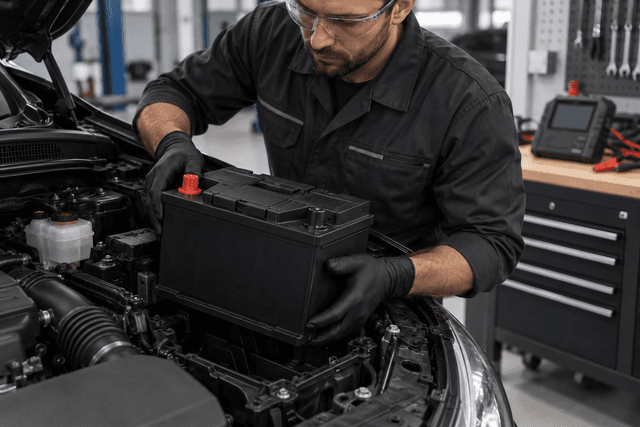
If you are not confident about the steps, leave the installation to a qualified technician. If you fit it yourself, wear eye protection and gloves, switch the engine off and keep the key away, disconnect and reconnect the terminals in the order given in the owner’s manual, avoid letting a metal tool touch both terminals, and keep any sparks or flames away from the battery.
- Battery registration: some cars require the new battery to be registered in the energy management system with a diagnostic tool so that charging is adjusted for a new battery. Ask the technician whether your car needs this.
- Saving settings: disconnecting the battery may erase settings such as the clock and radio, and some systems may need resetting according to the manual. Some technicians use a memory saver during the swap.
- Clean terminals: remove corrosion from the terminals and cable ends, and check that the clamps are sound before connecting.
- Secure mounting: fix the battery with its hold-down clamp so it cannot move, tighten the terminals without excessive force, and refit the protective covers.
After installation, start the car and watch for any warning message. If one appears, return to the technician to check the installation and registration rather than trying to clear the warning yourself.
How Do You Dispose of the Old Battery Safely?
A battery contains acid and lead, so do not open it, drain it or put it in household waste. Keep it upright, protect its terminals from contact, and hand it to the seller, a workshop or a party that accepts used batteries for recycling. If it is cracked or leaking, do not touch it with bare hands and ask the workshop to handle it.
Frequently Asked Questions About Choosing a Car Battery
How can I tell a battery fault from a starter fault?
Slow cranking with dim lights may point to the battery, while a click with bright lights may point to the starter motor. These are indications, not a diagnosis, so have the battery and charging system tested and review the signs of a failing starter motor before buying.
Can I fit a battery with a higher capacity than the original?
It may be possible in some cases if the size and technology still match, but the decision rests with the owner’s manual and the technician, especially in cars that record battery data in their system.
Can I fit a conventional battery to a car with stop-start?
This is not recommended; use the technology specified in the manual, such as EFB or AGM, because a lower technology may not withstand the frequent restart pattern.
Do all cars need the new battery to be registered?
No, but some cars require it using a diagnostic tool. Ask the technician or check the manual before installation, and do not assume the swap is complete once the terminals are connected.
What should I do with the old battery after replacing it?
Do not open it or throw it away with household waste. Keep it upright and hand it to the seller, a workshop or a party that accepts used batteries for recycling.
Conclusion
First confirm that the battery is the problem, then match size, terminals, capacity, CCA and technology to the owner’s manual, and check the manufacture date and warranty terms. Leave installation and registration to a technician if you are unsure, and dispose of the old battery safely.
Accident Damage Assessment in Saudi Arabia: Taqdeer Guide
Table of Contents:
|
Accident damage assessment is a step you may need after a Najm or traffic police report. According to the Saudi Authority for Accredited Valuers (TAQEEM), it means determining the cost of repairing the vehicle, including parts, or estimating its market value before or after the damage. These assessments are managed electronically through the Taqdeer system, which operates under the Authority’s supervision and lets you book an appointment and check the status of your assessment. This guide covers the stage after the report: when to seek an assessment, what to prepare, how to read the report and review it with your workshop and insurer, and what to do if you disagree with the result.
What Is Accident Damage Assessment and Who Oversees It?
On its official English website, TAQEEM describes vehicle damage assessment valuation as “the act or process of determining the value of repairing the vehicle including the spare parts, or estimating the market value of the vehicle before and after the accident”; the Arabic version also mentions labour explicitly. The outcome may therefore be a repair cost, or a market value before or after the damage, depending on the case.
TAQEEM describes Taqdeer as “an online integrated system for managing, operating, and organizing vehicle damage assessment processes” and lists “Book an appointment at Taqdeer centers” among its services. The Taqdeer system website (in Arabic) states that it operates under the supervision of the Saudi Authority for Accredited Valuers. An assessment is a technical valuation of the damage; it is neither the accident report nor your insurer’s decision.
When Do You Need an Assessment After a Najm or Police Report?
The sequence starts with attending to and documenting the accident. If you have not completed that stage, begin with the guide to Najm reporting steps and when to call the traffic police, then return to this guide.
The official pages we relied on do not state that an assessment is required for every accident, nor do they describe the content of report messages. Follow what the accident report and your insurer require in your case, and ask before any repair starts, because repairing damage before it is assessed may cost you the chance to document it as it was. Useful questions for your insurer:
- Does my case need a damage assessment, and from which body?
- Is the electronic report enough, or must it be sent in a particular way?
- Should I wait for the assessment before taking the car to a workshop?
- Which documents do you need with the report to progress the claim?
How Do You Book a Taqdeer Appointment and Track It?
The Taqdeer website presents the service in three consecutive stages, which can be summarised as follows:
- Book an appointment and go to the assessment center, using the booking service, which the site describes as booking a new appointment to assess your vehicle’s damage.
- Have the vehicle damage assessed at the assessment center.
- Receive the report electronically, with the option to follow it through the report status service, which lets you check the status of your assessment.
If your plans change before the appointment, the manage bookings service allows you, according to the site, to modify or cancel the booking, and the assessment centers page helps you find the nearest centers in your city. We do not mention numbers of centers, timings or fees here; follow what the service shows for your case when you book.
What Should You Prepare Before Visiting an Assessment Center?
The pages we reviewed do not publish a document list, so the list below is practical rather than an official requirement; what the booking screen and center ask for takes precedence:
- Your booking details as shown once the booking is complete.
- The accident report reference from Najm or the traffic police.
- Your ID and the vehicle registration; ask what is needed if you are not the vehicle owner.
- Unedited photos of the damage taken at the time of the accident.
- Your insurance policy details and the party handling the claim.
Do not repair the damage being assessed before the appointment unless the relevant authority tells you to, and do not drive an unsafe car; arrange transport if you notice a leak, a red warning light or a steering fault.
How Do You Read a Damage Assessment Report?
The report format may vary from case to case, but the Authority’s definition shows what it centres on: labour, spare parts, or market value before or after the damage. Use the table to review it item by item:
| Item | What to Check | What to Ask |
| Vehicle and accident details | The car and the accident reference match | Do these details relate to my car and this accident? |
| Spare parts | The listed parts compared with the documented damage | What type of part does the assessment assume? |
| Labour | Listed work such as bodywork and paint | Does the work cover all the damage I documented? |
| Market value | Whether a value before or after the damage is stated | On what basis was this value reached? |
To understand how the type of part affects a repair, see genuine vs aftermarket vs used car parts. Do not assume the report specifies the type of part unless it says so explicitly; ask about it.
How Do You Review the Assessment With Your Workshop and Insurer?
The assessment sets a value, while the compensation and repair path is governed by your policy and your insurer. Check your policy type and what it covers in the guide to comprehensive versus third-party car insurance, and do not assume that the assessed amount is what you will receive in every case.
- Show the report to the workshop before work starts and ask them to compare its items with what they will actually do.
- If hidden damage appears after disassembly, ask your insurer how it will be handled before the repair continues.
- Ask the workshop for an itemised invoice and photos before and after the repair.
- Record every contact with your insurer: the date, the person and what you were asked for.
If the car needs sensor or camera calibration after the repair, ask whether it is included in the assessment or in the workshop’s quote.
What Should You Do If You Disagree With the Assessment?
We did not find a published objection mechanism for assessment results on the official pages we reviewed, so we do not describe a specific procedure. The right step is to ask the source about the official procedure:
- Identify exactly which item you disagree with: a part, a piece of work or a market value.
- Gather supporting evidence: accident photos, the workshop’s notes after disassembly and any invoice.
- Contact Taqdeer through the support and help channels shown on its website and ask what procedure is available for your case.
- Also ask your insurer about its review procedure and what it needs from you in writing.
Do not accept a settlement you disagree with before you understand its consequences, and ask for written replies where possible.
Why Should You Keep the Assessment Report After the Repair?
The report and invoice help you later when you sell the car or when a buyer asks about the accident. The guide to reading a Mojaz report and its limits explains how accident records in a vehicle history should be understood and what cannot be concluded from them.
If you are a buyer looking at a car with signs of repair, ask for the assessment report and invoice if they exist, and use the guide on how to tell whether a car has been repaired alongside an independent technical inspection.
Frequently Asked Questions About Accident Damage Assessment
Is an accident damage assessment the same as a Najm report?
No. The report documents the accident, while the assessment estimates the repair cost or the market value of the vehicle before or after the damage.
Do I need an assessment for every accident?
Do not rely on a general rule; follow what the accident report and your insurer require in your case, and ask them before repairing the car.
How can I check the status of my assessment report?
The Taqdeer website offers an assessment status inquiry service and lists receiving the report electronically as one of the service stages.
Can I change or cancel my assessment appointment?
The website offers a manage bookings service for changes and cancellations; follow what the service shows for your booking.
Is the assessed amount the final compensation?
Not necessarily. Compensation depends on your policy and your insurer’s procedures, so ask your insurer how it is calculated in your case.
Conclusion
After the report, ask your insurer what your case needs, book the assessment through the official system and read the report item by item before any repair. If you disagree, ask Taqdeer and your insurer about the official procedure, and keep your documents for the future.
Mojaz Report: How to Read Used Car History and Its Limits
Table Of Contents:
|
A Mojaz report helps you read a used car’s history through the records available; it does not deliver a final verdict on its condition. Start by matching the vehicle’s identity, then read mileage, accident and maintenance records chronologically and compare them with documents and the car’s current condition. No accident record does not mean accident-free, and missing mileage readings do not validate the odometer. Use the report to identify seller questions and professional inspection priorities before deciding to buy, not as a replacement for inspection.
What does a Mojaz report show, and what are its limits?
The official Mojaz homepage (in Arabic) says it brings together key historical vehicle data from official sources in one report. Its report outline lists vehicle information, odometer reading history, accident records, maintenance and repairs, warranty information, spare parts, vehicle reputation and related images.
These are section names presented by the service, not a promise that every section contains data for every car. Read what is actually available, and do not turn a blank field into a positive or negative finding. Likewise, do not infer a specific rating or acceptance standard from the vehicle reputation heading; use any accompanying explanation and ask about unclear descriptions before relying on them.
Start by matching the car and the report version
Before discussing findings, establish that the report belongs to the actual car being offered. Ask to see the full version rather than a cropped image of a reassuring section, and match its identification details to the vehicle documents and the car. Do not rely on a similar colour or general description, or dismiss an identification mismatch as a minor error without checking.
- Check the VIN if shown, comparing every character with the documents and its designated location on the car; seek professional help if anything is unclear.
- Note the report date if visible, distinguishing it from the event dates inside; a recent report may contain only an older record.
- Write down any data mismatch and ask for an explanation before evaluating mileage or accidents or concluding the agreement.
For identification details and their locations, see the guide to vehicle identification numbers, while paying attention to the name of each identifier in the document you are reading.
How do you read odometer records chronologically?
Read the date of each distance reading, not just the last number. Put the available readings in order from oldest to newest, then compare the latest with the car’s odometer during the viewing. Check measurement units first; do not directly compare figures expressed in different units. Your aim is to understand the sequence and identify questions, not estimate true mileage from cabin appearance alone.
- Write the date and reading exactly as shown, distinguishing report information from something the seller says or a figure on an invoice.
- If a later reading is lower than an earlier one, request a documented explanation and discuss possibilities with a professional; the inconsistency warrants a pause but is not a standalone diagnosis of tampering.
- If there is a long gap, ask for documents covering that period; do not assume the car was unused throughout it.
- If there are no readings at all, note that mileage has not been verified through this method instead of automatically accepting the current figure.
If the seller mentions an odometer replacement, ask for the work record and evidence of readings before and after replacement, if available. Do not fill a missing sequence with estimates or treat consistent readings alone as a guarantee that the entire usage history is known.
How should you interpret accident records and available images?
If an accident record appears, read its details as written and compare them with repair documents supplied by the seller. Do not reduce the assessment to a record count or label damage minor or severe without supporting information. A report may describe a historical event, while repair quality and present condition need an independent inspection.
If related images appear, check their connection to the event, the vehicle and their date whenever that information is available. A photograph does not reveal everything behind visible parts, and missing images do not rule out damage. Where structural repairs are suspected, request a specialist inspection. The guide to signs of bodywork and structural repairs can help you frame questions, not make your own technical verdict.
If no accident record appears, the accurate wording is: no event is visible in the data you are reading. Do not replace that with the car has never had an accident, or let that inference cancel the inspection or the request for repair documents.
How do you relate maintenance and repairs to current condition?
Read available maintenance and repair entries with their dates, comparing them with the seller’s invoices. Distinguish a record of past work from proof that the relevant system works well today. If a repair description recurs, ask what was done and what happened afterwards, without automatically assuming a particular fault or an unsuccessful repair.
Warranty information alone does not mean cover is active or transferable to you; verify the document and terms with the relevant provider. Equally, do not infer from a spare parts section that every component is genuine or in good condition. A missing maintenance record does not prove neglect, but leaves a question requiring documents and inspection.
Compare documented work with the appropriate owner’s manual requirements alongside a professional. Do not derive a new servicing schedule from the report or assume one completed job means all other scheduled work was done or related components are sound.
A reading checklist: information and limits of inference
Use this table to organise your notes; it is not a real sample vehicle report. Always distinguish what you read, what you still do not know and the next step needed to close that gap.
| What you read | What it does not prove alone | Next step |
| Consecutive odometer readings | Complete mileage history | Compare with the odometer and documents |
| No odometer readings | Accuracy of current mileage | Seek more evidence and document the gap |
| An accident record | Current repair quality | Repair documents and specialist inspection |
| No visible accident record | An accident-free car | Professional body and paint inspection |
| Recorded maintenance work | The component’s condition today | Compare with the current inspection |
| Warranty information | Active cover for the buyer | Verify terms with the relevant provider |
Which questions should you ask the seller?
Start with an open question about the car’s usage history, then address unclear report entries. Request specific answers that can be connected to documents; personal trust or numerous photographs are not substitutes for verification. Keep your notes separate from the original report so your interpretations do not become confused with its records.
- Is this the full version for this exact vehicle? Which documents support the details or explain a visible discrepancy?
- Has the odometer been repaired or replaced? Are invoices or saved readings available for periods with no visible record?
- Are you aware of body repairs, repainting or accidents not shown here? What work was done and which documents are available?
- Where was the most recent service performed, what was actually done, and which recommended jobs remain outstanding?
- Will you allow an independent inspection and a review of findings before agreement? How can your explanation of a record mismatch be documented?
What still needs inspecting before you decide to buy?
Give the professional your report and notes before inspection, and request an assessment of the current structure, mechanical and electrical systems and safety components. Do not simply seek confirmation of an existing impression: ask what was checked and what could not be verified. To organise the rest of the viewing, see the used car inspection tips before purchase.
If a material identity or mileage discrepancy appears, or a significant repair remains unexplained, postpone the decision until it is clarified. If the gap cannot be closed, treat it as unknown information rather than proof of sound condition. Once the technical assessment is settled, review the vehicle ownership transfer steps on Absher separately; a history report does not replace the sale procedures.
Frequently asked questions about reading a Mojaz report
- Does no accident record mean the car is sound? No. It means an accident record is not visible in the available data you read. Body condition and repair quality still need inspection.
- Does the report validate the car’s mileage? Available reading sequences help comparisons but do not guarantee a complete history. If readings are missing, mileage cannot be accepted on the report alone.
- Is every section available for every car? Do not assume this from the section names on the website. Read the actual content and ask about missing information or unclear wording.
- What if the report contradicts the seller? Identify the conflicting entry, ask for a document explaining it and show it to a professional. Neither ignore the conflict nor automatically turn it into an accusation.
- Does a Mojaz report replace a technical inspection? No. A history report presents available historical information, whereas an inspection assesses current condition within its scope. Combine both with documents before deciding.
In short, read a Mojaz report as available evidence and open questions, not a certificate that the car has no defects. Match its identity, review the timeline and connect the findings with documents and an independent inspection. A stronger decision clearly distinguishes what is established from what remains unknown.

Comprehensive vs Third-Party Car Insurance: How to Choose
Table Of Contents:
|
The difference between the two types of car insurance in Saudi Arabia is that third-party insurance, which is the compulsory insurance, compensates the third party for the physical and material damage your vehicle causes and does not cover your own car, while comprehensive insurance compensates you for damage or loss to your car, including fire, theft, floods and hail, and also includes liability towards third parties. Here we explain what each type covers and excludes as stated in the official documents, what the deductible means, and how to choose the right policy.
What is the difference between comprehensive and third-party insurance in brief?
These are the main differences as stated in the Saudi Central Bank documents; the details follow in the next sections:
| Item | Third-party | Comprehensive |
| Status | Compulsory | Not compulsory; includes third-party liability cover |
| Physical and material damage to third parties | Covered within the policy limits | Covered as per the unified policy |
| Damage to your car in an accident you cause | Excluded | Covered after deducting the deductible |
| Fire, theft, floods and hail | Not covered for your car | Included |
| Towing your damaged car and storing it | Not provided for | Included up to the amount stated in the schedule |
| Death or injury of the driver | Excluded | An optional cover offered before the policy is issued |
What does third-party (compulsory) insurance cover?
The Unified Compulsory Motor Insurance Policy sets the minimum limit of civil liability cover towards third parties. If an accident occurs within the borders of the Kingdom and causes damage that is not excluded, the insurer compensates the third party for what the insured, the driver or the person responsible for the accident is liable to pay for:
- Physical damage to the third party inside or outside the vehicle: death or physical injuries, including total or partial disability, whether permanent or temporary.
- Material damage to property belonging to the third party.
- Expenses borne by the third party due to damage not excluded in the policy.
A third party is anyone who suffers damage that is not excluded, other than the insured or the driver responsible for the accident; so this insurance protects others from your mistakes and does not repair your car. Subject to the exceptions, the insurer may not refuse to compensate the injured party because of a violation committed by the driver, but it keeps the right to recover from them in cases set out in the policy, such as driving against traffic, running a red light, and driving without a licence suitable for the type of vehicle.
What does third-party insurance not cover?
Cases the unified policy excludes from compensation include:
- Loss of or damage to the insured vehicle, property of the insured or the driver, and goods carried in it.
- Death or physical injury of the insured or the driver.
- Using the vehicle in races or to test its speed or power, and car drifting.
- A deliberate accident, or giving inaccurate information or concealing material facts in the insurance proposal form.
- Fines and financial penalties, and the driver fleeing the accident scene without an acceptable reason.
- Driving under the influence of drugs or alcohol, and natural disasters such as hurricanes, earthquakes and floods.
What does comprehensive motor insurance cover?
According to the Comprehensive Motor Insurance Rules, the company compensates the insured for any risk causing damage or loss to the vehicle, including fire, theft, lightning and natural disasters such as floods and hail, in addition to third-party civil liability as per the unified policy. Compensation works as follows:
- Partial loss: the company bears the cost of repair at the repairing party stated in the schedule (the agency or an approved repair shop), and the cost is determined by the competent entity in charge of motor accident damage appraisal.
- Technical total loss (a car that cannot be repaired to a state legally fit for driving) or economic total loss (repair is costly according to the percentage agreed in the schedule): compensation is the sum insured without deducting the company's expenses.
- The company does not deduct any amount from the compensation for the use or wear of the vehicle before the accident.
- Towing the damaged vehicle and storing it after a covered accident, up to the amount stated in the schedule.
- If another party caused the damage, your insurer compensates you first and then claims against that party or its insurer.
Before issuing the policy, the company must offer you optional covers: renting a replacement vehicle, roadside assistance, death, injuries and medical expenses of the driver or named driver, and accidents outside the Kingdom; any you decline become excluded.
What does comprehensive insurance not cover?
The main exclusions in the rules include:
- Driving without a licence suitable for the type of vehicle, or with a licence that was withdrawn or has expired unless it is renewed within the set period.
- Compensation that is less than or equal to the deductible stated in the schedule.
- An accident while the vehicle is driven by someone other than the driver or the named driver.
- Manufacturing defects, and damage resulting from use or from mechanical or electrical malfunctions.
- Damage to or theft of tyres, rims, wheel covers or exterior mirrors, unless it happened at the time of a covered accident.
- Theft caused by leaving the vehicle running, leaving the keys in it, or not closing the windows and locking the doors.
- Accessories not fitted by the manufacturer, unless their type and value are explicitly stated in the policy.
- Car drifting, running a red light or driving against traffic, if the competent body's report proves it caused the accident.
- Driving in desert areas and on unpaved roads unless inside the city.
The company and the insured may agree to waive any exclusion unless that conflicts with the law, so ask about the ones that matter to you before signing.
What is the deductible in comprehensive insurance?
The rules define the deductible as the amount borne by the insured for any claim as stated in the policy schedule, and they control how it is applied:
- It is set by the insured in agreement with the company.
- It applies only to damage to the vehicle, not to third-party civil liability claims.
- It is calculated in proportion to the driver's share of liability if they are partly liable, and it is not charged if they are not liable according to the report of the competent body attending the accident.
- It applies once per accident, even if several claims result from it.
- It stays fixed throughout the policy period, whatever the type of accident or the value of the compensation.
In practice, it is what you will pay out of your own pocket in every accident you are liable for, so compare offers by it as well, not by the policy cost alone.
How do you choose car insurance that suits your car and your use?
The decision depends on whether you could bear the cost of repairing or losing your car yourself, so review these factors:
- The car's age and value: losing a new or high-value car is harder, and comprehensive cover compensates at the sum insured in a total loss; so make insurance part of your budget as in the new car buying guide.
- A used car: insurance does not cover manufacturing defects or malfunctions, so inspect it before buying and read our vehicle inspection tips before buying a used car, and make sure the sum insured reflects its fair value.
- Financing: if the car is financed, ask the finance provider which type of insurance the contract requires before signing; to compare the two ways of paying, read buying a car with financing or cash.
- Who drives the car: comprehensive cover applies to the insured and relatives such as parents, spouse, children and siblings, the domestic worker or someone working for the insured under an employment contract, and the named driver in the schedule; so add any other driver.
- How you use it: if you go on desert trips, ask about the exclusion of desert roads, and remember that accidents outside the Kingdom are an optional cover.
What should you check in the policy schedule before you pay?
The policy schedule is an integral part of the policy, so check:
- Insured and vehicle details, and match the chassis number and plate with the vehicle registration card.
- The type of cover, not the marketing name; the rules forbid describing third-party products with additional benefits as comprehensive insurance.
- The coverage period, with its start and end dates and times.
- The sum insured, the deductible, and the percentage at which the vehicle is considered an economic total loss.
- The repairing party (agency or approved repair shop) and the towing and storage cover limit.
- Named drivers, and the use restrictions and purpose of use.
- The optional covers you accepted or declined.
- Additional vehicle details, such as modifications and where it is parked at night, and make sure they are correct; and notify the company of any change in material facts within the set period.
These provisions may be updated, so confirm the latest version on the official website of the Insurance Authority, and the terms of your policy with a licensed insurance company.
Frequently asked questions about comprehensive and third-party car insurance
- If someone else hits me and I only have third-party insurance, who repairs my car? You are the third party under the at-fault driver's policy, so their insurer compensates you for the material damage as per the unified policy. If you are at fault, your policy does not cover your car.
- Do I need two policies with comprehensive insurance? The rules state that comprehensive insurance also covers civil liability towards third parties as per the unified policy, so it combines both protections in one policy.
- Is a third-party policy with additional benefits considered comprehensive? No. The rules forbid naming or describing such products in any way as comprehensive insurance, so read the written covers, not the product name.
- Does third-party insurance cover flood or fire damage to my car? No, it does not cover your car at all, and natural disasters are among its exceptions. Najm requires comprehensive insurance on the vehicle to report an accident caused by natural disasters or fire.
- Can the policy be cancelled when I sell the car? Yes. Transfer of the vehicle's ownership is one of the cancellation cases under both policies, along with cancellation of its registration and the existence of an alternative policy, and the insured is refunded the amount due for the remaining period according to the calculation method set in the policy.
In short: third-party insurance is the compulsory minimum that protects others from damage caused by your vehicle, and comprehensive insurance adds protection for your own car in return for a deductible you agree on. Choose according to your car's value, its financing and how you use it, and read the policy schedule before you pay. If you are looking for your next car, you can browse the cars available at Saleh Cars Group.

Vehicle Driving Authorization on Absher: Conditions and Steps
Table of Contents:
|
Vehicle driving authorization on Absher is an electronic service that lets a vehicle owner add an authorized person to drive the vehicle inside or outside the Kingdom, depending on the type of authorization selected. The owner starts from Vehicles, then Manage Vehicles, selects the vehicle, chooses Authorize Vehicles and then Issue Authorization. Before that, the vehicle registration must be valid with active insurance, and both parties must have Absher accounts. This guide covers the conditions, steps, period limits, the difference from ownership transfer and what the owner should check first.
What Is Vehicle Driving Authorization on Absher?
The official Issue an Authorization service page on the National Portal says the service allows you electronically to add an authorized person to drive a vehicle inside or outside the Kingdom, depending on the selected type of authorization. The service belongs to the Ministry of Interior, targets individuals, both citizens and residents, and lists its channels as the website portal and the iOS and Android apps.
The authorization is therefore permission to drive, not a sale or a transfer of ownership. The vehicle owner issues the authorization, and the authorized person is added to drive within the selected type and period. Read the service name in your account carefully and do not confuse it with other vehicle services in the same menu.
What Are the Vehicle Authorization Conditions and Required Documents?
The Prerequisites tab of the official service page lists the following conditions, as shown at the time of writing:
- The vehicle registration license must be valid and have active insurance.
- The authorization period must not exceed the validity of the vehicle registration license.
- The authorization period must not exceed the validity of the authorized person’s driving license.
- Authorization cannot be granted to someone holding a final exit visa.
- The authorization period must not exceed the duration of the exit and re-entry visa if the authorized person holds one.
The Required Documents tab lists the following:
- The authorizer must be the vehicle owner.
- The vehicle must have valid insurance.
- Both the authorizer and the authorized person must have active Absher accounts.
- For an external authorization, the authorized person must hold an exit and re-entry visa whose duration is linked to the authorization period.
The text we reviewed adds no other conditions, so follow what the service requests for your case rather than lists circulating in forums or messages.
What Are the Steps to Authorize a Vehicle on Absher?
The following steps come from the official service page. Menus may look different in the portal and the app, so look for the same names:
- Log in to Absher with the vehicle owner’s account.
- Select "Vehicles".
- Click on "Manage Vehicles".
- Select the vehicle you want to authorize and check its details.
- Choose "Authorize Vehicles".
- Click on "Issue Authorization", enter the required information and select the type of authorization.
The page describes the service duration as immediate, but do not rely on pressing the issue button alone; review what the service displays after submission to confirm the transaction is complete. If a message prevents issuing the authorization, return to the conditions above and start with the item the message refers to, such as insurance validity or the validity of one of the licenses, instead of retrying without changing anything.
Driving Authorization Inside and Outside the Kingdom: What Differs?
The page states that the authorization applies inside or outside the Kingdom depending on the type of authorization you select in the final step. Decide the purpose before you start: will the authorized person drive only inside the Kingdom, or do they need to drive the vehicle abroad?
For an external authorization, the Required Documents tab requires the authorized person to hold an exit and re-entry visa. The page links the visa duration to the authorization period, but the Prerequisites wording (the authorization period must not exceed the visa duration) runs in the opposite direction to the Required Documents wording (the visa must not exceed the authorization period), so follow what the service accepts for your case. A holder of a final exit visa cannot be added as an authorized person.
The service page does not address the requirements of other countries or border crossings when travelling by car, so ask the competent authorities about this before relying on the authorization alone.
How Long Does the Authorization Last and How Is It Cancelled?
The service page does not set a fixed authorization period; it sets upper limits instead. The period must not exceed the validity of the vehicle registration, the validity of the authorized person’s driving license, or the duration of their exit and re-entry visa if they hold one. In practice, whichever of these dates expires first limits the period you can choose.
As for cancellation, the pages we reviewed do not explain the steps. Start from the Authorize Vehicles screen in the owner’s account and review the options shown to you. If nothing fits your case, ask the official Ministry of Interior support channels, and do not rely on an unofficial explanation that mentions a specific button or period.
If the vehicle registration is about to expire, review the vehicle registration renewal steps on Absher before choosing the authorization period, because the period may not exceed the registration validity.
How Does Authorization Differ From Ownership Transfer?
Some people confuse allowing someone to drive the car with selling it to them. As the service describes it, authorization adds an authorized driver and is issued by the vehicle owner, while ownership transfer is a separate procedure that changes the owner. The table summarises the difference:
| Item | Driving Authorization | Ownership Transfer |
| Purpose | Add an authorized person to drive the vehicle | Transfer vehicle ownership to another owner |
| Who starts it | The vehicle owner, according to the service page | According to the sale service conditions |
| Does the owner change? | The service describes no change of ownership | Yes, that is the purpose of the procedure |
| Period limits | Not beyond the registration and the authorized person’s driving license validity | Follows the transfer service conditions |
If your aim is to sell or buy the car, authorization is not a substitute for a sale; review the Absher ownership transfer steps and sale conditions to complete the correct procedure.
What Should the Owner Check Before Issuing the Authorization?
The official conditions determine whether the authorization can be issued, but they do not answer every practical question. Before issuing it, review the following points:
- Registration: confirm it is valid and note its expiry date, because that date limits the authorization period.
- Insurance: confirm the policy is valid for the same vehicle, then read its terms or ask the insurer about someone other than the owner driving, and do not assume any particular cover simply because the authorization was issued. To distinguish policy types, read about comprehensive versus third-party car insurance.
- Authorized person: confirm their driving license is valid, that they have an Absher account and, for a resident, their visa status.
- Purpose and period: choose the authorization type and period according to your actual need, not longer.
If an accident happens while the authorized person is driving, learn the steps to take after a car accident and Najm reporting. The service page does not address how responsibility for accidents or violations is shared between the owner and the authorized person, so do not build assumptions on it; ask the competent authority or your insurer about your case.
Frequently Asked Questions About Vehicle Driving Authorization
Must the person issuing the authorization be the car owner?
Yes. The Required Documents tab states that the authorizer must be the vehicle owner. The authorization is therefore not issued from the account of someone who does not own the vehicle, even if they usually drive it.
Does the authorized person need an Absher account?
Yes. The page requires both the authorizer and the authorized person to have Absher accounts. Confirm this before starting so the process does not stop when you enter the details.
Can someone holding a final exit visa be authorized?
No. The prerequisites state that authorization cannot be granted to someone holding a final exit visa. For a holder of an exit and re-entry visa, the authorization period is tied to the visa duration.
Can I authorize if the registration or insurance has expired?
The published condition is a valid vehicle registration with active insurance. If either has expired, resolve it first and then return to the authorization service.
Does authorization mean the insurance covers the authorized person?
The service page mentions insurance only as a condition for issuing the authorization. Review your policy and its terms with your insurer before allowing another person to drive.
Conclusion
Vehicle driving authorization on Absher starts from the owner’s account and requires a valid registration, active insurance and Absher accounts for both parties, with its period limited by the validity of the licenses and visa. Choose the right authorization type, review your insurance policy and do not use authorization as a substitute for ownership transfer.