Engine Flush Oil: Benefits, Usage, and Key Considerations
table of contents:
|
Engine Flush Oil: Benefits, Usage, and Key Considerations
If you're passionate about maintaining your car and keeping its performance at its best, this article will introduce you to the benefits of engine flush oil and how to use it properly.
What Is Engine Flush Oil?
Engine flush oil is a specialized product used to clean and maintain the internal components of a car engine. It's an essential part of routine vehicle maintenance, helping to remove deposits and impurities that build up over time within the engine.
Benefits of Engine Flush Oil
- Removes Deposits and Sludge: Over time, internal engine parts accumulate oil residues and dirt. Engine flush oil effectively dissolves and removes these contaminants, enhancing engine performance and extending its lifespan.
- Enhances Engine Performance: A clean engine runs more smoothly and efficiently, ensuring optimal performance.
- Improves Fuel Efficiency: Deposits in the engine can negatively affect fuel consumption. Regular engine cleaning with flush oil can mitigate this impact and contribute to better fuel economy.
- Reduces Harmful Emissions: A clean engine produces fewer harmful emissions, supporting environmental protection and helping the vehicle comply with emissions regulations.
Drawbacks of Engine Flush Oil
While engine flush oil offers several benefits, there are potential downsides to consider:
- May Cause Wear to Rubber Components: The chemical agents in engine flush oil can degrade rubber parts such as gaskets and seals.
- Risk of Oil Filter Clogging: The dislodged contaminants might clog the oil filter, potentially reducing engine efficiency.
- Frequent Oil and Filter Changes Required: After using engine flush oil, it's essential to replace both the engine oil and oil filter promptly.
Top Engine Flush Oil Brands
There are many engine flush products on the market, but the best ones feature strong chemical formulations capable of breaking down tough deposits inside the engine. Notable options include:
- Liqui Moly Engine Flush:
Known for its powerful formula, it removes carbon, varnish, and other contaminants. It also provides corrosion protection for engine components. - Motul Engine Clean:
This product uses a potent blend of chemicals to dissolve internal build-ups, helping improve engine performance and efficiency. - Fuchs Engine Flush:
Offers an effective formula that eliminates deposits while protecting the engine from wear and tear.
How to Choose the Best Engine Flush Oil
Here are some tips to help you pick the right engine flush:
- Look for a product with strong chemical agents capable of removing sludge and debris.
- Ensure the product is compatible with your engine type and model year.
- Follow the product manufacturer’s instructions carefully for safe usage.
How to Use Engine Flush Oil
- Choose the Right Product: Select a flush oil compatible with your engine type. Refer to your vehicle’s manual or consult a professional mechanic.
- Warm Up the Engine Slightly: Run the engine for a few minutes until it is warm—but not fully hot.
- Switch Off Before Adding: Turn the engine off before adding the flush, and never add it to a very hot engine to avoid burns, excessive vapor release or damage.
- Apply the Product Correctly: Follow the manufacturer’s instructions, applying the flush through the designated oil filler port or other recommended areas.
- Idle the Engine: After adding the flush, run the engine at idle for 5–10 minutes without driving. This allows the solution to break down and suspend deposits.
- Drain and Replace the Oil: After the flush cycle, drain the old oil and replace it with fresh oil and a new oil filter.
- Dispose of Old Oil Properly: Used engine oil is hazardous waste and must be disposed of according to local environmental regulations.
Is Engine Flush Worth It?
- Noise Reduction: A well-cleaned engine often operates more quietly, providing a smoother and more comfortable driving experience.
- Better Oil Circulation: Engine deposits can obstruct oil flow and hinder cooling. After flushing, oil circulates more freely, aiding in better cooling and reducing the risk of overheating.
Can Washing the Engine Cause Damage?
Yes, aggressive washing with water can damage internal engine filters and allow contaminants to enter the engine, potentially causing long-term harm. Improper washing techniques can do more harm than good if not performed correctly.
Why Does Engine Oil Turn Black?
During combustion, small soot particles form and mix with the engine oil, turning it black. The more soot produced, the darker the oil becomes. This is a natural process resulting from normal engine operation and fuel combustion.
FAQs
Related Blogs

Driving License Renewal on Absher: Requirements and Steps
Table of Contents:
|
Driving license renewal in Saudi Arabia is done electronically through the Absher platform under traffic services, without visiting traffic offices, provided you complete the regulatory requirements such as paying the fees and completing a medical examination. This electronic service covers private driving licenses and motorcycle licenses only, and the remaining validity of the license must be less than 365 days. This guide explains the requirements as shown on the official service page at the time of writing, the renewal and delivery steps, why a request may not proceed, and how it differs from renewing the vehicle registration (Istimara).
What Is the Driving License Renewal Service on Absher and Who Can Use It?
The driving license renewal page on the National Portal describes a service that lets individuals renew their driving license electronically, easily and efficiently, without visiting traffic offices. It lists the service duration as immediate and the delivery channels as the website portal and smartphone apps. The Absher service guide defines the beneficiary as a citizen or resident who is registered and activated on the Absher platform.
So first make sure your Absher account is active and that you can log in, then check your license type. According to the prerequisites tab, the service covers renewing private driving licenses and motorcycle licenses only. If your license is of another type, do not assume this service will accept it; ask the official traffic channels about the right procedure for your case.
What Are the Published Driving License Renewal Requirements?
The official service page lists the following requirements. Use the table as a checklist before logging in to Absher, while following what the service displays for your case when you apply. Requirements may be updated, and the service page at the time you apply is the reference.
| Requirement as Shown on the Service Page | What to Check Before Starting |
| A private or motorcycle driving license | The license type recorded in your details |
| Payment of license renewal fees through government payments via banks | That payment was actually made for the correct service, not just that a payment screen was opened |
| Payment of traffic violations, if any | The status of any violations recorded against you before applying |
| Remaining license validity of less than 365 days | Your expiry date, using the driving license information service |
| A medical examination through a certified medical center | That the examination was done at a certified center |
The required documents tab repeats payment of any violations, payment of the renewal fees and the medical examination, and does not mention uploading photos or extra papers. Do not rely on circulated lists that add unpublished documents. If you have violations, review how to check and pay traffic violations before starting the renewal.
What Are the Steps for Driving License Renewal on Absher?
The following steps are taken from the service page on the National Portal. If the menus look different in your interface, look for the driving license renewal service under traffic services, and do not choose a similarly named service such as vehicle registration renewal.
- Log in to the Absher platform.
- Select “My Services”.
- Choose “Traffic” from the services list.
- Select the “Renew Driving License” service.
- Read the service description, terms and conditions, then select “Next”.
- Review your personal information, specify the renewal period (2 years, 5 years or 10 years), then select “Confirm Renewal”.
- Fill in your National Address details for license delivery.
- Review the entered data.
- Pay the delivery fees using a card (Visa, Mada, Mastercard).
- A message confirms that the driving license renewal is completed.
Note that the payment inside these steps is for delivery. For the renewal fees themselves, the prerequisites tab says they are paid through government payments via banks. This guide does not state amounts for any period; follow what the service shows for your case. Before filling in the address, make sure your National Address is correct, because it is used for the license delivery request.
Closing the screen or completing a payment alone does not prove the renewal is complete. Check for the success message, then review your license details before repeating any step if your session was interrupted.
Why Can License Renewal Fail to Proceed, and What Should You Check?
The service page does not publish a list of error messages, but the published requirements help you identify which item to review. Always start with the text of the message shown in your account, then compare it with the following possibilities:
- The remaining validity of the license is not less than 365 days; check the expiry date through the driving license information service.
- The renewal fees have not been paid or the payment has not appeared yet; review the transaction status and receipt before paying again.
- There are unpaid traffic violations; do not assume that filing a dispute replaces this requirement before its outcome is clear.
- There is no medical examination from a certified medical center.
- The license type is not covered, because the service is limited to private and motorcycle licenses.
- The account is not registered or activated on Absher, since the service guide defines the beneficiary as a registered and activated user.
If the message is unclear, note its text, the time of the attempt and the stage where you stopped, then contact the official support channels shown on the service page. Never share your password or verification code with anyone, and do not treat a failed attempt as a final rejection without confirmation from the competent authority.
How Does Driving License Renewal Differ From Istimara Renewal?
The two documents are often confused because both are called a license. The driving license belongs to the driver, while the Istimara is the vehicle registration and relates to the car itself. Each therefore has its own Absher service and its own requirements, so do not apply the conditions of one to the other.
The medical examination and the remaining license validity are published requirements for driving license renewal and have nothing to do with the condition of your car. If what you need to renew is the vehicle document, follow the guide to vehicle registration renewal on Absher and why it may fail, which explains that service’s requirements and steps.
Likewise, vehicle insurance does not appear among the driving license renewal requirements on the service page. If you are reviewing your car insurance at the same time for other reasons, read about comprehensive versus third-party car insurance to choose a suitable policy.
Frequently Asked Questions About Driving License Renewal
Can I renew my driving license without visiting a traffic office?
Yes, according to the official service page: the service is electronic through Absher without the need to visit traffic offices, provided the regulatory requirements are completed. If your case cannot proceed, follow the service message and the competent authority’s guidance.
How early can I renew my license before it expires?
The prerequisites tab requires the remaining validity of the license to be less than 365 days. You can check your license validity electronically through the driving license information service listed among the related services.
Is a medical examination required for driving license renewal?
Yes. The official page lists a medical examination through a certified medical center among both the prerequisites and the required documents. Complete the examination at a certified center before starting the service.
What renewal periods are available?
The service steps mention choosing the renewal period of 2 years, 5 years or 10 years while reviewing your details. Choose from the options shown to you and review what applies to each option as displayed in the service.
How do I receive my license after renewal?
The steps include filling in your National Address details for license delivery and then paying the delivery fees by card. The National Portal also lists a digital driving license display service among the related services, which is separate from renewal.
Conclusion
Prepare the driving license renewal requirements first: pay the fees and any violations, complete the medical examination at a certified center, and confirm that the remaining validity meets the published condition. Then follow the steps on Absher and check for the success message. If the request cannot proceed, address the item identified in the message or request clarification through the official channels.

Saudi Traffic Violations: How to Check, Pay and Dispute
Table Of Contents:
|
To check traffic violations in Saudi Arabia, open the Query Traffic Violations page on the Absher platform and enter your ID number together with the violation number or your date of birth. To pay, sign in to the Efaa platform through the National Single Sign-On, choose the violations you want to pay, then pay through the SADAD system, a mada card or a credit card. To object, use the Dispute Traffic Violations service that the Ministry of Interior provides online. These procedures may be updated from time to time, so confirm the latest steps on the official platform before you act.
What are traffic violations and who issues them?
Traffic violations are violations related to the Traffic Law and its implementing regulations. As the description of the dispute service on the National Platform explains, they are issued by the General Department of Traffic or by any other authority authorised to apply the Traffic Law and its implementing regulations. In practice, you deal with them through three main services:
- Inquiry: to find out which violations are registered against you, through the Query Traffic Violations page on the Absher platform.
- Payment: through the Efaa platform, as part of a Ministry of Finance service for paying government violations registered against individuals.
- Dispute: through the Dispute Traffic Violations service provided by the Ministry of Interior, if you have something showing that the violation is incorrect.
It helps to distinguish traffic violations from other government violations, such as Ministry of Transport violations or municipal violations, because each authority has its own services; you will find a summary in the table below.
How do you check traffic violations on Absher?
The Absher platform provides a dedicated page called Query Traffic Violations, which asks for specific search details. The steps usually go as follows:
- Open the Query Traffic Violations page from the official Absher website.
- Enter your ID number in its field.
- Choose the search type: by violation number or by date of birth.
- Enter the violation number or the date of birth, depending on the type you chose.
- Complete the verification code shown on the page, then display the result.
If you want to see the violations registered against you by different government entities in one place, the Efaa platform steps start with signing in through the National Single Sign-On (Nafath) and then viewing the registered violations, which we explain in the next section.
How do you pay traffic violations through the Efaa platform?
The service for paying government violations registered against individuals enables citizens, residents and visitors to view and pay all the violations registered against them by government entities, including traffic, smoking, government fines and other violations. The service page on the National Platform lists the payment steps as follows:
- Go to the Efaa platform.
- Choose to sign in through the National Single Sign-On.
- View the violations registered against you.
- Select the violations you want to pay.
- Continue to the electronic payment page.
- Complete the payment through the SADAD system, a mada card or a credit card.
According to the service description, the platform aims to unify and simplify violation procedures through a single digital platform that the relevant entities are linked to, so violations are issued and managed centrally. The National Platform also states that the service itself is free, meaning there is no charge for using it; this does not mean the violation amount is waived.
How do you dispute a traffic violation?
The Dispute Traffic Violations service provided by the Ministry of Interior allows you to dispute traffic violations issued by the General Department of Traffic and any other authority authorised to apply the Traffic Law and its implementing regulations. The service is provided online through the web portal and the mobile apps, and its path as shown on the service page is:
- Go to My Services.
- Choose Traffic.
- Choose Dispute Traffic Violations, then follow the instructions shown to complete the request.
We have not listed deadlines or detailed conditions for disputes here because they do not appear in the service description on the National Platform; read the conditions and instructions shown to you inside the service before submitting, and do not delay your dispute if you believe the violation is incorrect. Before you start, the following helps:
- Make sure the violation really concerns your vehicle or your licence, and that its details match what happened.
- Write the reason for your dispute clearly and briefly, stating facts rather than impressions.
- If you have documents that support your position, prepare them in advance, and provide the details the service asks for.
- Keep proof that you submitted the request until you receive the decision.
What is the difference between violation services on the official platforms?
Several entities register violations, and each service has a specific purpose. The table below summarises the services listed in the official sources we relied on:
| Service | Entity or platform | What it lets you do |
| Query Traffic Violations | Absher platform | Search by ID number with the violation number or date of birth |
| Payment of government violations registered against individuals | Ministry of Finance through the Efaa platform | View violations registered by government entities and choose which to pay |
| Dispute Traffic Violations | Ministry of Interior | Dispute violations from the traffic department and authorities authorised to apply the Traffic Law |
| Violations inquiry at the Ministry of Transport | Ministry of Transport and Logistic Services | Display violation details by searching with the violation number or the identification number |
| Municipal violations inquiry | Qassim Region Municipality as an example | View registered violations and the details of each one after signing in through the National Single Sign-On |
If a violation is registered with an entity other than the traffic department, look for that entity's inquiry service on the National Platform; for example, the Ministry of Transport and Logistic Services offers an inquiry through its web portal via the Ministry Services link and then the Violations Inquiry service in the list of inquiry services.
What are the most common causes of traffic violations you can avoid?
The best way to deal with violations is not to commit them in the first place, and most of their common causes can be avoided with simple habits that protect you and others on the road:
- Exceeding the speed limit: watch the road signs, because the limit changes between highways, inner streets and school areas, and cruise control helps you hold a steady speed on long roads.
- Not wearing a seat belt: make it a habit before moving off, for you and all passengers, however short the trip.
- Using the phone while driving: set navigation and calls before moving off, and leave messages until you stop in a safe, permitted place.
- Expired documents: track the expiry dates of your driving licence, the vehicle registration (istimara) and the insurance policy, and renew them before they are due.
- An expired periodic inspection: note its date in your phone calendar, and prepare the car beforehand with this checklist for preparing your car for the periodic inspection.
- Running a red light or stopping in prohibited places: slow down when approaching a signal, be ready to stop when it changes, and park only in permitted spaces.
- Neglecting the car's condition: make sure the lights and indicators work, and do not ignore warning lights; read about dashboard warning light meanings to know when to stop immediately.
Remember that driver assistance systems such as lane departure warning and adaptive cruise control help you, but they do not replace your attention, and they do not take over your responsibility to follow the rules.
What practical tips should you follow before paying or disputing?
- Check your violations regularly so they do not pile up without your knowledge.
- Read the details of each violation before deciding, then choose whether to pay it or dispute it.
- Reach the official platforms by typing their address yourself or through their official apps, and do not pay through links sent to you in messages from unknown sources.
- Do not share your verification code, login details or card details with anyone.
- Keep proof of payment until you are sure the violation status has been updated.
- If you face a technical problem, contact the entity that provides the service through its official channels.
Frequently asked questions about traffic violations
- Do I need to visit a government office to settle a violation? Usually not; the inquiry, payment and dispute services mentioned are provided online through the official portals and apps, and the dispute service page shows a branches link for anyone who needs it.
- Can I pay more than one violation at the same time? The Efaa platform steps include viewing the registered violations and then selecting the violations you want to pay before continuing to payment, so you decide what to pay.
- Does the Efaa platform include non-traffic violations? Yes. The service description states that it covers traffic, smoking, government fines and other violations registered by government entities.
- Can I dispute a traffic violation registered by an entity other than the traffic department? According to the service description, disputes cover traffic violations issued by the General Department of Traffic and any other authority authorised to apply the Traffic Law and its implementing regulations.
- Who do I call if I face a problem? The service pages on the National Platform list the Ministry of Finance number 19990 for the payment service and the Ministry of Interior number 966114011111 for the dispute service, as well as each entity's official email address.
Dealing with traffic violations is easier than it looks: check them on Absher, pay them on the Efaa platform, dispute them through the Ministry of Interior service if you have a clear reason, and always review the updated steps on the official platforms. Most importantly, avoid their common causes from the start: keep to the speed limit, fasten your seat belt, keep your phone out of your hand, and renew your documents before they expire.

Vehicle Driving Authorization on Absher: Conditions and Steps
Table of Contents:
|
Vehicle driving authorization on Absher is an electronic service that lets a vehicle owner add an authorized person to drive the vehicle inside or outside the Kingdom, depending on the type of authorization selected. The owner starts from Vehicles, then Manage Vehicles, selects the vehicle, chooses Authorize Vehicles and then Issue Authorization. Before that, the vehicle registration must be valid with active insurance, and both parties must have Absher accounts. This guide covers the conditions, steps, period limits, the difference from ownership transfer and what the owner should check first.
What Is Vehicle Driving Authorization on Absher?
The official Issue an Authorization service page on the National Portal says the service allows you electronically to add an authorized person to drive a vehicle inside or outside the Kingdom, depending on the selected type of authorization. The service belongs to the Ministry of Interior, targets individuals, both citizens and residents, and lists its channels as the website portal and the iOS and Android apps.
The authorization is therefore permission to drive, not a sale or a transfer of ownership. The vehicle owner issues the authorization, and the authorized person is added to drive within the selected type and period. Read the service name in your account carefully and do not confuse it with other vehicle services in the same menu.
What Are the Vehicle Authorization Conditions and Required Documents?
The Prerequisites tab of the official service page lists the following conditions, as shown at the time of writing:
- The vehicle registration license must be valid and have active insurance.
- The authorization period must not exceed the validity of the vehicle registration license.
- The authorization period must not exceed the validity of the authorized person’s driving license.
- Authorization cannot be granted to someone holding a final exit visa.
- The authorization period must not exceed the duration of the exit and re-entry visa if the authorized person holds one.
The Required Documents tab lists the following:
- The authorizer must be the vehicle owner.
- The vehicle must have valid insurance.
- Both the authorizer and the authorized person must have active Absher accounts.
- For an external authorization, the authorized person must hold an exit and re-entry visa whose duration is linked to the authorization period.
The text we reviewed adds no other conditions, so follow what the service requests for your case rather than lists circulating in forums or messages.
What Are the Steps to Authorize a Vehicle on Absher?
The following steps come from the official service page. Menus may look different in the portal and the app, so look for the same names:
- Log in to Absher with the vehicle owner’s account.
- Select "Vehicles".
- Click on "Manage Vehicles".
- Select the vehicle you want to authorize and check its details.
- Choose "Authorize Vehicles".
- Click on "Issue Authorization", enter the required information and select the type of authorization.
The page describes the service duration as immediate, but do not rely on pressing the issue button alone; review what the service displays after submission to confirm the transaction is complete. If a message prevents issuing the authorization, return to the conditions above and start with the item the message refers to, such as insurance validity or the validity of one of the licenses, instead of retrying without changing anything.
Driving Authorization Inside and Outside the Kingdom: What Differs?
The page states that the authorization applies inside or outside the Kingdom depending on the type of authorization you select in the final step. Decide the purpose before you start: will the authorized person drive only inside the Kingdom, or do they need to drive the vehicle abroad?
For an external authorization, the Required Documents tab requires the authorized person to hold an exit and re-entry visa. The page links the visa duration to the authorization period, but the Prerequisites wording (the authorization period must not exceed the visa duration) runs in the opposite direction to the Required Documents wording (the visa must not exceed the authorization period), so follow what the service accepts for your case. A holder of a final exit visa cannot be added as an authorized person.
The service page does not address the requirements of other countries or border crossings when travelling by car, so ask the competent authorities about this before relying on the authorization alone.
How Long Does the Authorization Last and How Is It Cancelled?
The service page does not set a fixed authorization period; it sets upper limits instead. The period must not exceed the validity of the vehicle registration, the validity of the authorized person’s driving license, or the duration of their exit and re-entry visa if they hold one. In practice, whichever of these dates expires first limits the period you can choose.
As for cancellation, the pages we reviewed do not explain the steps. Start from the Authorize Vehicles screen in the owner’s account and review the options shown to you. If nothing fits your case, ask the official Ministry of Interior support channels, and do not rely on an unofficial explanation that mentions a specific button or period.
If the vehicle registration is about to expire, review the vehicle registration renewal steps on Absher before choosing the authorization period, because the period may not exceed the registration validity.
How Does Authorization Differ From Ownership Transfer?
Some people confuse allowing someone to drive the car with selling it to them. As the service describes it, authorization adds an authorized driver and is issued by the vehicle owner, while ownership transfer is a separate procedure that changes the owner. The table summarises the difference:
| Item | Driving Authorization | Ownership Transfer |
| Purpose | Add an authorized person to drive the vehicle | Transfer vehicle ownership to another owner |
| Who starts it | The vehicle owner, according to the service page | According to the sale service conditions |
| Does the owner change? | The service describes no change of ownership | Yes, that is the purpose of the procedure |
| Period limits | Not beyond the registration and the authorized person’s driving license validity | Follows the transfer service conditions |
If your aim is to sell or buy the car, authorization is not a substitute for a sale; review the Absher ownership transfer steps and sale conditions to complete the correct procedure.
What Should the Owner Check Before Issuing the Authorization?
The official conditions determine whether the authorization can be issued, but they do not answer every practical question. Before issuing it, review the following points:
- Registration: confirm it is valid and note its expiry date, because that date limits the authorization period.
- Insurance: confirm the policy is valid for the same vehicle, then read its terms or ask the insurer about someone other than the owner driving, and do not assume any particular cover simply because the authorization was issued. To distinguish policy types, read about comprehensive versus third-party car insurance.
- Authorized person: confirm their driving license is valid, that they have an Absher account and, for a resident, their visa status.
- Purpose and period: choose the authorization type and period according to your actual need, not longer.
If an accident happens while the authorized person is driving, learn the steps to take after a car accident and Najm reporting. The service page does not address how responsibility for accidents or violations is shared between the owner and the authorized person, so do not build assumptions on it; ask the competent authority or your insurer about your case.
Frequently Asked Questions About Vehicle Driving Authorization
Must the person issuing the authorization be the car owner?
Yes. The Required Documents tab states that the authorizer must be the vehicle owner. The authorization is therefore not issued from the account of someone who does not own the vehicle, even if they usually drive it.
Does the authorized person need an Absher account?
Yes. The page requires both the authorizer and the authorized person to have Absher accounts. Confirm this before starting so the process does not stop when you enter the details.
Can someone holding a final exit visa be authorized?
No. The prerequisites state that authorization cannot be granted to someone holding a final exit visa. For a holder of an exit and re-entry visa, the authorization period is tied to the visa duration.
Can I authorize if the registration or insurance has expired?
The published condition is a valid vehicle registration with active insurance. If either has expired, resolve it first and then return to the authorization service.
Does authorization mean the insurance covers the authorized person?
The service page mentions insurance only as a condition for issuing the authorization. Review your policy and its terms with your insurer before allowing another person to drive.
Conclusion
Vehicle driving authorization on Absher starts from the owner’s account and requires a valid registration, active insurance and Absher accounts for both parties, with its period limited by the validity of the licenses and visa. Choose the right authorization type, review your insurance policy and do not use authorization as a substitute for ownership transfer.
Accident Damage Assessment in Saudi Arabia: Taqdeer Guide
Table of Contents:
|
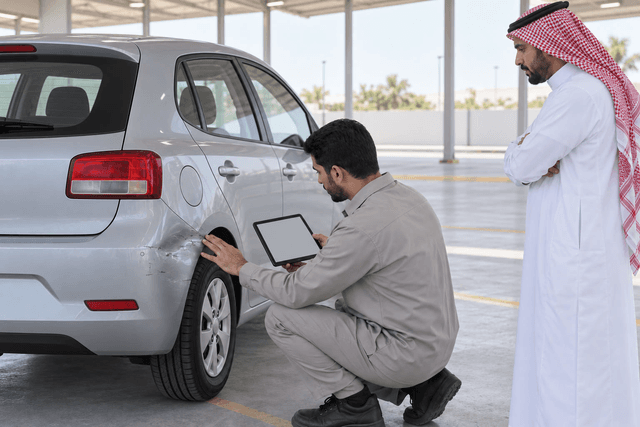
Accident damage assessment is a step you may need after a Najm or traffic police report. According to the Saudi Authority for Accredited Valuers (TAQEEM), it means determining the cost of repairing the vehicle, including parts, or estimating its market value before or after the damage. These assessments are managed electronically through the Taqdeer system, which operates under the Authority’s supervision and lets you book an appointment and check the status of your assessment. This guide covers the stage after the report: when to seek an assessment, what to prepare, how to read the report and review it with your workshop and insurer, and what to do if you disagree with the result.
What Is Accident Damage Assessment and Who Oversees It?
On its official English website, TAQEEM describes vehicle damage assessment valuation as “the act or process of determining the value of repairing the vehicle including the spare parts, or estimating the market value of the vehicle before and after the accident”; the Arabic version also mentions labour explicitly. The outcome may therefore be a repair cost, or a market value before or after the damage, depending on the case.
TAQEEM describes Taqdeer as “an online integrated system for managing, operating, and organizing vehicle damage assessment processes” and lists “Book an appointment at Taqdeer centers” among its services. The Taqdeer system website (in Arabic) states that it operates under the supervision of the Saudi Authority for Accredited Valuers. An assessment is a technical valuation of the damage; it is neither the accident report nor your insurer’s decision.
When Do You Need an Assessment After a Najm or Police Report?
The sequence starts with attending to and documenting the accident. If you have not completed that stage, begin with the guide to Najm reporting steps and when to call the traffic police, then return to this guide.
The official pages we relied on do not state that an assessment is required for every accident, nor do they describe the content of report messages. Follow what the accident report and your insurer require in your case, and ask before any repair starts, because repairing damage before it is assessed may cost you the chance to document it as it was. Useful questions for your insurer:
- Does my case need a damage assessment, and from which body?
- Is the electronic report enough, or must it be sent in a particular way?
- Should I wait for the assessment before taking the car to a workshop?
- Which documents do you need with the report to progress the claim?
How Do You Book a Taqdeer Appointment and Track It?
The Taqdeer website presents the service in three consecutive stages, which can be summarised as follows:
- Book an appointment and go to the assessment center, using the booking service, which the site describes as booking a new appointment to assess your vehicle’s damage.
- Have the vehicle damage assessed at the assessment center.
- Receive the report electronically, with the option to follow it through the report status service, which lets you check the status of your assessment.
If your plans change before the appointment, the manage bookings service allows you, according to the site, to modify or cancel the booking, and the assessment centers page helps you find the nearest centers in your city. We do not mention numbers of centers, timings or fees here; follow what the service shows for your case when you book.
What Should You Prepare Before Visiting an Assessment Center?
The pages we reviewed do not publish a document list, so the list below is practical rather than an official requirement; what the booking screen and center ask for takes precedence:
- Your booking details as shown once the booking is complete.
- The accident report reference from Najm or the traffic police.
- Your ID and the vehicle registration; ask what is needed if you are not the vehicle owner.
- Unedited photos of the damage taken at the time of the accident.
- Your insurance policy details and the party handling the claim.
Do not repair the damage being assessed before the appointment unless the relevant authority tells you to, and do not drive an unsafe car; arrange transport if you notice a leak, a red warning light or a steering fault.
How Do You Read a Damage Assessment Report?
The report format may vary from case to case, but the Authority’s definition shows what it centres on: labour, spare parts, or market value before or after the damage. Use the table to review it item by item:
| Item | What to Check | What to Ask |
| Vehicle and accident details | The car and the accident reference match | Do these details relate to my car and this accident? |
| Spare parts | The listed parts compared with the documented damage | What type of part does the assessment assume? |
| Labour | Listed work such as bodywork and paint | Does the work cover all the damage I documented? |
| Market value | Whether a value before or after the damage is stated | On what basis was this value reached? |
To understand how the type of part affects a repair, see genuine vs aftermarket vs used car parts. Do not assume the report specifies the type of part unless it says so explicitly; ask about it.
How Do You Review the Assessment With Your Workshop and Insurer?
The assessment sets a value, while the compensation and repair path is governed by your policy and your insurer. Check your policy type and what it covers in the guide to comprehensive versus third-party car insurance, and do not assume that the assessed amount is what you will receive in every case.
- Show the report to the workshop before work starts and ask them to compare its items with what they will actually do.
- If hidden damage appears after disassembly, ask your insurer how it will be handled before the repair continues.
- Ask the workshop for an itemised invoice and photos before and after the repair.
- Record every contact with your insurer: the date, the person and what you were asked for.
If the car needs sensor or camera calibration after the repair, ask whether it is included in the assessment or in the workshop’s quote.
What Should You Do If You Disagree With the Assessment?
We did not find a published objection mechanism for assessment results on the official pages we reviewed, so we do not describe a specific procedure. The right step is to ask the source about the official procedure:
- Identify exactly which item you disagree with: a part, a piece of work or a market value.
- Gather supporting evidence: accident photos, the workshop’s notes after disassembly and any invoice.
- Contact Taqdeer through the support and help channels shown on its website and ask what procedure is available for your case.
- Also ask your insurer about its review procedure and what it needs from you in writing.
Do not accept a settlement you disagree with before you understand its consequences, and ask for written replies where possible.
Why Should You Keep the Assessment Report After the Repair?
The report and invoice help you later when you sell the car or when a buyer asks about the accident. The guide to reading a Mojaz report and its limits explains how accident records in a vehicle history should be understood and what cannot be concluded from them.
If you are a buyer looking at a car with signs of repair, ask for the assessment report and invoice if they exist, and use the guide on how to tell whether a car has been repaired alongside an independent technical inspection.
Frequently Asked Questions About Accident Damage Assessment
Is an accident damage assessment the same as a Najm report?
No. The report documents the accident, while the assessment estimates the repair cost or the market value of the vehicle before or after the damage.
Do I need an assessment for every accident?
Do not rely on a general rule; follow what the accident report and your insurer require in your case, and ask them before repairing the car.
How can I check the status of my assessment report?
The Taqdeer website offers an assessment status inquiry service and lists receiving the report electronically as one of the service stages.
Can I change or cancel my assessment appointment?
The website offers a manage bookings service for changes and cancellations; follow what the service shows for your booking.
Is the assessed amount the final compensation?
Not necessarily. Compensation depends on your policy and your insurer’s procedures, so ask your insurer how it is calculated in your case.
Conclusion
After the report, ask your insurer what your case needs, book the assessment through the official system and read the report item by item before any repair. If you disagree, ask Taqdeer and your insurer about the official procedure, and keep your documents for the future.
CVT vs Automatic: Differences and Pre-Purchase Checks
Table Of Contents:
|
CVT vs automatic: neither is the best choice for everyone. What matters is how the car responds in your daily use, the transmission’s condition and its service history, not its name alone. You may prefer the continuous acceleration of the former or the distinct shifts of the latter. Before buying, identify the actual transmission, drive the car in suitable conditions and separate normal behaviour from a symptom requiring professional inspection. This is a buying comparison, not a blanket reliability verdict.
CVT vs Automatic: What Exactly Are We Comparing?
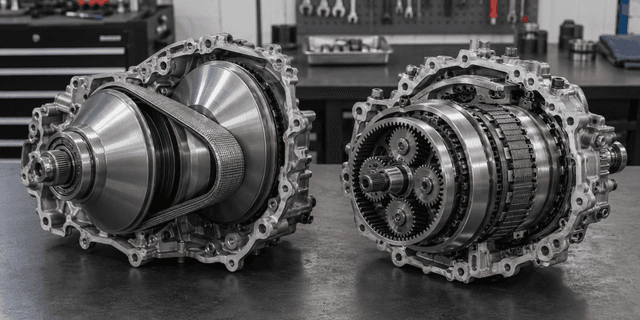
Here, CVT means a conventional design that continuously varies its transmission ratio using variable pulleys and a metal belt or chain, depending on its construction. Conventional automatic means a transmission with fixed gear ratios that shifts between them and uses a torque converter to transfer power between the engine and transmission. The comparison does not cover every technology described as automatic or erase differences within either family.
A torque converter alone does not identify the type: some CVTs also use one. Likewise, do not assume that an e-CVT in a hybrid is the same pulley-and-belt transmission. The term can describe a hybrid system that varies the relationship between engine speed and vehicle movement differently. Architectures vary between systems, so consult the description of the particular vehicle rather than relying on the letters.
For an introduction to other designs, read the guide to transmission types and how they work; here, the focus is what to observe and verify when choosing.
How Do Acceleration and Shifts Feel Different?
With a CVT, engine sound may rise and engine speed may stay relatively steady while the car continues gaining road speed. This can be part of ratio control, not sufficient evidence of transmission slip. Software may also simulate stepped shifts, so the tachometer alone cannot identify transmission type or establish its health. What matters is a predictable response appropriate to the driving situation.
In a stepped automatic, engine speed may fall on an upshift or rise when you request more acceleration. How noticeable each shift feels depends on calibration, the engine and cabin isolation. Not every perceptible shift is a fault, but repeated harsh jolts should not be accepted merely because the transmission is conventional. Compare with a healthy car of the same specification if possible and seek professional advice when unsure.
A Comparison Table for Setting Your Priorities
| Comparison point | Conventional CVT | Stepped automatic |
| Acceleration | Continuous ratio changes, sometimes with simulated shifts | Shifts between fixed ratios with varying smoothness |
| Sound and feel | May hold higher engine speed during acceleration | Engine sound may change noticeably during shifts |
| Suitability check | Observe pull-away smoothness and whether the acceleration sound suits you | Observe shift timing and response to acceleration requests |
| Maintenance | Fluid specification and schedule depend on the particular transmission | Fluid specification and schedule depend on the particular transmission |
| Buying decision | Vehicle condition and use matter more than the label | Vehicle condition and use matter more than the label |
Which Suits Traffic, Long Trips and Hills?
Describe your daily driving rather than ranking technologies from best to worst. In traffic, assess low-speed control and the transition between stopping and moving. On an open road, notice refinement at a steady speed and the response to moderate, legal acceleration. The engine, weight, accelerator calibration and insulation can influence your impression as much as transmission type, so do not attribute every difference to it.
If you regularly drive on hills or carry passengers and luggage, check load limits and driving instructions in the owner’s manual. Do not infer towing capability from the transmission name or test loads or gradients outside permitted limits. For fuel consumption, compare data for the exact trim and engine under comparable measurement conditions; a CVT does not guarantee lower fuel use on every trip.
What Should You Verify About Fluid and Service History?
Ask for invoices showing service dates, mileage and the fluid specification used, not merely a statement that the fluid was changed. Do not assume automatic transmission fluid suits a CVT or that all CVT fluids are interchangeable. The reference is the approved specification for that transmission and its correct service procedure. Transmission type alone cannot establish one fluid-change schedule for every car.
Discuss how your operating conditions affect the service schedule with a qualified provider, along with any documented repairs or leaks. Do not request an indiscriminate fluid change or flush as a cure for every vibration, and do not open hot components to inspect fluid yourself. Read about transmission fluid changes and care for general background, then give your vehicle’s manual priority over conflicting general advice.
A Pre-Purchase Checklist for Either Transmission
Treat the drive as a way to gather observations, not a certificate that the car is fault-free. Agree on a safe, permitted route and have a passenger take notes without distracting you. Do not deliberately overheat the transmission or use aggressive launches to expose faults.
- Confirm the transmission in the actual vehicle’s specifications and production year. Advertisement wording and selector appearance are insufficient, and specifications may differ between trims.
- Review the service history and any previous replacement or repair. Ask why the repair was needed and what was done; request documents rather than relying on verbal reassurance.
- Start with gentle driving and observe pull-away, low-speed movement and gradual acceleration. Stay within speed limits and never watch the instruments at the expense of the road.
- With the car fully stopped and the brakes applied, observe its response when selecting forward or reverse as instructed in the manual. Never switch direction while moving or repeat the manoeuvre aggressively.
- Note whether the observation occurred at the start or after driving, with or without air conditioning, and whether it repeated under the same conditions. Do not set a universal delay threshold separating healthy from faulty.
- Before a final agreement, arrange an independent professional inspection including an appropriate road test and electronic checks when needed, with an explanation rather than just a fault-code printout.
To compare comfort, visibility and the rest of the car as well, use the pre-purchase test drive checklist alongside these transmission-specific checks.
When Does an Observation Need Professional Diagnosis?
Repeated vibration, a noticeable response delay, a temperature warning or a sudden performance change deserves assessment, but none proves transmission failure by itself. The engine, its mounts or other systems may contribute. Describe when the symptom appeared rather than requesting transmission replacement based on a video or personal impression.
If a temperature warning or loss of drive affects safety, end the test in a safe place, follow the owner’s manual and seek appropriate help. Do not clear warnings or keep accelerating to test them. Read about transmission symptoms that warrant inspection to recognise possible observations, not to diagnose your car or assume one definite cause.
Frequently Asked Questions About CVT and Automatics
Does Steady Engine Speed Mean a CVT Is Slipping?
Not necessarily; acceleration can continue at nearly constant engine speed. A changed response with reduced drive or a warning needs professional assessment, not a verdict from the tachometer alone.
Does a Conventional Automatic Always Last Longer?
It is not sound to generalise lifespan or reliability across all designs. Condition, history, maintenance and use are essential when assessing an individual car.
Can Both Types Use the Same Transmission Fluid?
Do not assume compatibility from a fluid’s name or colour. Check the specification required for the exact transmission and have a professional follow its approved service procedure.
Is e-CVT the Same as a Belt CVT?
Not necessarily: similar names do not establish identical construction. Check the explanation of the hybrid’s system; systems described by this term do not necessarily share one design.
Is a Short Drive Enough to Establish Transmission Health?
No; some symptoms may not appear during a short drive. Combine it with service records and an independent inspection, especially when documents are missing or observations remain unexplained.
Conclusion: Choose the Right Car, Not Just a Label
Choose after defining your use, testing the response and verifying maintenance and inspection findings. Do not reject a CVT solely because it sounds different, or accept a conventional automatic with unexplained symptoms. A stronger decision combines driving suitability with documented condition and clear instructions for caring for the car.
When to Replace Car Tyres: Tread, Cracks and Warning Signs
Table Of Contents:
|
If you are asking when to replace car tyres, the short answer is: replace a tyre when the surface of the tread reaches the level of the raised wear indicators inside the grooves, when a bulge, a deep cut or clear cracks appear in its sidewall, or when the rubber has aged to the point at which the tyre or car manufacturer recommends replacement, even if the tread looks good. In this guide we explain how to check your tyres, what the wear pattern reveals, and how to choose the right replacement.
When should you replace car tyres? The key signs in brief
Replacement is not tied to a single distance for every car, but to the tyre's condition and its maker's recommendations. The main signs are:
- The tread surface has reached the level of the wear indicators in any part of the tyre, not just on average.
- A bulge or bubble in the sidewall, a deep cut, or exposed cords or internal fabric.
- Clear cracks in the sidewall or between the tread blocks, showing that the rubber has aged and hardened.
- Uneven wear that has left part of the tyre smooth even though the rest of its surface is sound.
- A persistent vibration that does not go away after balancing, or repeated pressure loss in the same tyre with no visible cause.
How do you check tread depth using the TWI wear indicators?
Inside the grooves are small raised bars called wear indicators, whose location is marked by the letters TWI or a small triangle on the tyre's shoulder, and when the tread surface is level with them, the tyre has reached the end of its usable life. To check:
- Park the car on level ground and turn the steering wheel to one side so you can see the front tyres clearly.
- Look for the TWI mark or triangle on the tyre's shoulder, then look into the groove next to it to find the raised bar.
- Compare the level of the tread surface with the bar; the closer they are to level, the closer the replacement date.
- Repeat the check on the inner edge, the centre and the outer edge, and at several points around the tyre's circumference.
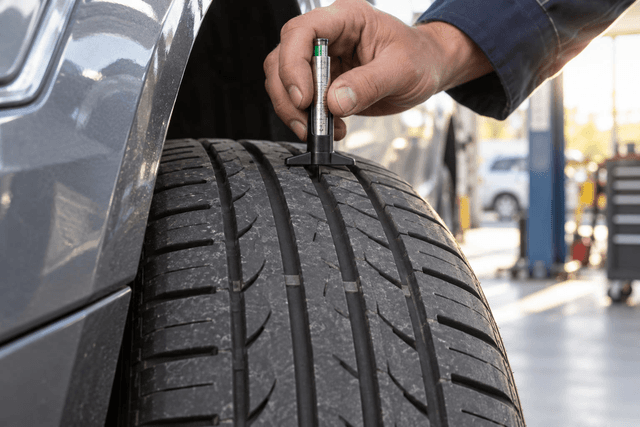
- For a more precise reading, use a tread depth gauge, available at tyre shops, and record the reading for each tyre.
- Some drivers use a coin as a rough gauge, but it is no substitute for a proper gauge or a look by a qualified technician.
Do not wait until they are exactly level if you travel often or drive in the rain, as water clearance and grip weaken gradually as the tread gets shallower.
What do tyre cracks and sidewall bulges mean?
The sidewall flexes with every turn of the wheel and carries the car's weight, so any damage to it is more dangerous than tread wear:
- Fine surface cracks: an early sign of rubber ageing caused by heat and sun, which calls for the tyre to be inspected by a specialist and monitored.
- Deep cracks: if they widen or reach the tyre's inner layers, it is time to replace it.
- A bulge or bubble: damage to the tyre's internal structure, usually after hitting a pothole or kerb, which requires immediate replacement and no travelling on it.
- Cuts and gashes: a deep cut in the sidewall weakens the tyre even if no air is leaking from it yet.
What does the tyre wear pattern reveal?
The wear pattern reveals the cause of the problem, and if you do not fix it, new tyres will wear the same way:
| Wear pattern | Likely cause | What to do |
| Both edges more than the centre | Pressure lower than recommended | Set the pressure according to the driver's door sticker and check it regularly |
| Centre more than the edges | Pressure higher than recommended | Set the recommended pressure, not the maximum pressure printed on the tyre |
| One inner or outer edge | Wheel alignment or suspension fault | Check the alignment and suspension parts |
| Diagonal, feather-like wear | Incorrect toe between the two wheels | Have the alignment set at an equipped workshop |
| Repeated patches or scallops | Unbalanced wheels or worn shock absorbers | Balance the wheels and check the shock absorbers |
| A single flat spot | Hard braking with a locked wheel, or standing a long time without moving | Have a specialist assess the tyre |
If you see wear on both edges, start by reviewing the causes, signs and solutions for low tyre pressure, and if the wear is on one edge or comes with the car pulling to one side, read about the difference between wheel balancing and alignment.
How do Saudi heat and sand affect tyre life?
Rubber ages over time even if the car is used little, and you will find how to tell a tyre's age from the DOT code in our article on how to read tyre size and manufacture date. There is no single lifespan for all tyres, so refer to the tyre and car makers' recommendations. In the Kingdom's climate, some factors speed up deterioration:
- Direct sun and high heat speed up the hardening and cracking of rubber, especially for cars standing for long periods in open car parks, so park in the shade whenever possible.
- Hot asphalt raises tyre temperature, and the effect grows with low pressure or overloading on long trips.
- Sandy, gravel and desert tracks expose the tread and sidewall to cuts from sharp stones, so inspect the tyres after every desert trip.
- If you lower tyre pressure (deflating) to drive on sand, restore it to the recommended value before returning to asphalt, because highway driving at low pressure raises tyre temperature.
Should you replace tyres in pairs or all four together?
Ideally all four tyres match, but replacing them all together is not always necessary:
- Replace both tyres on the same axle together at least, so grip does not differ between the two sides when braking or cornering.
- When replacing only one pair, many tyre makers recommend fitting the newer pair on the rear axle for better stability, unless the owner's manual says otherwise.
- In four-wheel-drive or all-wheel-drive cars, the owner's manual may require the four tyres to be close in size and degree of wear to protect the drive system, so check it before replacing only two.
What about the spare tyre?
The spare forgotten in the boot ages just like the other tyres, even if it is never used:
- Check its pressure regularly and before every trip, because a flat spare will not help you when you get a puncture.
- Read its manufacture date and inspect its sidewall, as it may be older than the tyres on the car.
- A small temporary spare is designed for a limited distance and speed stated in the owner's manual or on the tyre's side, so use it only to reach the nearest tyre shop.
- If your car comes with a repair kit instead of a spare, check its expiry and how to use it.
How do you choose the right replacement tyre: size, load and speed?
Choose what your car was designed for, not just what the shop has in stock, and check the following:
- Size: copy it from the sticker on the driver's door frame or from the owner's manual, not from the tyre currently fitted, which may be different.
- Load index and speed symbol: choose values equal to or higher than the car manufacturer's recommendation, never lower.
- Manufacture date: ask for recently made tyres with close dates, especially on the same axle.
- Type of use: a driver who often travels on highways has different needs from one who drives in the desert or carries heavy loads, so ask about the tyre designed for your use.
- Changing the size: do not change the size of your tyres or rims without consulting a specialist; to learn the effect, read our article on whether the wrong rims make your car use more fuel.
- After fitting: balance the wheels, set the pressure according to the driver's door sticker, and check the alignment if the old tyres were worn unevenly.
What is the tyre energy efficiency label in Saudi Arabia?
The Saudi Standards, Metrology and Quality Organization offers the Energy Efficiency Label for Tires service, and explains that the label serves as a guide for consumers before purchasing the product to increase their awareness of its energy efficiency before buying it.
The organization lists tyres among the products subject to the efficiency label regulations, and the aims of these labels include reducing energy consumption for the consumer, enabling the consumer to know a product's efficiency before buying, and protecting consumer safety and health and the environment. In practice:
- When comparing tyres of the same size, ask to see the energy efficiency label for each one and read its details.
- Do not make the label your only criterion; size, load index, speed symbol, manufacture date and the tyre's suitability for your use come first.
- Requirements and procedures may be updated from time to time, so check the latest information on the organization's website.
Frequently asked questions about replacing car tyres
- Should I replace a tyre that is old even if its tread is good? Tread depth alone is not enough, as rubber hardens over time; have it checked by a specialist and follow the tyre maker's recommendation.
- Can a puncture in the side of the tyre be repaired? Repairing holes in the sidewall or shoulder is not usually recommended, while for a hole in the tread area the technician decides whether it can be repaired based on its size and position.
- Can I fit two tyres of different types? This is not recommended on the same axle, and it is best for all four tyres to match in type and tread pattern, especially in four-wheel-drive cars.
- Are small cracks between the tread blocks dangerous? They are a sign of ageing that may not require immediate replacement, but have a specialist monitor them, and if they deepen, replace the tyre.
- How often should I check my tyres? Check their pressure and appearance regularly, for example when refuelling, before every trip, and after hitting a pothole or kerb or after a desert trip.
Checking your tyres takes only minutes: look at the wear indicators, inspect the sidewall, notice the wear pattern and read the manufacture date. If a danger sign appears, do not postpone the change; choose a replacement with the recommended size, load and speed ratings, then fix the cause of any uneven wear.