
Vehicle Driving Authorization on Absher: Conditions and Steps
Table of Contents:
|
Vehicle driving authorization on Absher is an electronic service that lets a vehicle owner add an authorized person to drive the vehicle inside or outside the Kingdom, depending on the type of authorization selected. The owner starts from Vehicles, then Manage Vehicles, selects the vehicle, chooses Authorize Vehicles and then Issue Authorization. Before that, the vehicle registration must be valid with active insurance, and both parties must have Absher accounts. This guide covers the conditions, steps, period limits, the difference from ownership transfer and what the owner should check first.
What Is Vehicle Driving Authorization on Absher?
The official Issue an Authorization service page on the National Portal says the service allows you electronically to add an authorized person to drive a vehicle inside or outside the Kingdom, depending on the selected type of authorization. The service belongs to the Ministry of Interior, targets individuals, both citizens and residents, and lists its channels as the website portal and the iOS and Android apps.
The authorization is therefore permission to drive, not a sale or a transfer of ownership. The vehicle owner issues the authorization, and the authorized person is added to drive within the selected type and period. Read the service name in your account carefully and do not confuse it with other vehicle services in the same menu.
What Are the Vehicle Authorization Conditions and Required Documents?
The Prerequisites tab of the official service page lists the following conditions, as shown at the time of writing:
- The vehicle registration license must be valid and have active insurance.
- The authorization period must not exceed the validity of the vehicle registration license.
- The authorization period must not exceed the validity of the authorized person’s driving license.
- Authorization cannot be granted to someone holding a final exit visa.
- The authorization period must not exceed the duration of the exit and re-entry visa if the authorized person holds one.
The Required Documents tab lists the following:
- The authorizer must be the vehicle owner.
- The vehicle must have valid insurance.
- Both the authorizer and the authorized person must have active Absher accounts.
- For an external authorization, the authorized person must hold an exit and re-entry visa whose duration is linked to the authorization period.
The text we reviewed adds no other conditions, so follow what the service requests for your case rather than lists circulating in forums or messages.
What Are the Steps to Authorize a Vehicle on Absher?
The following steps come from the official service page. Menus may look different in the portal and the app, so look for the same names:
- Log in to Absher with the vehicle owner’s account.
- Select "Vehicles".
- Click on "Manage Vehicles".
- Select the vehicle you want to authorize and check its details.
- Choose "Authorize Vehicles".
- Click on "Issue Authorization", enter the required information and select the type of authorization.
The page describes the service duration as immediate, but do not rely on pressing the issue button alone; review what the service displays after submission to confirm the transaction is complete. If a message prevents issuing the authorization, return to the conditions above and start with the item the message refers to, such as insurance validity or the validity of one of the licenses, instead of retrying without changing anything.
Driving Authorization Inside and Outside the Kingdom: What Differs?
The page states that the authorization applies inside or outside the Kingdom depending on the type of authorization you select in the final step. Decide the purpose before you start: will the authorized person drive only inside the Kingdom, or do they need to drive the vehicle abroad?
For an external authorization, the Required Documents tab requires the authorized person to hold an exit and re-entry visa. The page links the visa duration to the authorization period, but the Prerequisites wording (the authorization period must not exceed the visa duration) runs in the opposite direction to the Required Documents wording (the visa must not exceed the authorization period), so follow what the service accepts for your case. A holder of a final exit visa cannot be added as an authorized person.
The service page does not address the requirements of other countries or border crossings when travelling by car, so ask the competent authorities about this before relying on the authorization alone.
How Long Does the Authorization Last and How Is It Cancelled?
The service page does not set a fixed authorization period; it sets upper limits instead. The period must not exceed the validity of the vehicle registration, the validity of the authorized person’s driving license, or the duration of their exit and re-entry visa if they hold one. In practice, whichever of these dates expires first limits the period you can choose.
As for cancellation, the pages we reviewed do not explain the steps. Start from the Authorize Vehicles screen in the owner’s account and review the options shown to you. If nothing fits your case, ask the official Ministry of Interior support channels, and do not rely on an unofficial explanation that mentions a specific button or period.
If the vehicle registration is about to expire, review the vehicle registration renewal steps on Absher before choosing the authorization period, because the period may not exceed the registration validity.
How Does Authorization Differ From Ownership Transfer?
Some people confuse allowing someone to drive the car with selling it to them. As the service describes it, authorization adds an authorized driver and is issued by the vehicle owner, while ownership transfer is a separate procedure that changes the owner. The table summarises the difference:
| Item | Driving Authorization | Ownership Transfer |
| Purpose | Add an authorized person to drive the vehicle | Transfer vehicle ownership to another owner |
| Who starts it | The vehicle owner, according to the service page | According to the sale service conditions |
| Does the owner change? | The service describes no change of ownership | Yes, that is the purpose of the procedure |
| Period limits | Not beyond the registration and the authorized person’s driving license validity | Follows the transfer service conditions |
If your aim is to sell or buy the car, authorization is not a substitute for a sale; review the Absher ownership transfer steps and sale conditions to complete the correct procedure.
What Should the Owner Check Before Issuing the Authorization?
The official conditions determine whether the authorization can be issued, but they do not answer every practical question. Before issuing it, review the following points:
- Registration: confirm it is valid and note its expiry date, because that date limits the authorization period.
- Insurance: confirm the policy is valid for the same vehicle, then read its terms or ask the insurer about someone other than the owner driving, and do not assume any particular cover simply because the authorization was issued. To distinguish policy types, read about comprehensive versus third-party car insurance.
- Authorized person: confirm their driving license is valid, that they have an Absher account and, for a resident, their visa status.
- Purpose and period: choose the authorization type and period according to your actual need, not longer.
If an accident happens while the authorized person is driving, learn the steps to take after a car accident and Najm reporting. The service page does not address how responsibility for accidents or violations is shared between the owner and the authorized person, so do not build assumptions on it; ask the competent authority or your insurer about your case.
Frequently Asked Questions About Vehicle Driving Authorization
Must the person issuing the authorization be the car owner?
Yes. The Required Documents tab states that the authorizer must be the vehicle owner. The authorization is therefore not issued from the account of someone who does not own the vehicle, even if they usually drive it.
Does the authorized person need an Absher account?
Yes. The page requires both the authorizer and the authorized person to have Absher accounts. Confirm this before starting so the process does not stop when you enter the details.
Can someone holding a final exit visa be authorized?
No. The prerequisites state that authorization cannot be granted to someone holding a final exit visa. For a holder of an exit and re-entry visa, the authorization period is tied to the visa duration.
Can I authorize if the registration or insurance has expired?
The published condition is a valid vehicle registration with active insurance. If either has expired, resolve it first and then return to the authorization service.
Does authorization mean the insurance covers the authorized person?
The service page mentions insurance only as a condition for issuing the authorization. Review your policy and its terms with your insurer before allowing another person to drive.
Conclusion
Vehicle driving authorization on Absher starts from the owner’s account and requires a valid registration, active insurance and Absher accounts for both parties, with its period limited by the validity of the licenses and visa. Choose the right authorization type, review your insurance policy and do not use authorization as a substitute for ownership transfer.

Mojaz Report: How to Read Used Car History and Its Limits
Table Of Contents:
|
A Mojaz report helps you read a used car’s history through the records available; it does not deliver a final verdict on its condition. Start by matching the vehicle’s identity, then read mileage, accident and maintenance records chronologically and compare them with documents and the car’s current condition. No accident record does not mean accident-free, and missing mileage readings do not validate the odometer. Use the report to identify seller questions and professional inspection priorities before deciding to buy, not as a replacement for inspection.
What does a Mojaz report show, and what are its limits?
The official Mojaz homepage (in Arabic) says it brings together key historical vehicle data from official sources in one report. Its report outline lists vehicle information, odometer reading history, accident records, maintenance and repairs, warranty information, spare parts, vehicle reputation and related images.
These are section names presented by the service, not a promise that every section contains data for every car. Read what is actually available, and do not turn a blank field into a positive or negative finding. Likewise, do not infer a specific rating or acceptance standard from the vehicle reputation heading; use any accompanying explanation and ask about unclear descriptions before relying on them.
Start by matching the car and the report version
Before discussing findings, establish that the report belongs to the actual car being offered. Ask to see the full version rather than a cropped image of a reassuring section, and match its identification details to the vehicle documents and the car. Do not rely on a similar colour or general description, or dismiss an identification mismatch as a minor error without checking.
- Check the VIN if shown, comparing every character with the documents and its designated location on the car; seek professional help if anything is unclear.
- Note the report date if visible, distinguishing it from the event dates inside; a recent report may contain only an older record.
- Write down any data mismatch and ask for an explanation before evaluating mileage or accidents or concluding the agreement.
For identification details and their locations, see the guide to vehicle identification numbers, while paying attention to the name of each identifier in the document you are reading.
How do you read odometer records chronologically?
Read the date of each distance reading, not just the last number. Put the available readings in order from oldest to newest, then compare the latest with the car’s odometer during the viewing. Check measurement units first; do not directly compare figures expressed in different units. Your aim is to understand the sequence and identify questions, not estimate true mileage from cabin appearance alone.
- Write the date and reading exactly as shown, distinguishing report information from something the seller says or a figure on an invoice.
- If a later reading is lower than an earlier one, request a documented explanation and discuss possibilities with a professional; the inconsistency warrants a pause but is not a standalone diagnosis of tampering.
- If there is a long gap, ask for documents covering that period; do not assume the car was unused throughout it.
- If there are no readings at all, note that mileage has not been verified through this method instead of automatically accepting the current figure.
If the seller mentions an odometer replacement, ask for the work record and evidence of readings before and after replacement, if available. Do not fill a missing sequence with estimates or treat consistent readings alone as a guarantee that the entire usage history is known.
How should you interpret accident records and available images?
If an accident record appears, read its details as written and compare them with repair documents supplied by the seller. Do not reduce the assessment to a record count or label damage minor or severe without supporting information. A report may describe a historical event, while repair quality and present condition need an independent inspection.
If related images appear, check their connection to the event, the vehicle and their date whenever that information is available. A photograph does not reveal everything behind visible parts, and missing images do not rule out damage. Where structural repairs are suspected, request a specialist inspection. The guide to signs of bodywork and structural repairs can help you frame questions, not make your own technical verdict.
If no accident record appears, the accurate wording is: no event is visible in the data you are reading. Do not replace that with the car has never had an accident, or let that inference cancel the inspection or the request for repair documents.
How do you relate maintenance and repairs to current condition?
Read available maintenance and repair entries with their dates, comparing them with the seller’s invoices. Distinguish a record of past work from proof that the relevant system works well today. If a repair description recurs, ask what was done and what happened afterwards, without automatically assuming a particular fault or an unsuccessful repair.
Warranty information alone does not mean cover is active or transferable to you; verify the document and terms with the relevant provider. Equally, do not infer from a spare parts section that every component is genuine or in good condition. A missing maintenance record does not prove neglect, but leaves a question requiring documents and inspection.
Compare documented work with the appropriate owner’s manual requirements alongside a professional. Do not derive a new servicing schedule from the report or assume one completed job means all other scheduled work was done or related components are sound.
A reading checklist: information and limits of inference
Use this table to organise your notes; it is not a real sample vehicle report. Always distinguish what you read, what you still do not know and the next step needed to close that gap.
| What you read | What it does not prove alone | Next step |
| Consecutive odometer readings | Complete mileage history | Compare with the odometer and documents |
| No odometer readings | Accuracy of current mileage | Seek more evidence and document the gap |
| An accident record | Current repair quality | Repair documents and specialist inspection |
| No visible accident record | An accident-free car | Professional body and paint inspection |
| Recorded maintenance work | The component’s condition today | Compare with the current inspection |
| Warranty information | Active cover for the buyer | Verify terms with the relevant provider |
Which questions should you ask the seller?
Start with an open question about the car’s usage history, then address unclear report entries. Request specific answers that can be connected to documents; personal trust or numerous photographs are not substitutes for verification. Keep your notes separate from the original report so your interpretations do not become confused with its records.
- Is this the full version for this exact vehicle? Which documents support the details or explain a visible discrepancy?
- Has the odometer been repaired or replaced? Are invoices or saved readings available for periods with no visible record?
- Are you aware of body repairs, repainting or accidents not shown here? What work was done and which documents are available?
- Where was the most recent service performed, what was actually done, and which recommended jobs remain outstanding?
- Will you allow an independent inspection and a review of findings before agreement? How can your explanation of a record mismatch be documented?
What still needs inspecting before you decide to buy?
Give the professional your report and notes before inspection, and request an assessment of the current structure, mechanical and electrical systems and safety components. Do not simply seek confirmation of an existing impression: ask what was checked and what could not be verified. To organise the rest of the viewing, see the used car inspection tips before purchase.
If a material identity or mileage discrepancy appears, or a significant repair remains unexplained, postpone the decision until it is clarified. If the gap cannot be closed, treat it as unknown information rather than proof of sound condition. Once the technical assessment is settled, review the vehicle ownership transfer steps on Absher separately; a history report does not replace the sale procedures.
Frequently asked questions about reading a Mojaz report
- Does no accident record mean the car is sound? No. It means an accident record is not visible in the available data you read. Body condition and repair quality still need inspection.
- Does the report validate the car’s mileage? Available reading sequences help comparisons but do not guarantee a complete history. If readings are missing, mileage cannot be accepted on the report alone.
- Is every section available for every car? Do not assume this from the section names on the website. Read the actual content and ask about missing information or unclear wording.
- What if the report contradicts the seller? Identify the conflicting entry, ask for a document explaining it and show it to a professional. Neither ignore the conflict nor automatically turn it into an accusation.
- Does a Mojaz report replace a technical inspection? No. A history report presents available historical information, whereas an inspection assesses current condition within its scope. Combine both with documents before deciding.
In short, read a Mojaz report as available evidence and open questions, not a certificate that the car has no defects. Match its identity, review the timeline and connect the findings with documents and an independent inspection. A stronger decision clearly distinguishes what is established from what remains unknown.

Driving License Renewal on Absher: Requirements and Steps
Table of Contents:
|
Driving license renewal in Saudi Arabia is done electronically through the Absher platform under traffic services, without visiting traffic offices, provided you complete the regulatory requirements such as paying the fees and completing a medical examination. This electronic service covers private driving licenses and motorcycle licenses only, and the remaining validity of the license must be less than 365 days. This guide explains the requirements as shown on the official service page at the time of writing, the renewal and delivery steps, why a request may not proceed, and how it differs from renewing the vehicle registration (Istimara).
What Is the Driving License Renewal Service on Absher and Who Can Use It?
The driving license renewal page on the National Portal describes a service that lets individuals renew their driving license electronically, easily and efficiently, without visiting traffic offices. It lists the service duration as immediate and the delivery channels as the website portal and smartphone apps. The Absher service guide defines the beneficiary as a citizen or resident who is registered and activated on the Absher platform.
So first make sure your Absher account is active and that you can log in, then check your license type. According to the prerequisites tab, the service covers renewing private driving licenses and motorcycle licenses only. If your license is of another type, do not assume this service will accept it; ask the official traffic channels about the right procedure for your case.
What Are the Published Driving License Renewal Requirements?
The official service page lists the following requirements. Use the table as a checklist before logging in to Absher, while following what the service displays for your case when you apply. Requirements may be updated, and the service page at the time you apply is the reference.
| Requirement as Shown on the Service Page | What to Check Before Starting |
| A private or motorcycle driving license | The license type recorded in your details |
| Payment of license renewal fees through government payments via banks | That payment was actually made for the correct service, not just that a payment screen was opened |
| Payment of traffic violations, if any | The status of any violations recorded against you before applying |
| Remaining license validity of less than 365 days | Your expiry date, using the driving license information service |
| A medical examination through a certified medical center | That the examination was done at a certified center |
The required documents tab repeats payment of any violations, payment of the renewal fees and the medical examination, and does not mention uploading photos or extra papers. Do not rely on circulated lists that add unpublished documents. If you have violations, review how to check and pay traffic violations before starting the renewal.
What Are the Steps for Driving License Renewal on Absher?
The following steps are taken from the service page on the National Portal. If the menus look different in your interface, look for the driving license renewal service under traffic services, and do not choose a similarly named service such as vehicle registration renewal.
- Log in to the Absher platform.
- Select “My Services”.
- Choose “Traffic” from the services list.
- Select the “Renew Driving License” service.
- Read the service description, terms and conditions, then select “Next”.
- Review your personal information, specify the renewal period (2 years, 5 years or 10 years), then select “Confirm Renewal”.
- Fill in your National Address details for license delivery.
- Review the entered data.
- Pay the delivery fees using a card (Visa, Mada, Mastercard).
- A message confirms that the driving license renewal is completed.
Note that the payment inside these steps is for delivery. For the renewal fees themselves, the prerequisites tab says they are paid through government payments via banks. This guide does not state amounts for any period; follow what the service shows for your case. Before filling in the address, make sure your National Address is correct, because it is used for the license delivery request.
Closing the screen or completing a payment alone does not prove the renewal is complete. Check for the success message, then review your license details before repeating any step if your session was interrupted.
Why Can License Renewal Fail to Proceed, and What Should You Check?
The service page does not publish a list of error messages, but the published requirements help you identify which item to review. Always start with the text of the message shown in your account, then compare it with the following possibilities:
- The remaining validity of the license is not less than 365 days; check the expiry date through the driving license information service.
- The renewal fees have not been paid or the payment has not appeared yet; review the transaction status and receipt before paying again.
- There are unpaid traffic violations; do not assume that filing a dispute replaces this requirement before its outcome is clear.
- There is no medical examination from a certified medical center.
- The license type is not covered, because the service is limited to private and motorcycle licenses.
- The account is not registered or activated on Absher, since the service guide defines the beneficiary as a registered and activated user.
If the message is unclear, note its text, the time of the attempt and the stage where you stopped, then contact the official support channels shown on the service page. Never share your password or verification code with anyone, and do not treat a failed attempt as a final rejection without confirmation from the competent authority.
How Does Driving License Renewal Differ From Istimara Renewal?
The two documents are often confused because both are called a license. The driving license belongs to the driver, while the Istimara is the vehicle registration and relates to the car itself. Each therefore has its own Absher service and its own requirements, so do not apply the conditions of one to the other.
The medical examination and the remaining license validity are published requirements for driving license renewal and have nothing to do with the condition of your car. If what you need to renew is the vehicle document, follow the guide to vehicle registration renewal on Absher and why it may fail, which explains that service’s requirements and steps.
Likewise, vehicle insurance does not appear among the driving license renewal requirements on the service page. If you are reviewing your car insurance at the same time for other reasons, read about comprehensive versus third-party car insurance to choose a suitable policy.
Frequently Asked Questions About Driving License Renewal
Can I renew my driving license without visiting a traffic office?
Yes, according to the official service page: the service is electronic through Absher without the need to visit traffic offices, provided the regulatory requirements are completed. If your case cannot proceed, follow the service message and the competent authority’s guidance.
How early can I renew my license before it expires?
The prerequisites tab requires the remaining validity of the license to be less than 365 days. You can check your license validity electronically through the driving license information service listed among the related services.
Is a medical examination required for driving license renewal?
Yes. The official page lists a medical examination through a certified medical center among both the prerequisites and the required documents. Complete the examination at a certified center before starting the service.
What renewal periods are available?
The service steps mention choosing the renewal period of 2 years, 5 years or 10 years while reviewing your details. Choose from the options shown to you and review what applies to each option as displayed in the service.
How do I receive my license after renewal?
The steps include filling in your National Address details for license delivery and then paying the delivery fees by card. The National Portal also lists a digital driving license display service among the related services, which is separate from renewal.
Conclusion
Prepare the driving license renewal requirements first: pay the fees and any violations, complete the medical examination at a certified center, and confirm that the remaining validity meets the published condition. Then follow the steps on Absher and check for the success message. If the request cannot proceed, address the item identified in the message or request clarification through the official channels.
When to Replace Car Tyres: Tread, Cracks and Warning Signs
Table Of Contents:
|
If you are asking when to replace car tyres, the short answer is: replace a tyre when the surface of the tread reaches the level of the raised wear indicators inside the grooves, when a bulge, a deep cut or clear cracks appear in its sidewall, or when the rubber has aged to the point at which the tyre or car manufacturer recommends replacement, even if the tread looks good. In this guide we explain how to check your tyres, what the wear pattern reveals, and how to choose the right replacement.
When should you replace car tyres? The key signs in brief
Replacement is not tied to a single distance for every car, but to the tyre's condition and its maker's recommendations. The main signs are:
- The tread surface has reached the level of the wear indicators in any part of the tyre, not just on average.
- A bulge or bubble in the sidewall, a deep cut, or exposed cords or internal fabric.
- Clear cracks in the sidewall or between the tread blocks, showing that the rubber has aged and hardened.
- Uneven wear that has left part of the tyre smooth even though the rest of its surface is sound.
- A persistent vibration that does not go away after balancing, or repeated pressure loss in the same tyre with no visible cause.
How do you check tread depth using the TWI wear indicators?
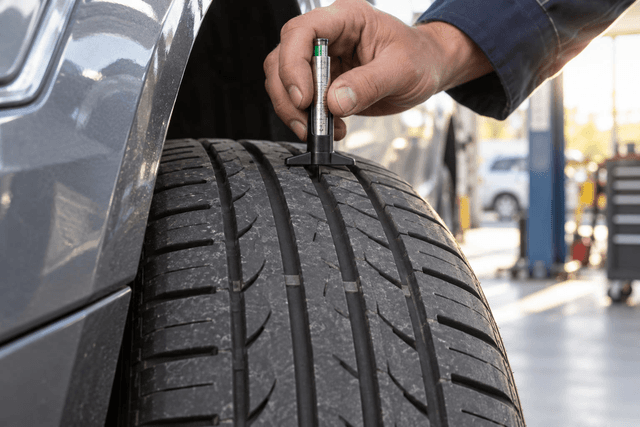
Inside the grooves are small raised bars called wear indicators, whose location is marked by the letters TWI or a small triangle on the tyre's shoulder, and when the tread surface is level with them, the tyre has reached the end of its usable life. To check:
- Park the car on level ground and turn the steering wheel to one side so you can see the front tyres clearly.
- Look for the TWI mark or triangle on the tyre's shoulder, then look into the groove next to it to find the raised bar.
- Compare the level of the tread surface with the bar; the closer they are to level, the closer the replacement date.
- Repeat the check on the inner edge, the centre and the outer edge, and at several points around the tyre's circumference.
- For a more precise reading, use a tread depth gauge, available at tyre shops, and record the reading for each tyre.
- Some drivers use a coin as a rough gauge, but it is no substitute for a proper gauge or a look by a qualified technician.
Do not wait until they are exactly level if you travel often or drive in the rain, as water clearance and grip weaken gradually as the tread gets shallower.
What do tyre cracks and sidewall bulges mean?
The sidewall flexes with every turn of the wheel and carries the car's weight, so any damage to it is more dangerous than tread wear:
- Fine surface cracks: an early sign of rubber ageing caused by heat and sun, which calls for the tyre to be inspected by a specialist and monitored.
- Deep cracks: if they widen or reach the tyre's inner layers, it is time to replace it.
- A bulge or bubble: damage to the tyre's internal structure, usually after hitting a pothole or kerb, which requires immediate replacement and no travelling on it.
- Cuts and gashes: a deep cut in the sidewall weakens the tyre even if no air is leaking from it yet.
What does the tyre wear pattern reveal?
The wear pattern reveals the cause of the problem, and if you do not fix it, new tyres will wear the same way:
| Wear pattern | Likely cause | What to do |
| Both edges more than the centre | Pressure lower than recommended | Set the pressure according to the driver's door sticker and check it regularly |
| Centre more than the edges | Pressure higher than recommended | Set the recommended pressure, not the maximum pressure printed on the tyre |
| One inner or outer edge | Wheel alignment or suspension fault | Check the alignment and suspension parts |
| Diagonal, feather-like wear | Incorrect toe between the two wheels | Have the alignment set at an equipped workshop |
| Repeated patches or scallops | Unbalanced wheels or worn shock absorbers | Balance the wheels and check the shock absorbers |
| A single flat spot | Hard braking with a locked wheel, or standing a long time without moving | Have a specialist assess the tyre |
If you see wear on both edges, start by reviewing the causes, signs and solutions for low tyre pressure, and if the wear is on one edge or comes with the car pulling to one side, read about the difference between wheel balancing and alignment.
How do Saudi heat and sand affect tyre life?
Rubber ages over time even if the car is used little, and you will find how to tell a tyre's age from the DOT code in our article on how to read tyre size and manufacture date. There is no single lifespan for all tyres, so refer to the tyre and car makers' recommendations. In the Kingdom's climate, some factors speed up deterioration:
- Direct sun and high heat speed up the hardening and cracking of rubber, especially for cars standing for long periods in open car parks, so park in the shade whenever possible.
- Hot asphalt raises tyre temperature, and the effect grows with low pressure or overloading on long trips.
- Sandy, gravel and desert tracks expose the tread and sidewall to cuts from sharp stones, so inspect the tyres after every desert trip.
- If you lower tyre pressure (deflating) to drive on sand, restore it to the recommended value before returning to asphalt, because highway driving at low pressure raises tyre temperature.
Should you replace tyres in pairs or all four together?
Ideally all four tyres match, but replacing them all together is not always necessary:
- Replace both tyres on the same axle together at least, so grip does not differ between the two sides when braking or cornering.
- When replacing only one pair, many tyre makers recommend fitting the newer pair on the rear axle for better stability, unless the owner's manual says otherwise.
- In four-wheel-drive or all-wheel-drive cars, the owner's manual may require the four tyres to be close in size and degree of wear to protect the drive system, so check it before replacing only two.
What about the spare tyre?
The spare forgotten in the boot ages just like the other tyres, even if it is never used:
- Check its pressure regularly and before every trip, because a flat spare will not help you when you get a puncture.
- Read its manufacture date and inspect its sidewall, as it may be older than the tyres on the car.
- A small temporary spare is designed for a limited distance and speed stated in the owner's manual or on the tyre's side, so use it only to reach the nearest tyre shop.
- If your car comes with a repair kit instead of a spare, check its expiry and how to use it.
How do you choose the right replacement tyre: size, load and speed?
Choose what your car was designed for, not just what the shop has in stock, and check the following:
- Size: copy it from the sticker on the driver's door frame or from the owner's manual, not from the tyre currently fitted, which may be different.
- Load index and speed symbol: choose values equal to or higher than the car manufacturer's recommendation, never lower.
- Manufacture date: ask for recently made tyres with close dates, especially on the same axle.
- Type of use: a driver who often travels on highways has different needs from one who drives in the desert or carries heavy loads, so ask about the tyre designed for your use.
- Changing the size: do not change the size of your tyres or rims without consulting a specialist; to learn the effect, read our article on whether the wrong rims make your car use more fuel.
- After fitting: balance the wheels, set the pressure according to the driver's door sticker, and check the alignment if the old tyres were worn unevenly.
What is the tyre energy efficiency label in Saudi Arabia?
The Saudi Standards, Metrology and Quality Organization offers the Energy Efficiency Label for Tires service, and explains that the label serves as a guide for consumers before purchasing the product to increase their awareness of its energy efficiency before buying it.
The organization lists tyres among the products subject to the efficiency label regulations, and the aims of these labels include reducing energy consumption for the consumer, enabling the consumer to know a product's efficiency before buying, and protecting consumer safety and health and the environment. In practice:
- When comparing tyres of the same size, ask to see the energy efficiency label for each one and read its details.
- Do not make the label your only criterion; size, load index, speed symbol, manufacture date and the tyre's suitability for your use come first.
- Requirements and procedures may be updated from time to time, so check the latest information on the organization's website.
Frequently asked questions about replacing car tyres
- Should I replace a tyre that is old even if its tread is good? Tread depth alone is not enough, as rubber hardens over time; have it checked by a specialist and follow the tyre maker's recommendation.
- Can a puncture in the side of the tyre be repaired? Repairing holes in the sidewall or shoulder is not usually recommended, while for a hole in the tread area the technician decides whether it can be repaired based on its size and position.
- Can I fit two tyres of different types? This is not recommended on the same axle, and it is best for all four tyres to match in type and tread pattern, especially in four-wheel-drive cars.
- Are small cracks between the tread blocks dangerous? They are a sign of ageing that may not require immediate replacement, but have a specialist monitor them, and if they deepen, replace the tyre.
- How often should I check my tyres? Check their pressure and appearance regularly, for example when refuelling, before every trip, and after hitting a pothole or kerb or after a desert trip.
Checking your tyres takes only minutes: look at the wear indicators, inspect the sidewall, notice the wear pattern and read the manufacture date. If a danger sign appears, do not postpone the change; choose a replacement with the recommended size, load and speed ratings, then fix the cause of any uneven wear.
Overheating Without Coolant Loss: Causes and Safe Action
Table of Contents:
|
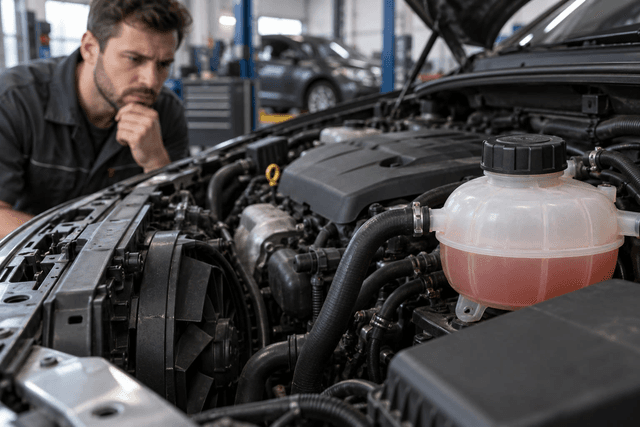
Overheating without coolant loss is possible: coolant visible in the reservoir does not prove that it circulates through the engine or releases heat effectively. The fault may involve coolant flow, airflow or cooling controls, and the temperature reading itself may also need checking. If an overheating warning appears, stop somewhere safe, switch off the engine and request assistance. Do not keep driving because the reservoir looks full.
Overheating Without Coolant Loss: What Does a Stable Level Mean?
The everyday expression water level refers here to engine coolant, not a recommendation to use plain water. This article focuses on a level that appears normal despite an overheating warning. For the wider picture, see the guide to engine overheating causes and what to do.
The reservoir’s role and the method for reading its level depend on the cooling-system design: it may be a pressurized part of the system or a recovery tank. Coolant also expands when hot, so comparing a hot reading with a cold one cannot establish system health. A visual reading within the marks on a cold engine, following the manual, tells you only about the level. It does not prove that passages are free of air or restrictions, or rule out a fault or a leak whose effects are not yet apparent.
How Can the Engine Overheat When Coolant Is Present?
The cooling system must move heat away from the engine and then transfer it to the air through the radiator. A failure at either stage can raise the temperature without an obvious drop in level. These are possibilities for inspection, not a shopping list of replacement parts:
- Fan or fan control: insufficient air may pass through the radiator while stationary. Seeing a fan turn once does not prove that its speed or all operating modes are correct.
- Thermostat: if it does not regulate coolant passage correctly, heat transfer to the radiator may be impaired despite an apparently adequate amount in the reservoir.
- Trapped air: air can interfere with coolant movement and heat transfer, particularly if the problem started after cooling-system work. The timing is a clue for the technician, not proof of a diagnosis.
- Insufficient pumping: the water pump may not provide the required flow. This does not necessarily produce a visible leak or an obvious noise that the driver can identify.
- Restricted heat exchange: internal restrictions in radiator passages or an external obstruction to airflow can reduce cooling. Reservoir level cannot distinguish between them.
- System pressure: a fault in the cap or components that retain pressure can affect the coolant’s resistance to boiling. Never test a cap by removing it while hot or guess at a different pressure rating.
For an explanation of circulation specifically, read about the water pump’s role in circulating coolant. Mentioning the pump does not make it the most likely cause in your car, and replacing it without checking the rest of the system may not solve the problem.
What Can Traffic and Highway Patterns Tell You?
Record only the conditions you already observed during previous use. Do not drive again or leave the engine running to reproduce overheating. The pattern can help a workshop organize its checks, but it is not a conclusive diagnosis:
| Previous observation | What might the technician check? | What does it not prove? |
| Temperature rises at a stop and eases when moving | Airflow, fan performance and fan control | It does not prove that only the fan is faulty |
| The warning appears on the highway or uphill | Coolant flow and heat exchange under load | It does not identify the pump or radiator specifically |
| It began after a coolant change or repair | Correct filling, trapped air and connections | It does not confirm trapped air without checks |
| It coincides with air conditioning use | Cooling performance as load and airflow change | It does not prove low AC refrigerant |
If the connection with AC use is your main observation, there is a separate explanation of engine overheating when the air conditioning is on. The key point here is that a normal coolant level cannot rule out a cooling fault, whatever the conditions when the warning appears.
Could the Temperature Reading Be Wrong?
A temperature sensor, its wiring or the display system may affect the reading. However, do not assume the warning is false because the reservoir is full or you cannot see steam. Some cooling faults show no obvious external sign at first. Treat the warning seriously until a qualified technician verifies the actual temperature and readings.
The technician compares diagnostic data and appropriate measurements with the vehicle’s specifications and operating conditions. A fault code alone cannot condemn a part, and the absence of a code does not prove that cooling is normal. There is also no single operating temperature for every car. Use the owner’s manual and vehicle-specific service information to interpret the gauge and warning message.
What Should You Do Safely When the Warning Appears?
- Move to the nearest safe stopping place away from traffic and use hazard lights as needed. Stop and switch off the engine. Do not try to drive to a workshop with an overheating warning.
- Stay clear of steam and spraying fluid. Never open a hot radiator or coolant reservoir cap, and do not assume that pressure has disappeared just because the gauge has fallen.
- Do not work near fans or put hands or tools in their operating area: a fan may start automatically even after the engine is switched off. Do not test it by hand or touch hot hoses.
- Do not pour cold water onto a hot engine or add fluid to a hot system. Request roadside assistance and arrange transport for inspection rather than repeatedly restarting the engine to see what happens.
Once the engine has cooled completely, you may record the level visible from outside the reservoir if this is possible and safe according to the manual, without removing caps or parts. A normal level or a warning that disappears after shutdown does not establish that the fault has gone or that continuing the journey is safe.
What Information and Checks Should You Discuss With the Workshop?
Tell the technician when the warning appeared: while stopped, climbing or travelling. Mention any preceding service work or fluid addition. Describe the message and any smell or steam you noticed from a safe position. Photograph the dashboard only after stopping, and do not reproduce the fault for documentation.
- Ask for the coolant level, specification and system condition to be checked, rather than accepting the reservoir is full as the entire assessment.
- Discuss fan operation and control, thermostat and pump function, and radiator flow as indicated by the diagnostic findings.
- Leave pressure and cap testing and air-removal procedures to the technician, using tools and methods appropriate to the system design.
- Ask what evidence identifies the fault and which check verified the repair before the car is handed back.
If initial checks do not identify the cause, broader diagnosis may be necessary. Do not jump to a head-gasket diagnosis, or rule it or another internal fault out solely because the reservoir level is stable. Testing should determine the next step.
Why Is Adding Water Not a Universal Fix?
If the level is within the correct limits, adding fluid will not repair a fan or restore impaired flow, and may exceed the permitted fill level. Use coolant meeting the vehicle’s specification and the concentration stated in the manual. Plain water is not a universal substitute, and color alone does not establish compatibility. Read about coolant differences and choosing a suitable fluid for more context.
Do not mix unknown products or experiment with additives to treat overheating. Flushing and air removal are not identical procedures on every vehicle; leave them to a professional when technically justified. Maintaining the correct level matters, but it is only one part of system health, not a replacement for checking performance.
Frequently Asked Questions About Overheating With a Stable Level
Does a full reservoir mean the radiator is full?
Not necessarily; it depends on the system design and condition. The visible level alone does not prove correct filling or circulation, and never justifies opening a hot cap.
Does the absence of a leak rule out pump failure?
No. Leakage is not the only possible sign of a pump fault. Its ability to circulate coolant needs appropriate assessment, not just a look underneath the car.
Can I drive if the gauge drops after stopping?
A lower reading does not prove the fault has gone. After an overheating warning, do not resume driving to test the car; request assistance and inspection before using it again.
Should I remove the thermostat to solve the problem?
Do not remove the thermostat as an experiment: it is part of cooling regulation. A technician should assess it and fit the correct replacement if necessary.
Does overheating without coolant loss mean a faulty sensor?
No. The overheating can be real despite a stable level. Do not ignore the warning or disconnect the sensor; have the reading and system performance checked together.
Conclusion: Check Cooling Performance, Not Just the Level
A stable coolant level neither rules out overheating nor identifies its cause. Stop safely at a warning, switch off the engine, avoid hot caps and fans, and give your observations to a qualified technician. A sound repair starts with evidence of the fault, not extra water or random parts replacement.

Saudi Traffic Violations: How to Check, Pay and Dispute
Table Of Contents:
|
To check traffic violations in Saudi Arabia, open the Query Traffic Violations page on the Absher platform and enter your ID number together with the violation number or your date of birth. To pay, sign in to the Efaa platform through the National Single Sign-On, choose the violations you want to pay, then pay through the SADAD system, a mada card or a credit card. To object, use the Dispute Traffic Violations service that the Ministry of Interior provides online. These procedures may be updated from time to time, so confirm the latest steps on the official platform before you act.
What are traffic violations and who issues them?
Traffic violations are violations related to the Traffic Law and its implementing regulations. As the description of the dispute service on the National Platform explains, they are issued by the General Department of Traffic or by any other authority authorised to apply the Traffic Law and its implementing regulations. In practice, you deal with them through three main services:
- Inquiry: to find out which violations are registered against you, through the Query Traffic Violations page on the Absher platform.
- Payment: through the Efaa platform, as part of a Ministry of Finance service for paying government violations registered against individuals.
- Dispute: through the Dispute Traffic Violations service provided by the Ministry of Interior, if you have something showing that the violation is incorrect.
It helps to distinguish traffic violations from other government violations, such as Ministry of Transport violations or municipal violations, because each authority has its own services; you will find a summary in the table below.
How do you check traffic violations on Absher?
The Absher platform provides a dedicated page called Query Traffic Violations, which asks for specific search details. The steps usually go as follows:
- Open the Query Traffic Violations page from the official Absher website.
- Enter your ID number in its field.
- Choose the search type: by violation number or by date of birth.
- Enter the violation number or the date of birth, depending on the type you chose.
- Complete the verification code shown on the page, then display the result.
If you want to see the violations registered against you by different government entities in one place, the Efaa platform steps start with signing in through the National Single Sign-On (Nafath) and then viewing the registered violations, which we explain in the next section.
How do you pay traffic violations through the Efaa platform?
The service for paying government violations registered against individuals enables citizens, residents and visitors to view and pay all the violations registered against them by government entities, including traffic, smoking, government fines and other violations. The service page on the National Platform lists the payment steps as follows:
- Go to the Efaa platform.
- Choose to sign in through the National Single Sign-On.
- View the violations registered against you.
- Select the violations you want to pay.
- Continue to the electronic payment page.
- Complete the payment through the SADAD system, a mada card or a credit card.
According to the service description, the platform aims to unify and simplify violation procedures through a single digital platform that the relevant entities are linked to, so violations are issued and managed centrally. The National Platform also states that the service itself is free, meaning there is no charge for using it; this does not mean the violation amount is waived.
How do you dispute a traffic violation?
The Dispute Traffic Violations service provided by the Ministry of Interior allows you to dispute traffic violations issued by the General Department of Traffic and any other authority authorised to apply the Traffic Law and its implementing regulations. The service is provided online through the web portal and the mobile apps, and its path as shown on the service page is:
- Go to My Services.
- Choose Traffic.
- Choose Dispute Traffic Violations, then follow the instructions shown to complete the request.
We have not listed deadlines or detailed conditions for disputes here because they do not appear in the service description on the National Platform; read the conditions and instructions shown to you inside the service before submitting, and do not delay your dispute if you believe the violation is incorrect. Before you start, the following helps:
- Make sure the violation really concerns your vehicle or your licence, and that its details match what happened.
- Write the reason for your dispute clearly and briefly, stating facts rather than impressions.
- If you have documents that support your position, prepare them in advance, and provide the details the service asks for.
- Keep proof that you submitted the request until you receive the decision.
What is the difference between violation services on the official platforms?
Several entities register violations, and each service has a specific purpose. The table below summarises the services listed in the official sources we relied on:
| Service | Entity or platform | What it lets you do |
| Query Traffic Violations | Absher platform | Search by ID number with the violation number or date of birth |
| Payment of government violations registered against individuals | Ministry of Finance through the Efaa platform | View violations registered by government entities and choose which to pay |
| Dispute Traffic Violations | Ministry of Interior | Dispute violations from the traffic department and authorities authorised to apply the Traffic Law |
| Violations inquiry at the Ministry of Transport | Ministry of Transport and Logistic Services | Display violation details by searching with the violation number or the identification number |
| Municipal violations inquiry | Qassim Region Municipality as an example | View registered violations and the details of each one after signing in through the National Single Sign-On |
If a violation is registered with an entity other than the traffic department, look for that entity's inquiry service on the National Platform; for example, the Ministry of Transport and Logistic Services offers an inquiry through its web portal via the Ministry Services link and then the Violations Inquiry service in the list of inquiry services.
What are the most common causes of traffic violations you can avoid?
The best way to deal with violations is not to commit them in the first place, and most of their common causes can be avoided with simple habits that protect you and others on the road:
- Exceeding the speed limit: watch the road signs, because the limit changes between highways, inner streets and school areas, and cruise control helps you hold a steady speed on long roads.
- Not wearing a seat belt: make it a habit before moving off, for you and all passengers, however short the trip.
- Using the phone while driving: set navigation and calls before moving off, and leave messages until you stop in a safe, permitted place.
- Expired documents: track the expiry dates of your driving licence, the vehicle registration (istimara) and the insurance policy, and renew them before they are due.
- An expired periodic inspection: note its date in your phone calendar, and prepare the car beforehand with this checklist for preparing your car for the periodic inspection.
- Running a red light or stopping in prohibited places: slow down when approaching a signal, be ready to stop when it changes, and park only in permitted spaces.
- Neglecting the car's condition: make sure the lights and indicators work, and do not ignore warning lights; read about dashboard warning light meanings to know when to stop immediately.
Remember that driver assistance systems such as lane departure warning and adaptive cruise control help you, but they do not replace your attention, and they do not take over your responsibility to follow the rules.
What practical tips should you follow before paying or disputing?
- Check your violations regularly so they do not pile up without your knowledge.
- Read the details of each violation before deciding, then choose whether to pay it or dispute it.
- Reach the official platforms by typing their address yourself or through their official apps, and do not pay through links sent to you in messages from unknown sources.
- Do not share your verification code, login details or card details with anyone.
- Keep proof of payment until you are sure the violation status has been updated.
- If you face a technical problem, contact the entity that provides the service through its official channels.
Frequently asked questions about traffic violations
- Do I need to visit a government office to settle a violation? Usually not; the inquiry, payment and dispute services mentioned are provided online through the official portals and apps, and the dispute service page shows a branches link for anyone who needs it.
- Can I pay more than one violation at the same time? The Efaa platform steps include viewing the registered violations and then selecting the violations you want to pay before continuing to payment, so you decide what to pay.
- Does the Efaa platform include non-traffic violations? Yes. The service description states that it covers traffic, smoking, government fines and other violations registered by government entities.
- Can I dispute a traffic violation registered by an entity other than the traffic department? According to the service description, disputes cover traffic violations issued by the General Department of Traffic and any other authority authorised to apply the Traffic Law and its implementing regulations.
- Who do I call if I face a problem? The service pages on the National Platform list the Ministry of Finance number 19990 for the payment service and the Ministry of Interior number 966114011111 for the dispute service, as well as each entity's official email address.
Dealing with traffic violations is easier than it looks: check them on Absher, pay them on the Efaa platform, dispute them through the Ministry of Interior service if you have a clear reason, and always review the updated steps on the official platforms. Most importantly, avoid their common causes from the start: keep to the speed limit, fasten your seat belt, keep your phone out of your hand, and renew your documents before they expire.