How to Test MAF Sensor Readings and Clean the Sensor
Table of Contents:
|
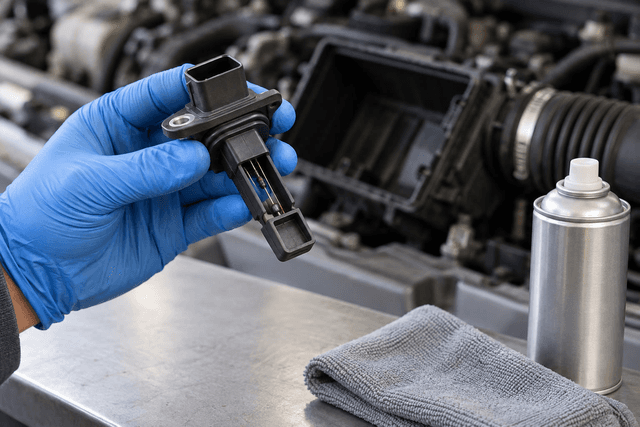
How to test MAF sensor readings correctly starts with ruling out simple causes such as a clogged air filter or air entering after the sensor, then a visual inspection, then reading codes and live data with an OBD-II scan tool and comparing them with what the service data states or the technician expects. If the sensor is dirty, clean it only with a spray made for MAF sensors and without touching the sensing element. Your owner’s manual and a qualified technician remain the reference for your car’s values and procedures.
What Does the MAF Sensor Measure and When Should You Suspect It?
The MAF (mass air flow) sensor usually sits between the air filter box and the throttle body and measures the amount of air entering the engine, so the engine computer can calculate the right amount of fuel. It differs from the manifold absolute pressure (MAP) sensor, which measures pressure inside the manifold, and from the intake air temperature sensor, which may be built into the MAF sensor housing. Some engines rely on a MAP sensor instead of a MAF sensor or alongside it, so first confirm which sensor your car has.
Symptoms may include the engine warning light, an unstable idle, misfiring, weak pulling and higher fuel consumption, and they are shared with many other faults; so see MAF sensor symptoms, causes and prevention for details, and causes of power loss under acceleration if weak pulling is the main symptom.
Which Simple Causes Should You Rule Out Before Testing the Sensor?
Many abnormal readings are caused by what surrounds the sensor rather than the sensor itself. Check the following with the engine off and cold:
- Air filter: a clogged or poorly seated filter may restrict airflow or let dust reach the sensor. Review the signs your car needs a new air filter.
- Air entering after the sensor: the sensor does not measure this air, so the air-fuel mixture may be upset and symptoms may resemble a sensor fault.
- Intake hose and clamps: look for a crack, a loose hose or a slack clamp between the sensor and the throttle body.
- Sensor connector: make sure it is firmly seated, its pins are free of corrosion and moisture, and its wires are intact.
How to Test MAF Sensor Readings Step by Step
Order the tests from the simplest to the most precise, and do not move on before finishing the previous step:
- Visual inspection: look for dirt, oil traces, damage or a foreign object in the air path, without touching the delicate sensing element with your fingers or any tool.
- Reading codes and live data with an OBD-II scan tool, usually the most important step.
- Unplug test: an indicative test that a technician performs with care, and it should not be relied on alone.
- Multimeter check: an electrical test that differs from car to car and is done according to the service manual.
How Do You Read Fault Codes and Live Data With a Scan Tool?
Connect the scan tool to the diagnostic port under the dashboard, and note the stored and pending codes and the freeze frame data before clearing anything. Codes may point to the sensor circuit, a reading out of range, or a lean or rich mixture; for other reasons, see the common causes of the engine warning light.
Then open the live data and watch the sensor reading:
- At idle: once the engine reaches operating temperature, compare the reading with what the service data states or the technician expects for your engine.
- When raising the revs gradually: the reading is expected to rise smoothly, while jumps, dropouts or a flat reading may point to a problem with the sensor or its wiring.
- Fuel trims: the technician reads them alongside the sensor reading, as their pattern may help distinguish unmetered air from an inaccurate reading.
Do not rely on figures published for other cars, because values vary with the engine and its design.
Is the Unplug Test Reliable, and When Is a Multimeter Used?
In this test the technician unplugs the sensor connector with the engine off and then starts it to see whether its behaviour changes, since the computer usually falls back on estimated values without the signal. If performance clearly improves, this may suggest an inaccurate reading, but the result is indicative, not a final verdict.
Some cars enter limp mode, run worse or show no change at all, and a fault code is stored because of the disconnection; so the test stays with the technician as part of a broader diagnosis, and the car should not be driven with the sensor unplugged.
A multimeter is used to check the supply, ground and signal, but connector pins and the measuring method differ between cars, and some sensors send a frequency signal that a standard measurement cannot read; so it follows the wiring diagram in the service manual or is done by a qualified technician.
How Do You Clean a MAF Sensor Correctly?
Cleaning helps when the sensor is dirty but sound; it does not fix an electrical fault. Follow the cleaner’s label; in general:
- Switch the engine off, let it cool, and work in a well-ventilated place away from flames, as cleaning sprays are usually flammable.
- Disconnect the sensor connector, then remove the sensor carefully with the right tool, as some sensors use special screws.
- Spray the sensing element with a cleaner made for MAF sensors only, from the distance recommended on the can, without touching it or wiping it with a cloth, brush or cotton bud.
- Let it air-dry completely, and never install it while wet.
- Refit the sensor and connector, tighten the intake hose and clamps, then start the engine and watch its behaviour and the engine warning light.
Which Mistakes Damage the MAF Sensor During Cleaning?
Avoid the following, because it may damage the sensor or hide the fault instead of fixing it:
- Using brake cleaner, carburettor cleaner or general solvents, which may leave residue or damage plastic and the sensing element.
- Blowing compressed air or spraying water, which may damage the delicate element or let moisture reach the circuit.
- Touching or wiping the sensing element, or cleaning while the engine is running or hot.
- Over-oiling washable air filters, because excess oil may travel with the air and contaminate the sensor; follow the filter instructions or use the filter specified in the manual.
- Clearing codes straight after cleaning before confirming the cause has been addressed.
Once the real cause has been addressed, the codes can be cleared and the repair verified with normal driving and another look at the live data; the computer may need some driving to relearn its fuel trims. If the code returns, the problem is not solved yet.
When Is Cleaning Enough and When Does the MAF Sensor Need Replacing?
Cleaning is often enough if the reading returns to a normal pattern and the symptoms disappear. Replacement is considered when:
- The sensing element is broken, the sensor body is cracked or its terminals are damaged.
- The reading stays abnormal after cleaning and after ruling out air leaks and wiring or connector problems.
- The technician confirms with a scan tool or electrical measurement that the fault is inside the sensor itself.
When replacing it, choose a part matching the part number or the vehicle identification number, as a non-matching sensor may give wrong readings. If high fuel consumption continues after the repair, review the causes of higher fuel consumption, as there are many other possible reasons.
What Do the Test Results Mean and What Is the Next Step?
The table summarises common findings; all of them are possibilities that need confirmation:
| Symptom or finding | What it may mean | Next step |
| Clogged or poorly seated air filter | Restricted airflow or dust reaching the sensor | Replace the filter as per the manual, then retest |
| Cracked hose or slack clamp after the sensor | Air entering that the sensor does not measure | Fix the leak before judging the sensor |
| Dirt or oil traces on the sensor | Inaccurate reading | Clean it with the dedicated spray and find the oil source |
| Reading does not rise smoothly with revs | Dirty or failed sensor or a wiring problem | Clean it, then have the wiring and reading checked by a technician |
| Code related to the sensor circuit | Fault in the connector, wiring or sensor | Inspect the connector and request electrical testing per the service manual |
| Code returns after cleaning and repairs | Fault inside the sensor or an undetected cause | Diagnosis by a qualified technician; replacement may be needed |
Frequently Asked Questions About Testing and Cleaning the MAF Sensor
How do I know if the MAF sensor is bad?
Symptoms alone are not enough because they resemble other faults. Confirmation comes from reading codes and live data after ruling out the air filter, air leaks and the connector, preferably with a qualified technician.
What is the best spray for cleaning a MAF sensor?
A product whose label clearly states that it is made for MAF sensors, leaves no residue once dry and is safe on plastic parts. Read the label and follow its instructions.
Can I clean the MAF sensor with brake or carburettor cleaner?
This is not recommended, because these cleaners are harsher than needed and may leave residue or damage the sensing element.
Should I clear the fault code after cleaning the MAF sensor?
Clear it only after the cause has been addressed, then verify by driving and checking the live data. Clearing the code does not fix the fault, and if it returns, have it diagnosed.
Can I drive the car with a faulty MAF sensor?
It may remain drivable, with performance and fuel consumption affected. But if the engine warning light flashes, the engine clearly loses power or a red warning appears, avoid driving and call for help.
Conclusion
The right way to test a MAF sensor starts with ruling out the air filter, air leaks and the connector, then a visual inspection, then reading codes and live data. Clean the sensor with a dedicated spray without touching the sensing element, do not clear codes before the cause is addressed, and leave electrical tests and the replacement decision to a qualified technician.

Genesis Models 2026: G70, G80, G90, GV70 and GV80 Guide
Table of Contents:
|
If you are looking for Genesis models 2026, the Genesis cars page on our site lists five models: three sedans, the G70, G80 and G90, and two SUVs, the GV70 and GV80, with model years from 2024 to 2026. Genesis is a luxury car brand from South Korea. This guide explains how the models differ in size, engine, power, drive system and equipment, helps you choose what suits a family, city driving or long trips, and then shows how to compare trims before buying. The specifications given here are those of the representative trim of each model in our listings and may vary by trim and model year, so check the car page for the exact specifications of the trim you are interested in.
Comparison of Genesis Models 2026 Listed on Our Site
The table below summarises the listed models based on one representative trim per model, such as the GV70 Prestige Plus 2026, G70 Prestige 2026, G80 Prestige 2026, GV80 Premium 2026 and G90 Prestige 2026. A dash means the value is not stated in the listing data or that we left it out because it needs confirming on the car page.
| Model | Type | Listed model years | Engine | Power | Seats | Drive |
| GV70 | SUV | 2024, 2025, 2026 | 2.5 L, 4 cylinders | 304 HP | 5 | - |
| G70 | Sedan | 2025, 2026 | 2 L, 4 cylinders | - | 5 | Rear-wheel |
| G80 | Sedan | 2024, 2025, 2026 | 2.5 L turbo, 4 cylinders | 304 HP | 5 | Rear-wheel |
| GV80 | SUV | 2026 | 2.5 L, 4 cylinders | 304 HP | 5 | Four-wheel |
| G90 | Sedan | 2026 | 3.5 L, 6 cylinders | - | 5 | - |
The representative trim data lists petrol fuel and an automatic transmission for every model except the GV80, where these two values are not stated. All five trims share blind spot monitoring, while forward collision warning appears in the data for the GV70, GV80 and G90.
Genesis Sedans: G70, G80 and G90
The Genesis G70 is the smallest sedan in the listed range and has a sporty character. The representative trim (Prestige 2026) has a 2 L petrol engine with 4 cylinders, an automatic transmission, rear-wheel drive, a recorded fuel economy of 12.5 km/L and 19 inch wheels. Its recorded equipment includes ventilated and heated seats, a navigation system and a smart entry system. It suits drivers who mostly move around the city and want a smaller car that is easy to park. Its listed trims are Prestige and Platinum for 2025 and 2026.
The Genesis G80 is a mid-size executive sedan. The representative trim (Prestige 2026) has a 2.5 L turbo engine with 4 cylinders and 304 HP, an automatic transmission, rear-wheel drive, a recorded fuel economy of 12.5 km/L and 18 inch wheels. Its listing data mentions a power rear sunshade and a rear centre armrest with control buttons, alongside heated seats, navigation and smart entry, so it suits buyers who care about rear passenger comfort and long drives between cities. Its listed trims are Prestige (2025 and 2026), Platinum (2025) and Royal (2024).
The Genesis G90 is the large sedan at the top of the range. The representative trim (Prestige 2026) has a 3.5 L engine with 6 cylinders, an automatic transmission, a recorded fuel economy of 10.8 km/L and 20 inch wheels. Its recorded equipment includes a smart air massage system for the driver seat, memory for the front seats, ventilated and heated seats and a power tailgate. It suits those who cover long distances and want a large sedan with advanced comfort equipment. Its listed trim is Prestige 2026.
Genesis SUVs: GV70 and GV80
The Genesis GV70 is an SUV that is smaller than the GV80. The representative trim (Prestige Plus 2026) has a 2.5 L petrol engine with 4 cylinders and 304 HP, an automatic transmission, a recorded fuel economy of 11.5 km/L and 19 inch wheels. Its equipment includes a panoramic roof, forward collision warning, blind spot monitoring and a power tailgate. It combines the raised SUV seating position with a size that suits city streets, which makes it a fit for a small family. Its listed trims are Prestige Plus (2025 and 2026), Premium (2025), Platinum Sport (2024) and Royal Sport (2024).
The Genesis GV80 is the largest SUV in the listed range. The representative trim (Premium 2026) has a 2.5 L engine with 4 cylinders and 304 HP, four-wheel drive, 22 inch wheels and 5 seats. Its recorded equipment includes ventilated and heated seats, navigation, smart entry, forward collision warning, a power tailgate and natural wood interior trim. Four-wheel drive makes it the closest choice in the range for buyers who travel often or sometimes drive on light dirt roads. Its listed trims are Premium, Platinum and Royal for 2026.
Which Genesis Model Suits Your Use?
- Family: the GV80 and GV70 are practical choices thanks to the SUV seating position and the power tailgate in the representative trims, while the G80 and G90 suit those who prefer a comfortable sedan for rear passengers. All representative trims have five seats, so check the seat count on the car page if your family is larger.
- City: the G70 is the smallest of the listed sedans, and the GV70 suits those who want a moderately sized SUV that is easy to handle in traffic and car parks.
- Long trips: the G80 and G90 are comfortable sedans with equipment for rear passengers, and the GV80 offers four-wheel drive and SUV height for carrying the family and luggage on trips.
- Dirt roads and the desert: the GV80 is the only model whose data states four-wheel drive, and no off-road drive modes are listed for it, so it is more suited to light dirt roads.
If you are torn between two models, start with your daily use and then move on to size, because the differences between trims within one model can be larger than the differences you expect between two similar models.
How Do You Compare Genesis Trims Before Buying?
Trim names repeat across models, but the equipment of the same trim name can differ from one model to another and from one year to another. For example, the G80 comes in Prestige, Platinum and Royal trims, while the GV70 comes in Platinum Sport and Royal Sport for 2024, and Prestige Plus (2025 and 2026) and Premium (2025). Follow these steps:
- Choose the model first by size: a sedan (G70, G80 or G90) or an SUV (GV70 or GV80).
- Open the page of each trim and compare the engine, power, drive system and wheel size, because the figures in this guide apply to the representative trim only.
- Compare safety equipment such as blind spot monitoring, forward collision warning and the camera system.
- Compare comfort equipment such as seat ventilation and heating, the sunroof, smart entry, navigation and the power tailgate.
- Pay attention to the model year, as the same trim may be listed for two years, such as the G80 Prestige for 2025 and 2026.
Before you sign, read the new car buying guide with steps before signing and delivery to know what to check in the contract and when you take delivery of the car.
Genesis 2026 Prices, Offers and Finance
Many people search for the Genesis G80 price or Genesis 2026 prices, but the price varies by model, trim and model year, so we do not quote figures in this guide. The current price of each trim appears on its own car page, and any offers can be found on the current offers page. If you are considering instalments, use the car finance instalment calculator to estimate the instalment based on your details before applying to a finance provider.
The listed models can be viewed at the Saleh Cars Group branches, and you will find addresses and contact options on the contact and branches page or through the unified number 920022122.
Frequently Asked Questions About Genesis Models
Which Genesis models 2026 are listed on our site?
The site lists five models: the G70, G80 and G90 sedans, and two SUVs, the GV70 and GV80. Each has a trim for 2026, plus trims from 2024 and 2025 for some models.
How much is the Genesis G80 2026?
The price varies between G80 trims, and the current price of each trim appears on its car page, with offers on the offers page and the instalment calculator for estimating finance. We do not quote prices here because they can change.
What is the difference between the Genesis G80 Prestige, Platinum and Royal trims?
The listed G80 trims are Prestige (2025 and 2026), Platinum (2025) and Royal (2024). The specifications in this guide are for the Prestige 2026 trim; check the page of each car for the equipment differences between trims.
Is the Genesis GV80 four-wheel drive?
Yes in the representative trim (Premium 2026), whose data states four-wheel drive with a 2.5 L engine and 304 HP. Check the drive system on the page of the trim you are interested in before deciding.
Which Genesis car suits a family?
The GV80 and GV70 are practical family choices thanks to the SUV seating position and the power tailgate in the representative trims, while the G80 and G90 suit those who prefer a comfortable sedan for rear passengers. All representative trims have five seats.
Conclusion
The Genesis models listed on our site are five: the G70, G80 and G90 sedans, and the GV70 and GV80 SUVs, with the GV80 standing out for four-wheel drive in its representative trim. Choose the size that suits your use first, then compare trims on the car pages because the specifications here apply to the representative trim only, and browse all listings on the Genesis cars page.

No Down Payment Car Finance: How It Works, What to Check
Table of Contents:
|
No down payment car finance means asking a finance company to finance the full price of the car instead of paying part of it upfront, so the whole amount is spread over monthly instalments. This option eases the burden of a large sum at purchase, but it raises the amount financed, so the monthly instalment is usually higher and the total you pay by the end of the contract is often greater. It is not necessarily available to every applicant, because approval and its details are subject to the finance company’s terms and credit approval. In this guide we explain how this option works, what finance companies look at, the documents and costs that still apply, and the questions to ask before signing.
What Does No Down Payment Car Finance Mean?
In standard instalment buying you pay part of the car’s price at purchase, known as the down payment or deposit, and the finance company finances the rest in instalments. With no down payment, which many people search for as instalments without a deposit, you ask for the full price to be financed, and your instalment commitment starts according to the contract schedule.
The financing here is provided by the finance company, not the car showroom, so it decides on approval, the term and the instalment according to its terms. The option may also come in different forms: some contracts require no down payment but include a final payment at the end of the term, and some ask for fees or amounts at signing even without a down payment. So ask for the offer details in writing, and do not rely on the advertising headline alone.
How Does Skipping the Down Payment Change the Instalment and the Total?
The general rule is simple: whatever you do not pay upfront goes into the amount financed. The larger the amount financed, the higher the monthly instalment usually is if the term stays the same, and the total financing cost is often greater because it is calculated on a larger amount. If the term is extended to lower the instalment, the total you pay may rise even further.
| Item | No down payment | With a down payment |
| Amount you pay at purchase | Lower, though fees or insurance may still apply depending on the offer | Higher because it includes the deposit |
| Amount financed | The full price of the car | The price minus the deposit |
| Monthly instalment for the same term | Usually higher | Usually lower |
| Total paid by the end of the contract | Often higher | Often lower |
| Impact of any change in your income | Heavier because the monthly commitment is larger | Relatively lighter |
| Your emergency savings | Stay with you | Shrink by the amount of the deposit |
To try out the effect of the down payment and the term on the instalment before requesting a formal offer, use the car instalments and finance calculator page, and treat the result as an estimate, because the actual instalment is set by the finance company in its written offer.
What Do Finance Companies Look at When You Apply With No Down Payment?
Criteria differ from one company to another, but finance companies generally look at your ability to repay, and the conditions for an application without a down payment may differ from those with one, depending on each company’s policy. The main points usually reviewed include:
- Your income, its source and stability, and how your salary is deposited, according to the finance company’s terms.
- Existing obligations such as other instalments or financing, and what remains of your income after them.
- Your credit record and how regularly you have repaid past obligations.
- Your employer, its sector and your length of service, as required by the finance company.
- Residency status and validity for residents, since residents can buy with financing according to the finance company’s terms.
There is no single rule that guarantees approval, and the final decision rests with the finance company after reviewing the application. Ask it directly about its criteria before applying, and if you want to know where you stand in advance, check your credit record through the official approved channels.
What Documents Are Commonly Requested for Car Finance?
The list varies by finance company and customer type, and the documents commonly requested include:
- Proof of identity: the national ID for citizens, or a valid residence permit for residents.
- A salary definition letter or salary certificate from your employer.
- A bank statement for the period set by the finance company.
- National address details and contact information.
- Additional documents for the self-employed or for certain cases, as requested by the finance company.
Ask the finance company for its up-to-date list before applying, and make sure your details match across all documents, because a different name or employer from one paper to another may delay the review of your application.
What Costs Still Apply Even Without a Down Payment?
Not paying a deposit does not mean the car will cost you nothing beyond the instalment. Review these items with the finance company:
- Insurance: finance companies usually require the car to be insured for the whole contract, so ask about its type, who pays for it and whether it is included in the instalment or paid separately. To understand the difference between policies, read about comprehensive vs third-party car insurance.
- Administrative or file-opening fees, and when they are due.
- A final payment at the end of the contract, if there is one; it lowers the instalment but is an amount you must prepare for.
- Normal running costs such as fuel and routine maintenance, which do not change with or without a deposit.
Ask for all these items to be stated in the written offer, and add them to the instalments to know the real total cost before you decide.
What Questions Should You Ask the Finance Company Before Signing?
- Is the offer truly without a down payment, or has the deposit moved into a final payment or fees at signing?
- What is the monthly instalment, the number of instalments and the total amount by the end of the contract?
- What are the administrative fees, and are any other amounts due before delivery?
- What type of insurance is required, and is its cost included in the instalment?
- What are the early settlement terms, and what happens if an instalment is late?
- When does ownership of the car pass to you, and can you sell it before the contract ends?
- Is the approval final or preliminary, and how long does the offer remain valid?
Compare the answers from more than one company for the same car and the same term, and check the contract and the finance company’s official disclosures before signing. For calculating the total cost, reading the contract terms and comparing offers in detail, see our comparison of buying a car with financing or cash.
When Does No Down Payment Suit You, and When Is a Down Payment or the Two-Payment Option Better?
Instalments with no down payment may suit you in the following cases:
- Your income is stable, and the higher instalment leaves comfortable room in your monthly budget.
- You need the car now and do not want to drain your emergency savings.
- You accept that the total you pay will often be higher in return for not paying a large sum at the start.
A down payment may be better if you have money beyond your emergency reserve, because it usually lowers the amount financed, the instalment and the financing cost. And if you have part of the price but not enough to pay it in full, the two-payment option may be worth asking about, including its details and conditions, before turning to financing.
Start by choosing a car that fits your budget from the list of new cars on offer, then request a finance offer for that specific car, because the instalment changes with the car and its trim. Saleh Cars Group offers buyers whose money does not cover the full price the two-payment option or financing of the rest through approved finance companies, and you can ask its team about this through the contact and branches page.
Frequently Asked Questions About No Down Payment Car Finance
Can you buy a car in instalments with no down payment?
This is possible with some finance companies and in some offers, but it is subject to the finance company’s terms and credit approval, and it is not necessarily available to every applicant. Ask the finance company whether it is available in your case.
Is the instalment higher without a down payment than with one?
Usually yes for the same term, because the amount financed is larger. The instalment may look similar if the term is longer or there is a final payment, so compare the total amount, not the instalment alone.
Can a resident finance a car with no down payment?
Residents can buy with financing, but whether the no down payment option is available and its conditions, such as the employer and residency validity, are set by the finance company; ask it about its requirements for residents.
Is insurance required for car finance with no down payment?
Finance companies usually require the car to be insured for the whole contract, and the contract sets its type and who bears its cost, so read this clause carefully and ask about it before signing.
Does no down payment mean I will pay nothing at delivery?
Not necessarily; there may be administrative fees, insurance costs or other amounts depending on the finance company’s terms, so ask for a written list of everything payable before delivery.
Conclusion
Instalments with no down payment let you get the car without a large sum at the start, but they mean a larger amount financed, a usually higher instalment and an often higher total. Prepare your documents, know what the finance company looks at, add insurance, fees and any final payment to the instalments, and do not sign before you have written answers. If you have money beyond your emergency reserve, compare this option with a down payment or the two-payment option.

Buying a Chinese Car in Saudi Arabia: What to Check First
Table of Contents:
|
Before buying a Chinese car in Saudi Arabia, check things that do not show in the showroom: the brand’s parent company and who officially represents it in the Kingdom, whether there are service centres and spare parts in your city, the written warranty terms, and whether the car meets the GCC specification suited to heat and dust; then take a test drive and try the technology and the screen interface in Arabic. This guide is a neutral checklist that does not favour one brand over another; it helps you ask the seller the right questions before you sign.
Why Does the Parent Company of a Chinese Brand Matter?
The Saudi market includes many Chinese brands, and some of them belong to a larger group. Knowing the parent company helps you understand who stands behind the car and direct your questions about the dealer and the service network. Examples of these relationships include:
- Jetour, Omoda and Jaecoo: brands that belong to Chery.
- Haval: a brand owned by Great Wall Motor that specialises in SUVs and crossovers.
- Deepal: a company owned by Changan.
- Lynk & Co: a brand within the Geely group.
- Hongqi: a brand owned and operated by FAW Group.
However, two brands belonging to one group do not necessarily share the same dealer or service centres in the Kingdom, so ask about each brand separately. The brands and models available on the market also change over time. If you want to recognise these brands’ badges and names, see the guide to car brand logos and names.
How Do You Verify the Authorised Dealer and After-Sales Service in Your City?
Buy from the brand’s official agent in the Kingdom or from a dealer it has authorised, and ask the seller directly about their status. Ways to verify include checking the list of dealers and service centres on the brand’s official Saudi website if one exists, and making sure the warranty is activated with the agent in your name at delivery.
After-sales service is part of the buying decision, so ask before you sign:
- Where is the nearest authorised service centre to your city? Can it service this model with its powertrain, especially if it is hybrid or electric?
- Are routine maintenance parts such as filters and brake pads available locally? How are parts that are not in stock ordered?
- How are body panels, glass and lights handled after an accident, and does the agent supply them?
- Is there a roadside assistance service, and what are its written terms?
What Should You Read in the Written Warranty Terms?
Do not rely on a verbal promise from the seller; read the warranty booklet and the sales contract, and ask for any extra commitment to be written into the contract or invoice. Pay attention to the following:
- The covered parts, such as the engine, transmission and electrical systems, and whether the high-voltage battery in electric and hybrid cars has a separate warranty with its own terms.
- The warranty period and mileage limit as written in the booklet, and when they start to count.
- The conditions for keeping the warranty valid, such as servicing at authorised centres and following the maintenance schedule in the owner’s manual.
- The exclusions, such as wear parts and unapproved modifications, and whether the warranty transfers to the next owner when you sell.
Is the Car GCC Specification and Suited to Saudi Heat?
Ask which market version the car was built for, and make sure it is the version intended for the Saudi or GCC market. A car built for other markets may differ in cooling, air conditioning and infotainment settings, and may not be covered by the local agent’s warranty.
For extreme heat and dust, many owner’s manuals include a maintenance schedule for severe operating conditions, so ask the service centre whether it applies to your use, particularly for the engine air filter and the cabin filter. Also check the fuel octane rating required in the owner’s manual or on the fuel filler flap, because some engines may require higher-octane fuel than others, and this belongs in your running-cost calculation.
What Should You Test on the Drive, the Technology and the Screen?
Drive the car on roads similar to your daily use, test the air conditioning in the heat of the day, and follow the test drive checklist before buying to assess comfort, noise and visibility. Then focus on the technology and screens, because they vary widely between models and trims:
- Driver assistance systems: confirm that the advertised features are fitted to the trim you are buying, and try how they are activated and how they warn you.
- Screen and instrument cluster: does the interface support Arabic with a clear translation? Do the navigation, voice commands and phone connection work as you expect?
- Software updates: are they delivered over the air or at the service centre? Who provides them in the Kingdom? Does the car’s app need an account or a subscription?
- Ease of use: can you adjust the air conditioning, mirrors and basic settings easily while driving without distraction?
Petrol, Hybrid or Electric: What Should You Consider?
The type of powertrain changes the questions you ask the seller:
- Petrol: check the required octane rating and the maintenance schedule in the owner’s manual.
- Hybrid: ask whether it is a conventional hybrid or a plug-in hybrid charged from an external source, and whether the service centre can maintain the hybrid system.
- Electric: make sure a home charger can be installed where you live and that charging is available on your usual routes, and ask how air conditioning and heat affect the driving range.
For both hybrid and electric cars, read the battery warranty terms in writing, and ask about technicians qualified to work on high-voltage systems in your city.
What Should You Ask About Insurance and Resale Value?
Request insurance quotes for the same model and trim before you sign, because the premium varies with the car and other factors, and compare the cover and exclusions rather than the premium alone.
There is no fixed rule for resale value; follow used-car listings for the same model to form a general idea, and remember that the car’s condition and its service history at an authorised centre affect it. It is also useful to check before buying whether the model is subject to any recall campaign.
Checklist Before Buying a Chinese Car
The table below summarises what to check, why it matters and how to verify it:
| What to check | Why it matters | How to verify |
| Seller status | The agent’s warranty and authorised servicing depend on it | Ask the seller and check the dealer list on the brand’s official website |
| Service centres and spare parts | Less waiting for maintenance or repairs | Ask about the nearest authorised centre and routine parts availability |
| Written warranty | Knowing what it covers and how it stays valid | Read the warranty booklet and ask for any extra promise in writing |
| GCC specification | Cooling and air conditioning suited to heat and dust | Ask about the market version and review the car’s documents |
| Fuel grade | Using the fuel the engine was designed for | Owner’s manual or the fuel filler flap label |
| Technology and screen | Confirming the features and Arabic language support | Try them during the test drive |
| Insurance and resale | Estimating the cost of ownership | Insurance quotes for the same trim and used-car listings |
Frequently Asked Questions About Buying a Chinese Car
Are Chinese cars suitable for Saudi heat?
It depends on the model, its specification and how it is maintained, not on the country of origin alone. Make sure the car is GCC specification, test the air conditioning in the heat of the day, and follow the maintenance schedule in the owner’s manual.
How can I confirm the seller is an official agent or authorised dealer?
Ask the seller about their status, check the dealer list on the brand’s official Saudi website if one exists, and make sure the warranty is activated with the agent in your name at delivery.
Does the warranty include routine servicing?
Not necessarily; a warranty usually covers manufacturing defects, while free routine servicing depends on the seller’s offer. Rely on what is written in the warranty booklet and the sales contract.
How do I know spare parts are available in my city?
Ask the nearest authorised service centre about routine maintenance parts for the model you want and how parts that are not in stock are ordered, and use the vehicle identification number (VIN) when ordering so the part matches.
Do the Chinese brands available in Saudi Arabia change?
Yes, new brands and models may arrive and the trims on offer may change over time, so check the current situation with the agent instead of relying on old information.
Conclusion
Buying a Chinese car is like buying any new car, but it deserves extra questions: who the parent company and the agent are, where the service centres and spare parts are, what the written warranty says, whether the specification is GCC, and how the technology and screen work in Arabic. You can browse the new cars currently listed at Saleh Cars Group and then apply this checklist to any model you are considering.

Ford Models: Taurus, Territory, Everest and Trims Guide
Table of Contents:
|
There are six Ford models listed on our site: the Taurus sedan, the Territory, Everest and Explorer SUVs, and the Ranger and F150 pickups. This guide explains how they differ in size, engine, seats and drive system, which kind of buyer in Saudi Arabia each model suits, and how to compare trims before you decide, and you can browse every listed car of the brand on the Ford cars page. Ford is a car brand of American origin.
Ford Models on Our Site: A Quick Comparison Table
The table below summarises the main specs of one listed trim of each model. These specs belong to the trim named in the table and vary by trim and model year, so check the car page for the exact specs of the trim you are interested in. A dash means the value is not stated in the trim data.
| Model | Type | Listed trim | Engine | Power (HP) | Torque (Nm) | Seats | Drive |
| TAURUS | Sedan | Ambiente New Shape 2026 | 2 L, 4 cylinders, petrol | 239 | — | 5 | Front-wheel |
| Territory | SUV | Titanium 2026 | 1.8 L, 4 cylinders | 190 | 320 | 5 | Front-wheel |
| Everest | SUV | XLS Diesel 2025 | 2 L, 4 cylinders, diesel | 168 | 405 | 7 | Four-wheel |
| EXPLORER | SUV | Active Comfort 4WD 2025 | 2.3 L, petrol | 300 | 420 | 7 | Permanent four-wheel |
| F150 | Pickup | Reg Cab 4x4 XLT 5.0L V8 Mod to Raptor R 2023 | 5 L, V8, petrol | 700 | — | 3 | Four-wheel |
| Ranger | Pickup | Wildtrak 2024 | 2 L, 4 cylinders, diesel, twin turbo | 207 | 500 | 5 | Four-wheel |
All the listed trims have an automatic transmission. Their stated fuel economy is: Taurus 15.5 km/L, Territory 15.6 km/L, Everest 14.2 km/L, Explorer 12.7 km/L, Ranger 14.6 km/L and F150 9.7 km/L.
Ford Taurus: A Sedan for the City and Daily Driving
The Ford Taurus (TAURUS) is the only sedan among the Ford models on our site and is listed for 2025 and 2026. The trim in the table, Ambiente New Shape 2026, has a 2 L four-cylinder petrol engine with 239 HP, an automatic transmission, front-wheel drive, five seats, 18 inch wheels and a stated 15.5 km/L. Its equipment includes forward collision warning, blind-spot information, a smart entry system, fabric seats and single-zone automatic air conditioning.
The Taurus suits buyers who want a five-seat sedan for daily driving in the city and for a small family. For 2026 the site lists, alongside the usual trims, New Shape trims with the same names: Ambiente, Trend and Titanium, so confirm which shape you want before comparing, as specs and equipment differ from one trim to another.
Ford Territory: A Five-Seat SUV for Families and the City
The Ford Territory is a five-seat SUV listed for 2025 and 2026. The Titanium 2026 trim named here has a 1.8 L four-cylinder engine with 190 HP and 320 Nm, an automatic transmission, front-wheel drive, 19 inch wheels and a stated 15.6 km/L.
This trim’s equipment includes a panoramic roof, ventilated front seats, leather seats, a powered tailgate, remote start and a wireless charger, as well as forward collision warning, blind-spot information and smart entry. The Territory suits a small family and buyers who spend most of their time in the city and want a higher seating position than a sedan, and the ventilated seats help in the hot summer months.
Everest and Explorer: Seven Seats for Large Families and Travel
The Ford Everest is a seven-seat SUV listed for 2025 in XLS, XLS Diesel, XLT and Limited trims. The XLS Diesel trim has a 2 L four-cylinder diesel engine with 168 HP and 405 Nm, an automatic transmission, four-wheel drive, 18 inch wheels and a stated 14.2 km/L, and its equipment includes a rear camera, an electric parking brake and fabric seats.
The Ford Explorer is a seven-seat SUV listed for 2025 in Active 4WD and Active Comfort 4WD trims. The latter has a 2.3 L petrol engine with 300 HP and 420 Nm, an automatic transmission, permanent four-wheel drive, 20 inch wheels and a stated 12.7 km/L, with a panoramic roof, adaptive cruise control, heated front seats, blind-spot information and smart entry.
Both models suit large families and long trips between cities, since both have seven seats and four-wheel drive in the trims named here. The clearest difference between them in these trims is fuel type and power: the Everest has a diesel engine, while the Explorer has a more powerful petrol engine with more comfort equipment.
Ranger and F150: Pickups for Work and Rough Roads
The Ford Ranger is a pickup listed for 2024 in the Wildtrak trim, with a 2 L four-cylinder twin-turbo diesel engine, 207 HP, 500 Nm, an automatic transmission, four-wheel drive, five seats, 18 inch wheels and a stated 14.6 km/L, plus adaptive cruise control, smart entry and dual-zone automatic air conditioning. It suits buyers who need a cargo bed and a cabin for five people for work and desert trips.
The listed Ford F150 is a 2023 model in the Reg Cab 4x4 XLT 5.0L V8 Mod to Raptor R trim, meaning a single-cab pickup modified in Raptor style, as the trim name indicates. It has a 5 L supercharged V8 petrol engine, 700 HP, an automatic transmission, four-wheel drive, three seats, 17 inch wheels and a stated 9.7 km/L, and its drive modes include normal, sand, snow, mud and sport. It suits sand and off-road enthusiasts who want high power and do not need rear seats.
How to Compare Ford Model Trims Before Buying?
The model name alone is not enough, as trims differ in engine, fuel type, equipment and wheel size. These are the trims of each model as listed on the site:
- Taurus: Ambiente, Trend and Titanium for 2025 and 2026, plus New Shape trims for 2026: Ambiente, Trend and Titanium.
- Territory: Ambiente, Trend and Titanium for 2025 and 2026, and Titanium Dark Edition for 2025.
- Everest: XLS, XLS Diesel, XLT and Limited for 2025.
- Explorer: Active 4WD and Active Comfort 4WD for 2025.
- Ranger: Wildtrak for 2024.
- F150: the Reg Cab 4x4 XLT 5.0L V8 Mod to Raptor R trim for 2023.
- Define your use first: number of passengers, city driving or travel, and whether you need four-wheel drive or a cargo bed.
- Fix the model year and then compare trims within it; the Taurus 2026, for example, is listed in the usual shape and the New Shape.
- On each car page, compare fuel type, power, torque, drive system, number of seats and wheel size.
- Review safety and driver-assistance systems such as forward collision warning, blind-spot information and adaptive cruise control, and do not assume they come with every trim.
- Pay attention to comfort features that matter in the heat: ventilated seats, the type of air conditioning and seat material.
For the inspection, signing and handover steps after choosing a trim, see the new car buying guide with steps before signing and handover.
How Do You Find the Price of the Ford Territory, Taurus and Other Models?
This guide does not give price figures because they differ by trim and year and change over time. The current price of each trim is shown on its own car page, and you can find current deals on the current car offers page. If you are considering buying in instalments, use the car finance calculator to estimate the instalment for the trim you chose.
The listed Ford models can be viewed at the Saleh Cars branches, and you can find their addresses on the contact and branch locations page or via the unified number 920022122.
Frequently Asked Questions About Ford Models
What is the price of the Ford Territory 2026?
The price differs between the Ambiente, Trend and Titanium trims; the current price of each trim is shown on its car page, and current deals are on the offers page.
What are the Ford Territory 2026 trims?
The site lists the Territory 2026 in Ambiente, Trend and Titanium trims, and a Titanium Dark Edition trim is listed for 2025. The Titanium 2026 trim named here has a panoramic roof, ventilated front seats and a powered tailgate.
What is the difference between the Ford Taurus 2025 and 2026?
The site lists the Taurus 2025 in Ambiente, Trend and Titanium trims, and for 2026 it adds New Shape trims with the same names. Compare the two trim pages to see the differences in specs and equipment.
What is the difference between the Ford Everest XLS and XLS Diesel?
Both trims are listed for 2025. The XLS Diesel trim runs on a 2 L diesel engine with 168 HP and 405 Nm, while the XLS specs should be checked on its own page because the engine varies by trim.
Which Ford models have seven seats?
In the trims named in this guide, the Everest and Explorer have seven seats, while the Taurus, Territory and Ranger have five seats, and the listed F150 has three seats.
Conclusion
The Ford models on our site cover different needs: the Taurus for the city and daily driving, the Territory for a small family, the Everest and Explorer for large families and travel, and the Ranger and F150 for work and rough roads. Define your use, compare the trims and their specs on the car pages, and follow everything listed for the brand on the Ford cars page.

JAECOO Models 2026: J5, J7 SPORT and J8 Buyer Guide
Table of Contents:
|
The JAECOO models 2026 listed on our site are three SUVs, the J5, the J7 SPORT and the J8, and the J5 is listed in both 2026 and 2027 versions. The three differ in size, seating and engine: the J5 and the J7 SPORT are compact five-seaters with a 1.5 L petrol engine, while the J8 is the largest, with seven seats and a 2.0 L turbo engine. This guide explains how they differ, which trims are listed for each model and who each one suits, and you can browse every listed car on the JAECOO cars page. JAECOO is a Chinese car brand. The specifications here are those of the listed trim named with each model and may vary by trim and model year, so check the car page for the exact specifications of the trim you want.
Which JAECOO Models 2026 Are Listed on Our Site?
The table below shows the three models with the specifications of one listed trim per model, named in the second column. The values come from the site’s listings, and a dash means the value is not stated here and needs confirming on the car page.
| Model | Listed trim | Type | Engine | Power | Torque | Transmission | Seats | Drive |
| J5 | COM 2027 | Compact SUV | 1.5 L, 4 cylinders, petrol | 147 HP | 210 Nm | CVT | 5 | Front |
| J7 SPORT | Comfort 2026 | Compact SUV | 1.5 L turbo, 4 cylinders, petrol | 146 HP | 210 Nm | Automatic | 5 | Front |
| J8 | LUXURY 2026 | Seven-seat SUV | 2.0 L turbo, 4 cylinders, petrol | 261 HP | 400 Nm | Automatic | 7 | - |
The table shows that the J5 and the J7 SPORT are close in displacement, power, torque and seating, and the clearest differences between them are the transmission, wheel size, screens and the rest of the equipment. The J8 moves up to a larger size with a stronger engine, more torque and a third row of seats, so it speaks to a different buyer.
Compact SUVs for the City and Small Families: J5 and J7 SPORT
The JAECOO J5 is the compact entry point to the brand’s models. The listed COM 2027 trim has a 1.5 L four-cylinder petrol engine with 147 HP and 210 Nm, a CVT transmission and front-wheel drive, and the listing states fuel economy of 17.9 km/L. Its listed equipment includes a smart entry system, a rear camera, 17-inch wheels, a 9.2-inch instrument screen, an 8-inch central screen, driver and front passenger airbags, and front side airbags.
The site lists the J5 in several trims: COM (Comfort) in 2026 and 2027 versions, Premium and Lux in the 2026 version, plus an entry for the Luxury trim in Blue Gray. The J5 suits drivers who spend most of their time in the city and want a raised five-seater, and who care about the fuel economy figure, keyless smart entry and parking with the help of the rear camera.
If you are searching for the JAECOO J7, the model currently listed on our site is the JAECOO J7 SPORT in the Comfort 2026 trim. It has a 1.5 L four-cylinder turbo petrol engine with 146 HP and 210 Nm, an automatic transmission, front-wheel drive, five seats and 18-inch wheels. Its listing mentions a 10.25 LCD digital instrument cluster, a 13.2 touchscreen, a sound-insulating windscreen, remote air conditioning start from the key, an electronic child safety lock for the doors, four airbags and a rear camera.
The J7 SPORT suits buyers who want a compact size close to the J5 but with larger screens, larger wheels and comfort features such as starting the air conditioning remotely before getting in, a practical feature in the Saudi summer. Families with young children will also value the electronic child lock on the doors.
A Seven-Seat Family SUV for Long Trips: J8
The JAECOO J8 is the largest JAECOO model listed with us, and all of its listed trims are from the 2026 version. The reference LUXURY 2026 trim has a 2.0 L four-cylinder turbo petrol engine with 261 HP and 400 Nm, an automatic transmission, normal and sport drive modes, seven seats, 19-inch wheels and listed fuel economy of 15.2 km/L.
This trim’s listed equipment goes beyond the two compacts: a panoramic sunroof, adaptive cruise control, forward collision warning, ventilated and heated seats, a smart entry system, a power tailgate, and a driver display and a central screen listed at 12.3 each, both supporting Arabic. We have not stated the drive type for this trim because it needs confirming, so check it on the car page or ask the branch.
The listed J8 trims are Executive, Premium, Premium in Matte Gray and LUXURY. The J8 suits large families who need a third row of seats and drivers who often travel between cities, since adaptive cruise control helps on highways, the higher torque helps when the car is full of passengers and luggage, and ventilated seats ease the summer heat.
Which JAECOO Model Suits Your Use?
- For the city and daily commuting: the J5, with its compact size, five seats and the fuel economy stated in its listing.
- For larger screens in a compact car: the J7 SPORT, with a 13.2 touchscreen and 18-inch wheels.
- For a large family: the J8, with seven seats and a power tailgate that makes loading luggage easier.
- For long trips between cities: the J8, with adaptive cruise control, forward collision warning and a 2.0 L turbo engine.
- For desert and sandy roads: the reference trims in this guide do not show a four-wheel-drive system, so check the drive system on each trim’s page before deciding.
How Should You Compare JAECOO Trims Before Buying?
The model name alone is not enough, because equipment changes from trim to trim and from year to year. Open the page of each trim you are considering and compare them in the order below, then read the steps for buying a new car before signing and delivery before you complete the deal.
- Model year: the J5 is listed in 2026 and 2027 versions, so compare COM 2026 with COM 2027 on their own pages rather than relying on the name.
- Trim ladder: for the J5 compare COM, Premium and Lux, and for the J8 compare Executive, Premium and LUXURY, focusing on screens, airbags, camera, sunroof, ventilated seats and adaptive cruise control.
- Colour entries: the J8 Premium in Matte Gray and the J5 Luxury in Blue Gray appear as separate entries, so check whether the entry differs in equipment or only in colour.
- Engine, transmission and drive system: confirm them on the trim’s own page, especially the drive system of the J8.
- Viewing: see the trim at the branch, try the seats and screens, and check how easy it is to reach the third row of the J8 if you will use it often.
How Do You Find JAECOO Prices, Offers and Finance Options?
The current price of each trim is shown on the car page itself, so open the page of the trim you want rather than relying on a general price for the model. Follow the current offers page to see the offers on the listed models.
If you are considering instalments, use the car finance calculator to estimate the instalment based on your details before applying. The listed models can be viewed at Saleh Cars branches, and you can find addresses and contact options on the contact and branches page or through the unified number 920022122.
Frequently Asked Questions About JAECOO Models
What is the difference between the JAECOO J5 and the JAECOO J7 SPORT?
Both are compact five-seat SUVs with a 1.5 L engine and 210 Nm in the reference trims. The J5 COM has a CVT and 17-inch wheels, while the J7 SPORT Comfort has a turbo engine, an automatic transmission, 18-inch wheels and larger screens.
How much do the JAECOO J8 and the JAECOO J7 SPORT cost?
The price varies by trim and year; the current price of each trim is on its car page, offers are on the offers page, and you can estimate the instalment with the finance calculator.
Is the 2027 JAECOO J5 listed on the site?
Yes, the COM (Comfort) trim of the J5 is listed in a 2027 version alongside the 2026 trims, and it is the reference trim in the table above.
What colours of the JAECOO J8 are listed?
Among the listed J8 trims is an entry named Premium in Matte Gray; the other colours offered for each trim appear on the car page, or you can ask about them at the branch.
How many seats does the JAECOO J8 have and does it suit families?
The reference LUXURY 2026 trim has seven seats, along with ventilated and heated seats and a power tailgate, which makes it the closest fit for a large family among the listed JAECOO models.
Conclusion
The JAECOO models listed with us split into two compact five-seaters, the J5 for the city and the J7 SPORT for those who want larger screens and wheels, and one seven-seat family SUV, the J8, for large families and travel. Compare trims on the car pages, confirm the price and drive system of each trim, and browse the full list on the JAECOO cars page.