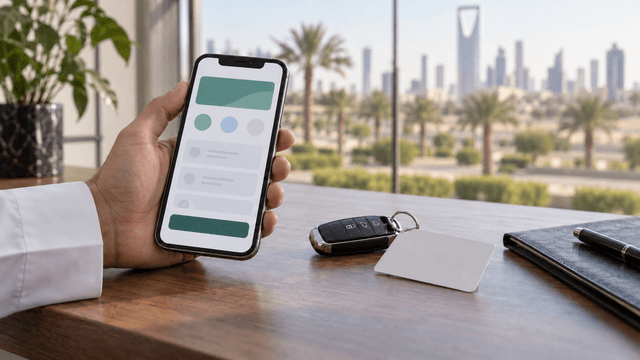
Vehicle Registration Renewal on Absher: Steps and Requirements
Table of Contents:
|
Vehicle registration renewal is available electronically through Absher vehicle services once the service requirements are met and the automated eligibility check is passed. Start by reviewing insurance, technical inspection and any required payments, then select the vehicle, choose registration renewal and confirm the transaction. Istimara means the vehicle registration here, not the person’s driving licence. This guide explains what to prepare and how to handle a renewal that cannot proceed, without confusing renewal with ownership transfer or an inspection booking.
What Is Vehicle Registration Renewal on Absher?
Renewal extends the registration of a previously registered vehicle. The official vehicle registration renewal page on the National Portal explains that the service is available electronically through Absher without visiting traffic offices, and that eligibility is checked automatically against the service requirements. Reaching the vehicle screen therefore does not establish that renewal is complete.
When checking an expiry date, first identify the document: a driving licence relates to the driver, while vehicle registration relates to the vehicle. This distinction matters when researching requirements; do not apply driving licence renewal conditions to registration renewal. Follow the service name shown in your account rather than an old screenshot of a different menu.
What Are the Vehicle Registration Renewal Requirements?
The official service page lists the following requirements. Use them as a checklist before starting, while also referring to what the service displays for your vehicle when you apply. A receipt or an old copy of a document is not a substitute for checking its validity and that it relates to the intended vehicle.
- Valid vehicle insurance: check the coverage dates and vehicle details, not just the purchase notification.
- A valid technical inspection certificate: distinguish an inspection appointment from an existing valid certificate.
- Payment of renewal fees and any late-renewal penalty, as required by the service, rather than relying on a widely quoted amount.
- Payment of any traffic violations: check the payment status rather than assuming that starting a bank transaction completes the process.
The required-documents tab also specifies an existing vehicle registration. This guide does not add requirements to upload photographs or other documents simply because somebody else encountered them; follow what the service actually requests. Because renewal eligibility is checked automatically, verify availability in your account rather than deciding based on a date quoted in an unofficial explanation.
How Should You Check Insurance, Inspection and Violations?
Start with insurance: open the policy details and check that the policy is valid and covers the same vehicle. To distinguish the type of cover from the validity of a policy, read about comprehensive versus third-party car insurance. Choosing cover that fits your needs is different from checking a renewal requirement; the name of the cover alone does not establish that an application will be accepted.
Next, review the inspection certificate. If you need to prepare for an appointment, use the periodic vehicle inspection preparation checklist to organise technical checks, not as proof of passing. Inspection is a separate process with its own result, not a renewal-screen button that substitutes for a valid certificate.
Then review violations and any payment requirements displayed. The guide to checking, paying and disputing traffic violations explains the related services. Do not confuse filing a dispute with satisfying the renewal payment requirement; rely on the displayed status and the relevant authority’s instructions rather than assuming another action removed the obstacle.
What Are the Steps to Renew Registration on Absher?
The following route follows the official service instructions. Read the details on each screen before moving on. If the menus appear in a different order in your interface, look for vehicle registration renewal under vehicle services rather than selecting another service because its name is similar.
- Log in to Absher through its official channel, then select Vehicles.
- Select Manage Vehicles from the services menu and review the vehicles shown in your account.
- Choose the vehicle whose registration you want to renew and check its details before proceeding.
- Select Renew Vehicle Registration; the system automatically checks eligibility against the service conditions and requirements.
- Review the information displayed, complete any requirements and select Confirm Renewal.
- Check for the successful renewal message, review the updated registration details and retain any transaction reference displayed.
Payment alone, or closing the screen, does not prove successful renewal. If your session ends before the result appears, return to the vehicle details and check what actually happened before repeating the steps. The aim is to confirm that the correct vehicle’s registration was updated, not simply to complete a sequence of clicks.
How Do Renewal, Ownership Transfer and Inspection Differ?
These services may relate to the same vehicle, but each serves a different purpose. Use the table to identify your starting point, then review the relevant service conditions separately. Do not assume completing one also completes another.
| Procedure | Purpose | What Does Not Prove Completion? |
| Registration renewal | Renew the vehicle registration | Buying insurance or booking an inspection alone |
| Ownership transfer | Transfer the vehicle to another owner | Registration renewal alone |
| Technical inspection | Inspect the vehicle and obtain its result | An appointment without the inspection taking place |
If your aim is to sell or buy the vehicle, review the Absher ownership transfer steps and sale conditions instead of treating renewal as a substitute for transfer. Organise your notes under separate headings: registration status, insurance status, inspection result and transfer transaction status when relevant. This helps avoid confusing different documents.
Why Can Renewal Fail to Proceed, and What Should You Do?
An unmet published requirement is a possible reason renewal cannot proceed, but it does not explain every message. Start with the text displayed in your account and review the item it identifies, rather than repeating the request or changing several things without understanding the issue.
- If the message concerns insurance or inspection, match the vehicle and validity dates against the relevant document and contact its issuer if the information conflicts.
- If it concerns payment, review the requirement, transaction status and receipt before paying again. Do not assume an amount or reason that the screen does not state.
- If eligibility is unclear or the renewal option is missing, review the current service conditions and vehicle details, then ask official support for clarification.
- If a technical message appears without explanation, note its text, the time and the stage reached. Reopen the service to check the result; do not describe it as a final rejection without confirmation.
When contacting support, explain where the process stopped and which documents you checked. Never share your password or verification code, and hide personal details in any screenshot you post. This is a way to organise follow-up, not a guarantee of processing time or acceptance.
Frequently Asked Questions About Vehicle Registration Renewal
- Is registration renewal the same as driving licence renewal? No. Registration, or Istimara, relates to the vehicle, while the driving licence relates to the driver. Check the service name before reviewing its requirements or using it.
- Is valid insurance enough to renew registration? No. Insurance is one requirement; the official page also lists a valid inspection certificate and payment requirements. Automated eligibility verification remains part of the renewal process.
- Is booking a periodic inspection enough? The published requirement is a valid technical inspection certificate. A booking is not that certificate and does not show that the vehicle passed the inspection.
- Must I visit a traffic office to renew? The official page describes electronic renewal through Absher without visiting traffic offices. If your case cannot proceed, follow the service message and support guidance rather than assuming a particular in-person procedure.
- How can I tell that renewal is complete? Check the successful renewal message and then review the registration details. The National Portal lists digital registration display and registration printing as related services; do not confuse accessing the document with carrying out renewal itself.
In short, prepare the vehicle requirements, renew the registration through Absher and verify the result. If the process cannot proceed, address the item identified in the message or request official clarification, without assuming fees, deadlines or exceptions that the service does not show.

Car Brand Logos and Names: A Guide to Badges in Saudi Arabia
Table Of Contents:
|
Car brand logos are the badges and names each manufacturer places on the front grille, the boot lid and the centre of the steering wheel, and the easiest way to learn them is to group them by country of origin: Japanese badges such as Toyota's three ovals, Korean ones such as Hyundai's slanted H, and Chinese brands, many of which spell out their full name in Latin letters, alongside German, European and American badges. In this guide you will find each brand's name as it is written and said, a short description of its badge, its meaning where it is documented, and a table for quick comparison.
What are car brand logos and where do you find them on a car?
A car badge (the logo or emblem) is the trademark that identifies the manufacturer, and it usually appears in several places:
- The centre of the front grille or the bonnet, the most visible spot for the logo.
- The boot lid, where the model name and sometimes the trim are usually written next to it.
- The centre of the steering wheel, the wheel caps and the car key.
Badges fall into two types: a standalone symbol such as a star, rings or a lion, or a name spelled out in letters, as with many American and new Chinese brands, and knowing this difference helps you recognise a car from a distance.
What are the best-known Japanese car brand logos?
Japanese badges are very familiar on the Kingdom's roads, and most are simple symbols that are easy to remember:
- Toyota: three ovals that form the letter T; the company says the two overlapping ovals represent mutual trust between the customer and the company, and the outer oval represents the global expansion of its technology.
- Lexus: a curved letter L inside an oval; it is Toyota's luxury vehicle division.
- Nissan: the name NISSAN across a thin circle; the name began as an abbreviation of the Japanese holding company Nihon Sangyo.
- Honda: a wide, upright letter H inside a frame with rounded corners.
- Mitsubishi: three red diamonds meeting at the centre, chosen by founder Iwasaki Yataro because they recalled the emblem of the Tosa clan that employed him and his own family crest.
- Mazda: a stretched letter M shaped like wings inside a circle; according to the company's website, the name is also linked to its founder, Jujiro Matsuda.
- Suzuki: a red letter S with sharp lines.
- Isuzu: the name ISUZU in bold letters; the name comes from the Isuzu River and means fifty bells.
What are the Korean car brand logos?
- Hyundai: a slanted letter H inside an oval; the Korean word means modernity.
- Kia: the word KIA in a sharp, angular script; according to the company, the name means rising from Asia.
- Genesis: two spread wings with a shield in the middle; it is the luxury brand of Hyundai Motor Group.
Which Chinese car brand logos are common in Saudi Arabia?
Chinese cars have become familiar in the Saudi market, and their best-known badges include:
- Changan: a shape like the letter V inside a circle; the name comes from the Chongqing Changan Arsenal and literally means long-lasting peace.
- Chery: an oval with a symbol resembling the letter A in the middle.
- Geely: the name GEELY is written in Latin letters on the rear of many of its models.
- Haval: the name HAVAL in large letters; it is a brand specialising in SUVs, owned by Great Wall Motor, which is named after the Great Wall of China.
- MG: the letters MG inside an octagon; it is a British marque founded in Oxford and owned today by the Chinese company SAIC Motor.
- BYD: the letters BYD in a bold typeface; the name had no particular meaning, and the company later adopted Build Your Dreams as a slogan matching its letters.
- Hongqi: a vertical red strip running from the bonnet to the grille on many of its models; the name means red banner, and it is the oldest Chinese passenger car brand, owned by FAW Group.
How do you recognise the new Chinese car brands?
Many Chinese brands have appeared in recent years, some cannot be recognised from the badge alone, and here are practical ways to tell them apart:
- Read the written name: many new brands spell out their full name on the grille or the boot instead of a standalone symbol, such as Jetour, Omoda, Jaecoo and Deepal.
- Know the parent company: Jetour, Omoda and Jaecoo belong to Chery, Deepal to Changan, Haval to Great Wall and Lynk & Co to Geely, and brands within one group may share some models or platforms.
- Learn what the name means: Jetour combines the words jet and tour, signifying a convenient journey according to the brand; the O in Omoda comes from oxygen and moda means modern, according to Chery; Jaecoo comes from the German word Jäger, meaning hunter, and the English word cool; and Deepal's Chinese name means deep blue.
- Do not rely on the badge alone: some brands have changed their logo more than once, and its look may differ from one model year to another, so confirm the manufacturer and model on the car's registration card.
- Check the VIN: its first characters identify the manufacturer, and it is recorded on the registration card and stamped on the car's body.
What are the German and European car brand logos?
European badges often rely on old symbols with well-known stories:
- Mercedes-Benz: a three-pointed star inside a circle, which for the original Daimler company symbolised Gottlieb Daimler's aim of motorisation on land, water and in the air.
- BMW: a circle divided into blue and white quarters inside a black ring bearing the company name; its colours recall the flag of Bavaria, while the idea that it is an aircraft propeller is a myth.
- Audi: four interlinked rings, each representing one of the four companies that joined to form Auto Union, Audi's predecessor.
- Volkswagen: the letters V and W inside a circle; the German name means people's car.
- Skoda: a winged arrow inside a circle; the arrow represents speed, the wings progress and freedom, and the eye precision; it is a Czech brand.
- Peugeot: a lion; the original logo was a lion walking on an arrow, symbolising the speed, strength and flexibility of Peugeot's saw blades; it is a French brand.
- Renault: a diamond-shaped lozenge that the French company has placed on the front of its cars since the nineteen-twenties.
- Land Rover: a green oval carrying the name of the British brand.
- Rolls-Royce: two interlocking letters R and the Spirit of Ecstasy mascot on the bonnet; the British company is a wholly owned subsidiary of the BMW group.
- Lamborghini: a raging bull, chosen by founder Ferruccio Lamborghini after he admired the fighting bulls at the Miura ranch in Spain; it is an Italian brand.
What are the American car brand logos?
American badges tend towards written names and simple shapes:
- Ford: a blue oval with the name Ford in white script.
- Chevrolet: the gold bowtie, whose origin is unsettled; the company's account says William Durant took it from a wallpaper pattern in a French hotel.
- GMC: the letters GMC, usually in red; it is a General Motors brand.
- Jeep: the word JEEP in plain letters, and many people know it by its grille with vertical slots.
- Dodge: the name DODGE in large letters on the grille or the rear.
- Lincoln: a four-point star inside a frame; it is a luxury brand owned by Ford and named after US President Abraham Lincoln.
Car brand logos table: brand, country of origin and badge description
A quick summary of each brand's badge:
| Brand | Country of origin | Badge description |
| Toyota | Japan | Three ovals |
| Nissan | Japan | Name inside a thin circle |
| Honda | Japan | Upright letter H |
| Mitsubishi | Japan | Three red diamonds |
| Hyundai | Korea | Slanted H in an oval |
| Kia | Korea | The word KIA in a sharp script |
| Changan | China | V shape inside a circle |
| Chery | China | A-like symbol in an oval |
| Jetour | China | Name in Latin letters |
| Haval | China | HAVAL in large letters |
| MG | Britain (Chinese owner) | MG inside an octagon |
| BYD | China | The letters BYD |
| Mercedes-Benz | Germany | Three-pointed star in a circle |
| BMW | Germany | Circle with blue and white quarters |
| Audi | Germany | Four interlinked rings |
| Volkswagen | Germany | VW letters in a circle |
| Peugeot | France | Lion |
| Ford | USA | Blue oval |
| Chevrolet | USA | Gold bowtie |
| GMC | USA | Red GMC letters |
Frequently asked questions about car brand logos
- How do I tell the Hyundai logo from the Honda logo? The Hyundai logo is a slanted letter H inside an oval, while the Honda logo is a wide, upright letter H inside a frame with rounded corners.
- Which car has a horse, bull or lion logo? The black prancing horse on a yellow background is the logo of Italy's Ferrari, the horse inside a coloured shield belongs to Germany's Porsche, the raging bull to Lamborghini and the lion to Peugeot.
- Is a brand's country of origin the country where the car is made? Not always; the country of origin is the brand's home, and its models may be built in other countries, so check the manufacturing details in the VIN and the registration card.
- Why do companies change their logos? Usually when they renew their identity, as Nissan, Kia and BYD have done in recent years, so you may see two logos for the same brand on cars from different years.
- How can I confirm a car's brand if its badge has been replaced? Some owners fit modified badges or the badge of another model, so rely on the registration card and the VIN rather than the badge, especially when buying a used car.
Car brand logos become easier to remember when you link each badge to its country and parent company, read the name written on the boot when in doubt, and check the registration card and the VIN before any purchase decision. You can browse the cars available at Saleh Cars Group to get to know the different brands and models.
Overheating Without Coolant Loss: Causes and Safe Action
Table of Contents:
|
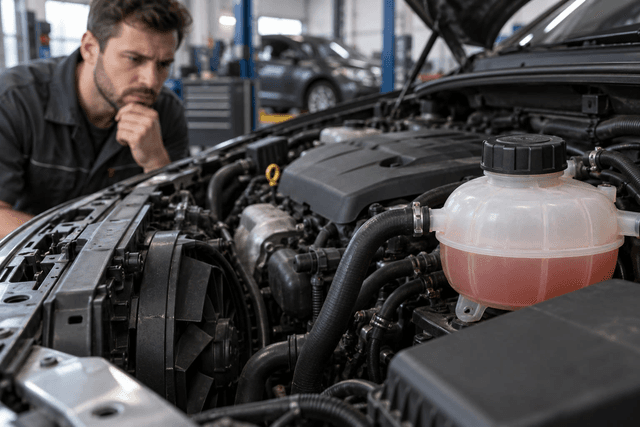
Overheating without coolant loss is possible: coolant visible in the reservoir does not prove that it circulates through the engine or releases heat effectively. The fault may involve coolant flow, airflow or cooling controls, and the temperature reading itself may also need checking. If an overheating warning appears, stop somewhere safe, switch off the engine and request assistance. Do not keep driving because the reservoir looks full.
Overheating Without Coolant Loss: What Does a Stable Level Mean?
The everyday expression water level refers here to engine coolant, not a recommendation to use plain water. This article focuses on a level that appears normal despite an overheating warning. For the wider picture, see the guide to engine overheating causes and what to do.
The reservoir’s role and the method for reading its level depend on the cooling-system design: it may be a pressurized part of the system or a recovery tank. Coolant also expands when hot, so comparing a hot reading with a cold one cannot establish system health. A visual reading within the marks on a cold engine, following the manual, tells you only about the level. It does not prove that passages are free of air or restrictions, or rule out a fault or a leak whose effects are not yet apparent.
How Can the Engine Overheat When Coolant Is Present?
The cooling system must move heat away from the engine and then transfer it to the air through the radiator. A failure at either stage can raise the temperature without an obvious drop in level. These are possibilities for inspection, not a shopping list of replacement parts:
- Fan or fan control: insufficient air may pass through the radiator while stationary. Seeing a fan turn once does not prove that its speed or all operating modes are correct.
- Thermostat: if it does not regulate coolant passage correctly, heat transfer to the radiator may be impaired despite an apparently adequate amount in the reservoir.
- Trapped air: air can interfere with coolant movement and heat transfer, particularly if the problem started after cooling-system work. The timing is a clue for the technician, not proof of a diagnosis.
- Insufficient pumping: the water pump may not provide the required flow. This does not necessarily produce a visible leak or an obvious noise that the driver can identify.
- Restricted heat exchange: internal restrictions in radiator passages or an external obstruction to airflow can reduce cooling. Reservoir level cannot distinguish between them.
- System pressure: a fault in the cap or components that retain pressure can affect the coolant’s resistance to boiling. Never test a cap by removing it while hot or guess at a different pressure rating.
For an explanation of circulation specifically, read about the water pump’s role in circulating coolant. Mentioning the pump does not make it the most likely cause in your car, and replacing it without checking the rest of the system may not solve the problem.
What Can Traffic and Highway Patterns Tell You?
Record only the conditions you already observed during previous use. Do not drive again or leave the engine running to reproduce overheating. The pattern can help a workshop organize its checks, but it is not a conclusive diagnosis:
| Previous observation | What might the technician check? | What does it not prove? |
| Temperature rises at a stop and eases when moving | Airflow, fan performance and fan control | It does not prove that only the fan is faulty |
| The warning appears on the highway or uphill | Coolant flow and heat exchange under load | It does not identify the pump or radiator specifically |
| It began after a coolant change or repair | Correct filling, trapped air and connections | It does not confirm trapped air without checks |
| It coincides with air conditioning use | Cooling performance as load and airflow change | It does not prove low AC refrigerant |
If the connection with AC use is your main observation, there is a separate explanation of engine overheating when the air conditioning is on. The key point here is that a normal coolant level cannot rule out a cooling fault, whatever the conditions when the warning appears.
Could the Temperature Reading Be Wrong?
A temperature sensor, its wiring or the display system may affect the reading. However, do not assume the warning is false because the reservoir is full or you cannot see steam. Some cooling faults show no obvious external sign at first. Treat the warning seriously until a qualified technician verifies the actual temperature and readings.
The technician compares diagnostic data and appropriate measurements with the vehicle’s specifications and operating conditions. A fault code alone cannot condemn a part, and the absence of a code does not prove that cooling is normal. There is also no single operating temperature for every car. Use the owner’s manual and vehicle-specific service information to interpret the gauge and warning message.
What Should You Do Safely When the Warning Appears?
- Move to the nearest safe stopping place away from traffic and use hazard lights as needed. Stop and switch off the engine. Do not try to drive to a workshop with an overheating warning.
- Stay clear of steam and spraying fluid. Never open a hot radiator or coolant reservoir cap, and do not assume that pressure has disappeared just because the gauge has fallen.
- Do not work near fans or put hands or tools in their operating area: a fan may start automatically even after the engine is switched off. Do not test it by hand or touch hot hoses.
- Do not pour cold water onto a hot engine or add fluid to a hot system. Request roadside assistance and arrange transport for inspection rather than repeatedly restarting the engine to see what happens.
Once the engine has cooled completely, you may record the level visible from outside the reservoir if this is possible and safe according to the manual, without removing caps or parts. A normal level or a warning that disappears after shutdown does not establish that the fault has gone or that continuing the journey is safe.
What Information and Checks Should You Discuss With the Workshop?
Tell the technician when the warning appeared: while stopped, climbing or travelling. Mention any preceding service work or fluid addition. Describe the message and any smell or steam you noticed from a safe position. Photograph the dashboard only after stopping, and do not reproduce the fault for documentation.
- Ask for the coolant level, specification and system condition to be checked, rather than accepting the reservoir is full as the entire assessment.
- Discuss fan operation and control, thermostat and pump function, and radiator flow as indicated by the diagnostic findings.
- Leave pressure and cap testing and air-removal procedures to the technician, using tools and methods appropriate to the system design.
- Ask what evidence identifies the fault and which check verified the repair before the car is handed back.
If initial checks do not identify the cause, broader diagnosis may be necessary. Do not jump to a head-gasket diagnosis, or rule it or another internal fault out solely because the reservoir level is stable. Testing should determine the next step.
Why Is Adding Water Not a Universal Fix?
If the level is within the correct limits, adding fluid will not repair a fan or restore impaired flow, and may exceed the permitted fill level. Use coolant meeting the vehicle’s specification and the concentration stated in the manual. Plain water is not a universal substitute, and color alone does not establish compatibility. Read about coolant differences and choosing a suitable fluid for more context.
Do not mix unknown products or experiment with additives to treat overheating. Flushing and air removal are not identical procedures on every vehicle; leave them to a professional when technically justified. Maintaining the correct level matters, but it is only one part of system health, not a replacement for checking performance.
Frequently Asked Questions About Overheating With a Stable Level
Does a full reservoir mean the radiator is full?
Not necessarily; it depends on the system design and condition. The visible level alone does not prove correct filling or circulation, and never justifies opening a hot cap.
Does the absence of a leak rule out pump failure?
No. Leakage is not the only possible sign of a pump fault. Its ability to circulate coolant needs appropriate assessment, not just a look underneath the car.
Can I drive if the gauge drops after stopping?
A lower reading does not prove the fault has gone. After an overheating warning, do not resume driving to test the car; request assistance and inspection before using it again.
Should I remove the thermostat to solve the problem?
Do not remove the thermostat as an experiment: it is part of cooling regulation. A technician should assess it and fit the correct replacement if necessary.
Does overheating without coolant loss mean a faulty sensor?
No. The overheating can be real despite a stable level. Do not ignore the warning or disconnect the sensor; have the reading and system performance checked together.
Conclusion: Check Cooling Performance, Not Just the Level
A stable coolant level neither rules out overheating nor identifies its cause. Stop safely at a warning, switch off the engine, avoid hot caps and fans, and give your observations to a qualified technician. A sound repair starts with evidence of the fault, not extra water or random parts replacement.

Driving License Renewal on Absher: Requirements and Steps
Table of Contents:
|
Driving license renewal in Saudi Arabia is done electronically through the Absher platform under traffic services, without visiting traffic offices, provided you complete the regulatory requirements such as paying the fees and completing a medical examination. This electronic service covers private driving licenses and motorcycle licenses only, and the remaining validity of the license must be less than 365 days. This guide explains the requirements as shown on the official service page at the time of writing, the renewal and delivery steps, why a request may not proceed, and how it differs from renewing the vehicle registration (Istimara).
What Is the Driving License Renewal Service on Absher and Who Can Use It?
The driving license renewal page on the National Portal describes a service that lets individuals renew their driving license electronically, easily and efficiently, without visiting traffic offices. It lists the service duration as immediate and the delivery channels as the website portal and smartphone apps. The Absher service guide defines the beneficiary as a citizen or resident who is registered and activated on the Absher platform.
So first make sure your Absher account is active and that you can log in, then check your license type. According to the prerequisites tab, the service covers renewing private driving licenses and motorcycle licenses only. If your license is of another type, do not assume this service will accept it; ask the official traffic channels about the right procedure for your case.
What Are the Published Driving License Renewal Requirements?
The official service page lists the following requirements. Use the table as a checklist before logging in to Absher, while following what the service displays for your case when you apply. Requirements may be updated, and the service page at the time you apply is the reference.
| Requirement as Shown on the Service Page | What to Check Before Starting |
| A private or motorcycle driving license | The license type recorded in your details |
| Payment of license renewal fees through government payments via banks | That payment was actually made for the correct service, not just that a payment screen was opened |
| Payment of traffic violations, if any | The status of any violations recorded against you before applying |
| Remaining license validity of less than 365 days | Your expiry date, using the driving license information service |
| A medical examination through a certified medical center | That the examination was done at a certified center |
The required documents tab repeats payment of any violations, payment of the renewal fees and the medical examination, and does not mention uploading photos or extra papers. Do not rely on circulated lists that add unpublished documents. If you have violations, review how to check and pay traffic violations before starting the renewal.
What Are the Steps for Driving License Renewal on Absher?
The following steps are taken from the service page on the National Portal. If the menus look different in your interface, look for the driving license renewal service under traffic services, and do not choose a similarly named service such as vehicle registration renewal.
- Log in to the Absher platform.
- Select “My Services”.
- Choose “Traffic” from the services list.
- Select the “Renew Driving License” service.
- Read the service description, terms and conditions, then select “Next”.
- Review your personal information, specify the renewal period (2 years, 5 years or 10 years), then select “Confirm Renewal”.
- Fill in your National Address details for license delivery.
- Review the entered data.
- Pay the delivery fees using a card (Visa, Mada, Mastercard).
- A message confirms that the driving license renewal is completed.
Note that the payment inside these steps is for delivery. For the renewal fees themselves, the prerequisites tab says they are paid through government payments via banks. This guide does not state amounts for any period; follow what the service shows for your case. Before filling in the address, make sure your National Address is correct, because it is used for the license delivery request.
Closing the screen or completing a payment alone does not prove the renewal is complete. Check for the success message, then review your license details before repeating any step if your session was interrupted.
Why Can License Renewal Fail to Proceed, and What Should You Check?
The service page does not publish a list of error messages, but the published requirements help you identify which item to review. Always start with the text of the message shown in your account, then compare it with the following possibilities:
- The remaining validity of the license is not less than 365 days; check the expiry date through the driving license information service.
- The renewal fees have not been paid or the payment has not appeared yet; review the transaction status and receipt before paying again.
- There are unpaid traffic violations; do not assume that filing a dispute replaces this requirement before its outcome is clear.
- There is no medical examination from a certified medical center.
- The license type is not covered, because the service is limited to private and motorcycle licenses.
- The account is not registered or activated on Absher, since the service guide defines the beneficiary as a registered and activated user.
If the message is unclear, note its text, the time of the attempt and the stage where you stopped, then contact the official support channels shown on the service page. Never share your password or verification code with anyone, and do not treat a failed attempt as a final rejection without confirmation from the competent authority.
How Does Driving License Renewal Differ From Istimara Renewal?
The two documents are often confused because both are called a license. The driving license belongs to the driver, while the Istimara is the vehicle registration and relates to the car itself. Each therefore has its own Absher service and its own requirements, so do not apply the conditions of one to the other.
The medical examination and the remaining license validity are published requirements for driving license renewal and have nothing to do with the condition of your car. If what you need to renew is the vehicle document, follow the guide to vehicle registration renewal on Absher and why it may fail, which explains that service’s requirements and steps.
Likewise, vehicle insurance does not appear among the driving license renewal requirements on the service page. If you are reviewing your car insurance at the same time for other reasons, read about comprehensive versus third-party car insurance to choose a suitable policy.
Frequently Asked Questions About Driving License Renewal
Can I renew my driving license without visiting a traffic office?
Yes, according to the official service page: the service is electronic through Absher without the need to visit traffic offices, provided the regulatory requirements are completed. If your case cannot proceed, follow the service message and the competent authority’s guidance.
How early can I renew my license before it expires?
The prerequisites tab requires the remaining validity of the license to be less than 365 days. You can check your license validity electronically through the driving license information service listed among the related services.
Is a medical examination required for driving license renewal?
Yes. The official page lists a medical examination through a certified medical center among both the prerequisites and the required documents. Complete the examination at a certified center before starting the service.
What renewal periods are available?
The service steps mention choosing the renewal period of 2 years, 5 years or 10 years while reviewing your details. Choose from the options shown to you and review what applies to each option as displayed in the service.
How do I receive my license after renewal?
The steps include filling in your National Address details for license delivery and then paying the delivery fees by card. The National Portal also lists a digital driving license display service among the related services, which is separate from renewal.
Conclusion
Prepare the driving license renewal requirements first: pay the fees and any violations, complete the medical examination at a certified center, and confirm that the remaining validity meets the published condition. Then follow the steps on Absher and check for the success message. If the request cannot proceed, address the item identified in the message or request clarification through the official channels.
Accident Damage Assessment in Saudi Arabia: Taqdeer Guide
Table of Contents:
|
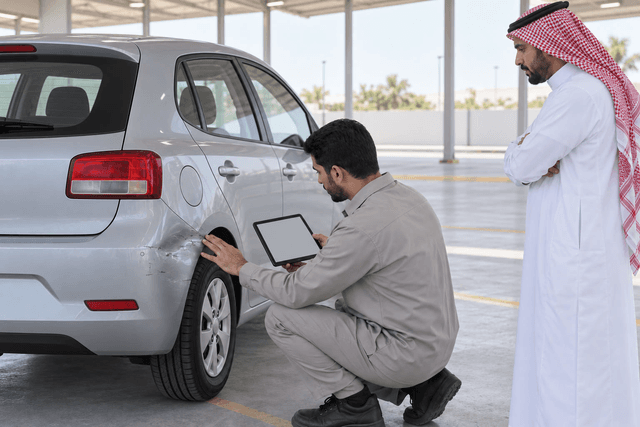
Accident damage assessment is a step you may need after a Najm or traffic police report. According to the Saudi Authority for Accredited Valuers (TAQEEM), it means determining the cost of repairing the vehicle, including parts, or estimating its market value before or after the damage. These assessments are managed electronically through the Taqdeer system, which operates under the Authority’s supervision and lets you book an appointment and check the status of your assessment. This guide covers the stage after the report: when to seek an assessment, what to prepare, how to read the report and review it with your workshop and insurer, and what to do if you disagree with the result.
What Is Accident Damage Assessment and Who Oversees It?
On its official English website, TAQEEM describes vehicle damage assessment valuation as “the act or process of determining the value of repairing the vehicle including the spare parts, or estimating the market value of the vehicle before and after the accident”; the Arabic version also mentions labour explicitly. The outcome may therefore be a repair cost, or a market value before or after the damage, depending on the case.
TAQEEM describes Taqdeer as “an online integrated system for managing, operating, and organizing vehicle damage assessment processes” and lists “Book an appointment at Taqdeer centers” among its services. The Taqdeer system website (in Arabic) states that it operates under the supervision of the Saudi Authority for Accredited Valuers. An assessment is a technical valuation of the damage; it is neither the accident report nor your insurer’s decision.
When Do You Need an Assessment After a Najm or Police Report?
The sequence starts with attending to and documenting the accident. If you have not completed that stage, begin with the guide to Najm reporting steps and when to call the traffic police, then return to this guide.
The official pages we relied on do not state that an assessment is required for every accident, nor do they describe the content of report messages. Follow what the accident report and your insurer require in your case, and ask before any repair starts, because repairing damage before it is assessed may cost you the chance to document it as it was. Useful questions for your insurer:
- Does my case need a damage assessment, and from which body?
- Is the electronic report enough, or must it be sent in a particular way?
- Should I wait for the assessment before taking the car to a workshop?
- Which documents do you need with the report to progress the claim?
How Do You Book a Taqdeer Appointment and Track It?
The Taqdeer website presents the service in three consecutive stages, which can be summarised as follows:
- Book an appointment and go to the assessment center, using the booking service, which the site describes as booking a new appointment to assess your vehicle’s damage.
- Have the vehicle damage assessed at the assessment center.
- Receive the report electronically, with the option to follow it through the report status service, which lets you check the status of your assessment.
If your plans change before the appointment, the manage bookings service allows you, according to the site, to modify or cancel the booking, and the assessment centers page helps you find the nearest centers in your city. We do not mention numbers of centers, timings or fees here; follow what the service shows for your case when you book.
What Should You Prepare Before Visiting an Assessment Center?
The pages we reviewed do not publish a document list, so the list below is practical rather than an official requirement; what the booking screen and center ask for takes precedence:
- Your booking details as shown once the booking is complete.
- The accident report reference from Najm or the traffic police.
- Your ID and the vehicle registration; ask what is needed if you are not the vehicle owner.
- Unedited photos of the damage taken at the time of the accident.
- Your insurance policy details and the party handling the claim.
Do not repair the damage being assessed before the appointment unless the relevant authority tells you to, and do not drive an unsafe car; arrange transport if you notice a leak, a red warning light or a steering fault.
How Do You Read a Damage Assessment Report?
The report format may vary from case to case, but the Authority’s definition shows what it centres on: labour, spare parts, or market value before or after the damage. Use the table to review it item by item:
| Item | What to Check | What to Ask |
| Vehicle and accident details | The car and the accident reference match | Do these details relate to my car and this accident? |
| Spare parts | The listed parts compared with the documented damage | What type of part does the assessment assume? |
| Labour | Listed work such as bodywork and paint | Does the work cover all the damage I documented? |
| Market value | Whether a value before or after the damage is stated | On what basis was this value reached? |
To understand how the type of part affects a repair, see genuine vs aftermarket vs used car parts. Do not assume the report specifies the type of part unless it says so explicitly; ask about it.
How Do You Review the Assessment With Your Workshop and Insurer?
The assessment sets a value, while the compensation and repair path is governed by your policy and your insurer. Check your policy type and what it covers in the guide to comprehensive versus third-party car insurance, and do not assume that the assessed amount is what you will receive in every case.
- Show the report to the workshop before work starts and ask them to compare its items with what they will actually do.
- If hidden damage appears after disassembly, ask your insurer how it will be handled before the repair continues.
- Ask the workshop for an itemised invoice and photos before and after the repair.
- Record every contact with your insurer: the date, the person and what you were asked for.
If the car needs sensor or camera calibration after the repair, ask whether it is included in the assessment or in the workshop’s quote.
What Should You Do If You Disagree With the Assessment?
We did not find a published objection mechanism for assessment results on the official pages we reviewed, so we do not describe a specific procedure. The right step is to ask the source about the official procedure:
- Identify exactly which item you disagree with: a part, a piece of work or a market value.
- Gather supporting evidence: accident photos, the workshop’s notes after disassembly and any invoice.
- Contact Taqdeer through the support and help channels shown on its website and ask what procedure is available for your case.
- Also ask your insurer about its review procedure and what it needs from you in writing.
Do not accept a settlement you disagree with before you understand its consequences, and ask for written replies where possible.
Why Should You Keep the Assessment Report After the Repair?
The report and invoice help you later when you sell the car or when a buyer asks about the accident. The guide to reading a Mojaz report and its limits explains how accident records in a vehicle history should be understood and what cannot be concluded from them.
If you are a buyer looking at a car with signs of repair, ask for the assessment report and invoice if they exist, and use the guide on how to tell whether a car has been repaired alongside an independent technical inspection.
Frequently Asked Questions About Accident Damage Assessment
Is an accident damage assessment the same as a Najm report?
No. The report documents the accident, while the assessment estimates the repair cost or the market value of the vehicle before or after the damage.
Do I need an assessment for every accident?
Do not rely on a general rule; follow what the accident report and your insurer require in your case, and ask them before repairing the car.
How can I check the status of my assessment report?
The Taqdeer website offers an assessment status inquiry service and lists receiving the report electronically as one of the service stages.
Can I change or cancel my assessment appointment?
The website offers a manage bookings service for changes and cancellations; follow what the service shows for your booking.
Is the assessed amount the final compensation?
Not necessarily. Compensation depends on your policy and your insurer’s procedures, so ask your insurer how it is calculated in your case.
Conclusion
After the report, ask your insurer what your case needs, book the assessment through the official system and read the report item by item before any repair. If you disagree, ask Taqdeer and your insurer about the official procedure, and keep your documents for the future.
Choosing a Car Battery: Size, Capacity, Type and Installation
Table of Contents:
|
Choosing a car battery starts with confirming that the battery really is the cause of the problem, then matching what the owner’s manual or the current battery label specifies: size and mounting, terminal orientation, capacity in Ah, cold cranking amps (CCA) and battery technology. After that, check the manufacture date and warranty terms, and make sure installation is done properly, which may include registering the battery in the car’s system. This guide explains each step in general terms; your owner’s manual and a qualified technician remain the reference for your car’s specifications.
When Should You Start Choosing a Car Battery?
Do not buy a battery just because the car failed to start once. Weak starting can be linked to the battery, but also to the starter motor, the connections or the charging system. Ask a specialist to test the battery and charging system with suitable equipment, and review the car battery failure symptoms and how to test them to recognise signs worth checking.
If the engine cranks normally but does not start, the battery may not be the cause; see the guide on an engine that cranks but will not start. If the battery keeps going flat, there may be a hidden electrical drain in the car, and fitting a new battery without fixing the cause may simply pass the problem on to it. Once testing confirms the battery, prepare the following before visiting the seller:
- A clear photo of the current battery label showing all printed details.
- The battery specification page in the owner’s manual, if available.
- Whether the car has an automatic engine stop-start system.
- Where the battery sits: engine bay, boot or under a seat.
Which Specifications Should Match the Manual or Label?
The first reference is the owner’s manual, then the label of the original battery if it is still fitted. The table below summarises what to compare before paying and where to find it.
| Item | Where to find it | Why it matters |
| Size or group | Owner’s manual or current battery label | Defines overall dimensions and fit on the tray |
| Mounting dimensions | Battery tray and hold-down clamp | A poorly secured battery vibrates and can be damaged |
| Terminal orientation | Position of the positive and negative terminals on the current battery | A different layout may stop cables reaching or strain them |
| Capacity (Ah) | Label or owner’s manual | Indicates the energy stored in the battery |
| Cold cranking amps (CCA) | Label | Indicates the battery’s ability to deliver starting current |
| Technology type | Label and owner’s manual | Must suit the charging system and any stop-start system |
Two batteries can look alike yet differ in terminal orientation, height or mounting lip. Ask the seller to compare the new battery directly with the old one. If the current label differs from the manual, the previous battery may not have matched in the first place; rely on the manual or ask the dealer or a qualified technician.
What Do Capacity (Ah) and Cold Cranking Amps (CCA) Mean?
Capacity in Ah describes how much energy the battery stores, which matters when the battery powers the car’s systems with the engine off. Cold cranking amps (CCA) describe the battery’s ability to deliver a high current at the moment of starting in cold conditions, according to a specific test standard.
A label may state CCA according to a different standard from another battery, so only compare two figures measured to the same standard, and ask the seller to clarify. The general rule is not to go below the car’s specified capacity or current.
On the other hand, a higher figure is not automatically better; what matters is that the battery keeps the correct size and technology. In cars that record battery data in their system, the actual capacity of the new battery may need to be entered during registration, so tell the technician about any difference from the original.
What Is the Difference Between Flooded, EFB and AGM Batteries?
The general idea of each type is as follows, while the manual decides what your car needs:
- Conventional flooded battery: common in cars without an automatic stop-start system; some serviceable types need the electrolyte level checked.
- EFB battery: an enhanced flooded battery built to withstand repeated starting and discharge cycles better than a conventional one, used in many cars with stop-start systems.
- AGM battery: the electrolyte is absorbed in glass fibre mats and the battery is sealed; it copes better with electrical loads and repeated discharge, and is used in cars with higher electrical demands.
In a car with automatic stop-start, the battery handles frequent engine restarts and powers systems while the engine is stopped. Fitting a lower technology than specified, such as a conventional flooded battery instead of EFB or EFB instead of AGM, may weaken system performance, shorten battery life and trigger warning messages. Moving to a higher technology should only happen if the owner’s manual or the dealer allows it.
If the battery sits inside the cabin or boot, the manufacturer may specify a sealed type or a particular vent outlet; do not fit a different battery in that location without confirming that it matches.
How Do You Read the Manufacture Date and Warranty Terms?
The manufacture date usually appears as a code printed on the lid or case or on a small sticker, and the code format differs between manufacturers, so ask the seller to explain the code on the battery itself, and prefer the most recently made battery among the matching options.
A battery stored for a long time may lose some charge, so ask whether the seller tested it before sale. For the warranty, read the written terms on the invoice or warranty card rather than relying on a verbal promise, and pay attention to the following:
- What the warranty covers, how a fault is proven, and whether the battery must be tested by the seller.
- Whether installation elsewhere, or fitting the battery to a car it does not match, affects the warranty.
- Which documents are needed for a claim; keep the invoice somewhere easy to find.
How Does Saudi Heat Affect Your Battery Choice?
High temperatures speed up the reactions inside a battery and may increase fluid loss and ageing of the internal plates. This does not mean choosing a battery simply because it is marketed for heat; it means sticking to the correct specification and technology and choosing a recently made battery.
After installation, help the battery by parking in the shade where possible, keeping the terminals clean and checking the battery and charging system during routine maintenance. For more on how heat affects the car in general, read the summer car care guide for Saudi heat.
What Should You Consider When Installing the New Battery?
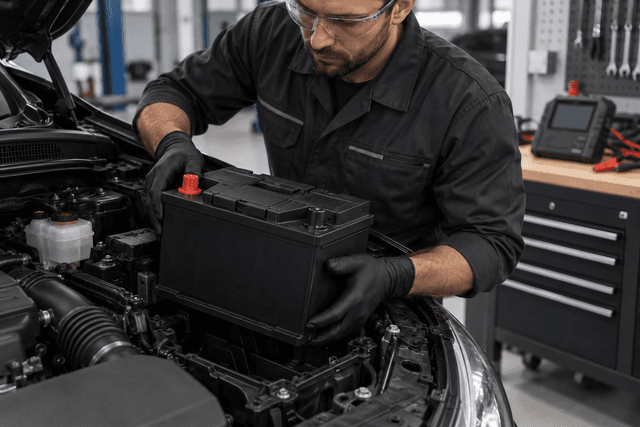
If you are not confident about the steps, leave the installation to a qualified technician. If you fit it yourself, wear eye protection and gloves, switch the engine off and keep the key away, disconnect and reconnect the terminals in the order given in the owner’s manual, avoid letting a metal tool touch both terminals, and keep any sparks or flames away from the battery.
- Battery registration: some cars require the new battery to be registered in the energy management system with a diagnostic tool so that charging is adjusted for a new battery. Ask the technician whether your car needs this.
- Saving settings: disconnecting the battery may erase settings such as the clock and radio, and some systems may need resetting according to the manual. Some technicians use a memory saver during the swap.
- Clean terminals: remove corrosion from the terminals and cable ends, and check that the clamps are sound before connecting.
- Secure mounting: fix the battery with its hold-down clamp so it cannot move, tighten the terminals without excessive force, and refit the protective covers.
After installation, start the car and watch for any warning message. If one appears, return to the technician to check the installation and registration rather than trying to clear the warning yourself.
How Do You Dispose of the Old Battery Safely?
A battery contains acid and lead, so do not open it, drain it or put it in household waste. Keep it upright, protect its terminals from contact, and hand it to the seller, a workshop or a party that accepts used batteries for recycling. If it is cracked or leaking, do not touch it with bare hands and ask the workshop to handle it.
Frequently Asked Questions About Choosing a Car Battery
How can I tell a battery fault from a starter fault?
Slow cranking with dim lights may point to the battery, while a click with bright lights may point to the starter motor. These are indications, not a diagnosis, so have the battery and charging system tested and review the signs of a failing starter motor before buying.
Can I fit a battery with a higher capacity than the original?
It may be possible in some cases if the size and technology still match, but the decision rests with the owner’s manual and the technician, especially in cars that record battery data in their system.
Can I fit a conventional battery to a car with stop-start?
This is not recommended; use the technology specified in the manual, such as EFB or AGM, because a lower technology may not withstand the frequent restart pattern.
Do all cars need the new battery to be registered?
No, but some cars require it using a diagnostic tool. Ask the technician or check the manual before installation, and do not assume the swap is complete once the terminals are connected.
What should I do with the old battery after replacing it?
Do not open it or throw it away with household waste. Keep it upright and hand it to the seller, a workshop or a party that accepts used batteries for recycling.
Conclusion
First confirm that the battery is the problem, then match size, terminals, capacity, CCA and technology to the owner’s manual, and check the manufacture date and warranty terms. Leave installation and registration to a technician if you are unsure, and dispose of the old battery safely.