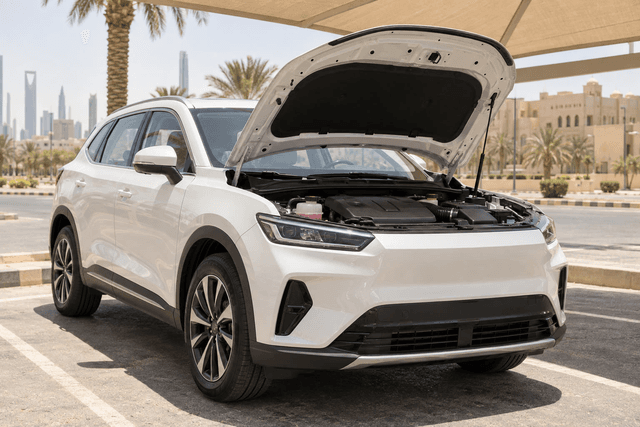
Summer Car Care: Protecting Your Car in Saudi Heat
Table Of Contents:
|
Summer car care means focusing on the systems that heat strains the most: check the cooling system and radiator coolant, the battery, tire pressure, AC performance, and engine oil before the peak of the heat, and protect the paint and cabin from direct sun. The Kingdom's long summer, with its high temperatures, dust, and desert trips, doubles the strain on the car, and most summer breakdowns can be avoided with a simple, regular review. In this guide, we show you what to check and how to act if a problem appears on the road.
Why does your car need special care in the Saudi summer?
Air and asphalt temperatures rise sharply in the summer months, so the car's systems work in harsher conditions than usual, and the strain on them increases with traffic, hours of AC use, and long trips.
- The engine and cooling system work harder to get rid of heat, especially in traffic and during long stops with the AC running.
- Heat speeds up the evaporation of battery fluid and the corrosion of its terminals, shortening its life even if it seems fine.
- Hot asphalt raises tire temperature and internal pressure, and magnifies the effect of any weakness or crack in them.
- Direct sun and dust affect the paint, dashboard, seats, and glass.
- Any small fault becomes more serious in summer, because breaking down on a highway at midday is unpleasant and can be dangerous.
How do you protect the engine and cooling system from the heat?
The cooling system is the first line of defence in summer, and neglecting it is one of the most common causes of costly breakdowns in this season.
- Check the coolant level in the reservoir with the engine cold, and never open the radiator cap while the engine is hot.
- Use the type of coolant recommended in the owner's manual rather than plain water, and learn about the difference between red and green radiator coolant before topping up or mixing.
- Look at the radiator hoses: cracking, swelling, or excessive softness are signs that they need replacing.
- Make sure the radiator fan runs when the temperature rises or the AC is on, and clean insects and dust off the front of the radiator.
- Keep an eye on the temperature gauge on the dashboard; if it rises repeatedly, read about the main causes of car engine overheating and deal with the cause early.
- Stick to the engine oil change schedule in the owner's manual, as oil endures higher temperatures in summer and needs to be in good condition.
How is the heat linked to a weak battery, and how do you look after it?
Many people believe that batteries only struggle in winter, but summer heat speeds up their internal wear, and the weakness then appears suddenly at the first hard start.
- Have the battery tested by a technician or parts shop before summer, especially if it has been installed for a long time.
- Clean white or green corrosion off the terminals, and make sure the cables are tightened properly.
- Watch for a slow-cranking starter or dim lights, as these are early signs of weakness.
- Try to park the car in the shade whenever possible, as this reduces the heat in the engine bay.
- To learn the signs in detail and ways to extend its life, see our article on car battery failure symptoms and how to extend its life.
How do you keep the AC working efficiently in summer?
In summer, the AC is not a luxury, and any weakness in it shows quickly as temperatures rise; servicing it early before the season is easier than repairing it at the peak.
- When getting into a car that has been parked in the sun, open the windows slightly for the first minute to let the hot air out, then close them and switch on the AC.
- Replace the cabin air filter on time, as a filter clogged with dust weakens airflow and causes an unpleasant smell.
- If the air becomes less cold than usual, the cause may be low refrigerant, a leak, or a weak condenser fan, and it needs a technical check.
- Pay attention to any strange noise when the compressor engages, or the engine stalling at idle with the AC on.
- To understand AC faults and how to fix them in detail, read our article on the car air conditioning system and its faults.
How do you protect the tires from hot asphalt?
The tire is the only part that touches the hot asphalt directly, so it needs closer monitoring in summer, especially before a trip.
- Check the air pressure in the morning when the tires are cold, and set it to the value on the driver's door sticker.
- Do not let air out of a tire because it is hot after driving; the rise in pressure with heat is normal and accounted for.
- Check the sidewalls for cracks or bulges, as old rubber is affected more by sun and heat.
- Check the manufacturing date printed on the tire's sidewall, and consult a technician if the tire is old even if the tread looks good.
- Do not exceed the car's permitted load on summer trips, as overloading raises tire temperature.
- Do not forget to check the spare tire and the tools for changing it before any long trip.
How do you protect the paint and cabin from the sun?
Strong sunlight affects the car's appearance and value over time, and simple daily protection is better than repairs later.
- Park the car in the shade or under a canopy whenever possible, and use a suitable cover when parking for long periods.
- Place a sunshade on the windscreen to reduce cabin heat and protect the dashboard from cracking.
- Suitable window tint reduces the heat inside the cabin and protects the seats; learn about how the right window tint protects your car.
- Wash the car early in the morning or in the evening, and do not wash it while the surface is hot in the sun, so water spots do not remain.
- Rinse the dust off with water first after sandstorms, and do not wipe it off dry so it does not scratch the paint.
- Do not leave lighters, aerosol cans, plastic water bottles, or electronic devices inside the car, as extreme heat may damage them or make them dangerous.
What should you do if your car overheats while driving?
If you notice the temperature gauge rising or steam coming from the front of the car, acting calmly and quickly reduces the damage to the engine.
- Switch off the AC immediately; you can temporarily run the heater at its highest setting to draw some heat away from the engine.
- Stop in a safe place away from the traffic lanes, and switch on the hazard lights.
- Turn off the engine if the gauge keeps rising or steam appears, and do not keep driving with the gauge in the red zone.
- Do not open the radiator cap or the coolant reservoir while the engine is hot, and wait until it has cooled down completely.
- Once the engine has cooled, check the coolant level and look for an obvious leak, then head to the nearest workshop or call for help.
Frequently asked questions about summer car care
- Does running the AC all the time harm the engine? No, if the cooling system is in good condition, but it adds load on the engine and battery, which is why maintenance matters more in summer.
- Should I change the engine oil earlier in summer? Follow the schedule in the owner's manual, and use the severe-conditions schedule, if there is one, if you drive a lot in traffic and extreme heat.
- Can I put plain water in the radiator when necessary? Only in an emergency and to reach the nearest workshop, then refill the system with the recommended coolant.
- Can tires burst because of the heat? Heat alone does not usually cause this, but it multiplies the risk of underinflated, old, or cracked tires.
- When should I check the car before a summer trip? A few days before the trip, so there is enough time to fix any issue with the cooling system, tires, or battery.
Summer in Saudi Arabia is a real test for every car, but most of its breakdowns start with small signs that can be noticed early. Review the cooling system, battery, tires, and AC before the peak of the heat, protect the paint and cabin from the sun, and never ignore the temperature gauge or any strange noise; with these simple habits, the summer months pass without surprises on the road.
New Car Buying Guide: Steps and Tips Before You Sign
Table Of Contents:
|
To buy a new car with confidence and without surprises, set your full budget rather than just the car's price, choose the body type and trim that suit your daily use, take a test drive yourself, ask for a written quotation that clearly states the warranty and everything the price includes, and inspect the car carefully before taking delivery. In this guide we explain these steps in order, from planning to the first service, keeping in mind the needs of drivers in the Kingdom, from summer heat to long highway trips between cities.
How do you set your budget before buying a new car?
A realistic budget does not stop at the car's showroom price; it includes everything you will pay to own and run it during the first years.
- The price of the car itself, making sure whether it includes tax, registration, and plates or not.
- Insurance, whose cost varies with the type of car and the type of cover you choose.
- Monthly fuel consumption based on the distance you usually drive and the size and type of the engine.
- Scheduled maintenance, oil changes, tires, and battery replacement over the medium term.
- Extras you may want, such as window tint, paint protection, and floor mats.
- The payment method: paying in cash differs from paying in installments in the total you end up paying, so calculate the full cost in both cases.
What type of car suits your use?
Start from how you will use the car, not from how it looks; the right car for an employee commuting within the city differs from the right car for a large family that often travels between cities.
- A sedan usually suits daily use in the city, is easy to park, and its fuel consumption is typically moderate.
- SUVs offer more space and ground clearance, suit families and trips, and some come with four-wheel drive for those who head out to the desert.
- A pickup suits those who need to carry cargo or do field work, but it is usually less comfortable for everyday city driving.
- The number of seats matters if your family is large; some cars offer a third row of seats, so check the trunk space when it is in use.
- Powertrain: petrol, hybrid, or electric, each with its pros and cons; learn about the difference between hybrid and electric cars before you decide.
- If saving fuel is a priority for you, check our list of the best fuel-efficient cars to narrow down your options.
How do you compare a car's trims and specifications?
A single model usually comes in several trims that differ in equipment and engine, and the gap between them can be significant in both price and everyday use.
- Ask for the specification sheet of the exact trim you will buy, and do not rely on photos or ads of a higher trim.
- Put safety systems ahead of luxuries: airbags, ABS, stability and traction control, the reversing camera, and parking sensors.
- Check the strength of the AC and whether there are rear AC vents if you carry passengers in the back seats, as this matters in the Kingdom's summer.
- Compare the transmission type and engine size with what suits your driving on highways and inclines.
- Pay attention to the size of the rims and tires; larger sizes may look better but can cost more to replace, and make sure there is a spare tire.
- Do not pay for features you will not use; choose the trim that covers your actual needs.
What should you check during a test drive?
- Adjust the seat, steering wheel, and mirrors, and make sure visibility in all directions is comfortable and clear.
- Drive the car on a road you usually use, in the city and on a highway if possible.
- Notice how smoothly the transmission shifts and how the accelerator responds when speeding up and overtaking.
- Test the brakes and steering at low speeds and when parking, and listen for any unusual noises or vibrations.
- Run the AC at full power and notice how quickly it cools and how noisy the cabin is.
- Bring your family along if you can so they can try the rear seats, ease of getting in and out, and fitting child seats.
What should you read in the quotation and warranty before signing?
- Ask for a written quotation that states the model, trim, model year, and color, and everything the price includes.
- Make sure agreed extras such as tint or floor mats are written into the quotation, and do not settle for verbal promises.
- Read the warranty terms: its duration and the distance it covers, the parts included and excluded, and the conditions for keeping it valid, such as sticking to the service schedule.
- Ask about free service packages if any, roadside assistance, and the service centers near you.
- Confirm the expected delivery date, and who handles registration, plates, and insurance.
- Check the current car offers before signing, as you may find extra benefits on the model you want.
What should you inspect on a new car before taking delivery?
Even a new car can pick up a scratch or a minor defect during shipping or storage, so set aside enough time to inspect it before signing for delivery.
- Inspect the paint in daylight for scratches or color differences, and check that the gaps between doors and fenders are even.
- Match the vehicle identification number (VIN) on the car with the number written on the documents.
- Make sure the odometer reading is low and consistent with a new car.
- Test all electrical systems: lights, windows, screen, camera, sensors, and AC.
- Check the manufacturing date and condition of the tires, and that the spare tire and tool kit are present.
- Make sure you receive the owner's manual, the warranty booklet, and the spare key, and that no warning light stays on in the dashboard after starting.
What are the common mistakes when buying a new car?
- Buying on emotion or because of an ad before making sure the car suits your actual needs.
- Focusing only on the monthly installment and ignoring the total you will pay.
- Ignoring running costs such as fuel, insurance, and maintenance.
- Signing before reading the full contract and warranty terms.
- Skipping the test drive or settling for a short loop around the showroom.
- Taking delivery at night or in a hurry without inspecting the car properly.
How do you care for your new car in the first months?
- Read the owner's manual, and follow any recommendations for the early driving period if the manufacturer mentions them.
- Keep to the first service appointment and the regular maintenance schedule to keep the warranty valid.
- Keep all maintenance invoices and records; they matter for the warranty and for the car's value when you sell it later.
- Park in the shade or use a sunshade to protect the paint and cabin from the heat of the sun.
- Check tire pressure regularly, especially before trips and during very hot periods.
Frequently asked questions about buying a new car
- Is it better to buy a new or a used car? A new car gives you a warranty, a clean history, and peace of mind, while a used car usually costs less but needs a careful inspection; if you choose used, read our important tips before buying a used car.
- Does a new car need an inspection before delivery? Yes, a simple but careful check at delivery reveals any scratch or missing accessory before you sign.
- Does servicing outside the dealership affect the warranty? It depends on the written warranty terms, so ask about them before buying and always keep a maintenance record.
- Are extras such as tint and paint protection necessary? They are optional and can be useful in the Kingdom's climate, but decide based on your needs and ask for them to be written clearly in the quotation.
- How long should the decision to buy a new car take? There is no fixed period, but give yourself enough time to compare, test drive, and read the quotation instead of deciding in a single visit.
Buying a new car is a big decision, and good planning saves you a lot of money and regret. Set your full budget, choose what suits your use, and test, read, and inspect before you sign. When you are ready, browse the cars available at Saleh Cars and compare models and trims at your own pace.
Buying a Car With Financing or Cash: Which Is Better?
Table Of Contents:
|
Should you buy your car in cash or with financing? Paying cash usually means you pay the lowest total amount and own the car immediately with no monthly commitments, but it can drain your savings. Financing lets you get the car now and spread its price over installments, but what you pay in the end is usually higher because of the financing cost and fees. The right decision depends on your savings, the stability of your income, and the total cost of each option, not on the monthly installment alone. In this article we compare the two methods and explain how to calculate the cost, compare offers, and read the contract before signing.
What is the difference between buying a car in cash and with financing?
When you buy in cash, you pay the full price of the car at the time of purchase and the financial relationship with the seller ends. When you buy with financing or installments, you pay part of the price as a down payment, the rest is split into monthly installments over a period set by the contract, and the financing cost is added to it.
- Cash: one amount paid once, with no monthly installments and no financing cost.
- Financing: a down payment smaller than the car's price, followed by monthly installments that are usually fixed until the end of the term.
- Some finance contracts include a final payment larger than the installments at the end of the term; it lowers the monthly installment but does not cancel the amount.
- In both cases, you still carry the same running costs, such as fuel, insurance, and scheduled maintenance.
What are the pros and cons of buying a car in cash?
- You usually pay the lowest possible total, because you carry no financing cost or related fees.
- You own the car immediately and can sell or trade it in whenever you like without going back to any party.
- There is no monthly commitment putting pressure on your budget if your income changes or unexpected expenses come up.
- Paying cash may give you a better chance to negotiate, or to benefit from cash-payment offers if available.
- On the other hand, buying in cash can drain your savings and leave you without enough of an emergency reserve.
- The amount you have may also push you toward a car that is less than you need, or make you delay the purchase until your savings are complete.
What are the pros and cons of buying a car with financing?
- You get the car now without waiting until you have saved its full price.
- You keep part of your savings for emergencies or other priorities in your life.
- The price is spread over installments known in advance, making it easier to plan your monthly budget.
- On the other hand, the total you pay is higher than the car's cash price in most cases, because of the financing cost and fees.
- The installment commits you for years, and any change in your income can turn it into a heavy burden.
- Financing may require a certain type of insurance throughout the term, and there may be restrictions on selling the car before full payment, depending on the contract.
How do you calculate the total cost of the car in both cases?
Do not compare the cash price with the monthly installment; compare the total amount that will come out of your pocket with each option.
- For cash: add the car's price to the registration fees, the extras you will buy, and the cost of insurance.
- For financing: add the down payment, the monthly installment multiplied by the number of months, the final payment if any, the administrative fees, and the cost of insurance for the whole term of the contract.
- Subtract the car's cash price from the financing total; the difference is the real cost of getting the car now instead of waiting.
- Add the expected running costs of fuel and maintenance; they are similar under both options, but they affect your ability to pay the installment. If fuel consumption matters for your budget, check our list of the best fuel-efficient cars.
- Work out how much of your savings will remain after each option, and make sure it is enough for emergencies.
How do you compare car finance offers?
- Ask each provider for a written offer for the same car, with the same term and the same down payment, so the comparison is fair.
- Compare the total amount paid and the overall financing cost, and do not settle for comparing the monthly installment.
- Ask about all fees linked to the contract, such as administrative fees, the cost of insurance, and any other charges.
- Pay attention to the effect of the term: a longer term lowers the installment, but it usually raises the total you pay.
- Pay attention to the effect of the down payment and the final payment on both the installment and the total amount.
- Ask about early settlement terms and the possibility of paying off the remaining amount before the end of the term.
- Check the current car offers, as some offers include special benefits on financing or on cash payment.
What should you read in the finance contract before signing?
- The car details in the contract: model, trim, model year, color, and VIN when available, and that they match what you agreed on.
- The down payment amount, the number of installments, the value and due date of each installment, and the final payment if any.
- The total amount you will pay until the end of the contract, clearly written.
- What happens if an installment is late or you default on payments, and the consequences of that.
- Insurance terms: its type, who bears its cost, and who receives the compensation in the event of an accident.
- When ownership of the car passes to you, and whether you can sell or trade it in before the contract ends.
- Early settlement terms and any fees or discounts linked to it.
- Do not sign any paper with blank spaces, ask about every clause you do not understand, and keep a full copy of the contract and the installment schedule.
When is cash better for you, and when is financing better?
- Cash is better if you have the car's price available and still keep enough of an emergency reserve afterwards.
- Cash is also better if you prefer not to commit to installments, or if your income is not steady.
- Financing is better if you need the car now for your work or your family and do not want to drain all your savings.
- Financing suits you if your income is stable and the installment leaves comfortable room in your budget for fuel, maintenance, and emergencies.
- There is a middle option: a larger down payment from your savings with a shorter term, which lowers the total financing cost without draining everything you have.
- If your budget is limited either way, consider a less expensive car or a used car in good condition; before that, read our important tips before buying a used car.
What are the common mistakes when buying a car with financing?
- Choosing the car based only on the monthly installment, without calculating the total amount.
- Stretching the finance term to lower the installment, then paying a larger total in the end.
- Ignoring the final payment and not preparing for it as the end of the contract approaches.
- Forgetting the costs of insurance, fuel, and maintenance when working out your ability to pay.
- Putting all your savings into the down payment and leaving no emergency reserve.
- Signing quickly under the pressure of an offer, without reading the contract or comparing other offers.
Frequently asked questions about buying a car in cash or with financing
- Is financing always more expensive than cash? Usually yes, because of the financing cost and fees, but some promotional offers may narrow the gap, so compare the total amount in each case.
- Is a larger down payment better? It reduces the amount financed, and therefore usually reduces the installment and the financing cost, as long as it does not drain your emergency reserve.
- Can I pay off the financing before the end of the term? That depends on the contract terms, so ask about early settlement and any fees or discounts linked to it before signing.
- Can I sell a financed car before the installments end? The contract determines this, and it usually requires settling the remaining amount first or getting the finance provider's approval.
- What matters more when comparing: the installment or the total amount? The total amount matters most; then make sure the installment fits comfortably in your monthly budget.
There is no single best option for everyone; cash saves you the financing cost, and installments give you flexibility. Calculate the total amount in both cases, keep an emergency reserve for yourself, and read the whole contract before signing. Once you have set your budget, browse the cars available at Saleh Cars and choose what suits your needs.

Test Drive Before Buying a Car: Checklist and Comparison
Table Of Contents:
|
To get real value from a test drive before buying a car, ask to drive the same trim you plan to buy, and drive it on a route similar to your daily journeys: streets with speed bumps and traffic lights, a stretch of highway, and a place to park. Test the air conditioning, visibility, noise and family seating, and record your notes under the same items for every car. Budget, trims and the contract are covered in the new car buying guide.
How do you prepare for a test drive before visiting the showroom?
A successful test drive starts before you sit behind the wheel; good preparation makes you test what matters to you, not whatever catches your attention in the moment.
- Write a short description of how you will use the car: city journeys, a daily highway commute, intercity travel, passengers in the rear seats, or a tight parking space at home.
- Choose three priorities you will not compromise on, such as back comfort, easy parking and strong cooling, and make them the focus of your assessment.
- Ask the showroom in advance whether the model, trim and engine you are considering are available to test, how long the drive lasts, which route is available and which documents are required, and bring your driving licence.
- If the test car is a different trim, ask the team to explain the differences in engine, equipment, and wheel and tyre size, because they affect how the car feels and how much noise you hear.
- If you are comparing two cars, try to drive both on the same day and at a similar time, so the heat, traffic and road conditions are alike.
What should you check before the car moves?
Set aside a few minutes before driving off; much of what will bother you in everyday use shows up while the car is standing still.
- Adjust the seat, steering wheel and mirrors, and check that you can reach the pedals comfortably without stretching your leg or sitting too close.
- Stay seated for several minutes and notice whether the seat supports your back and thighs, or whether you keep changing position.
- Make sure the instruments and the dashboard screen are readable in sunlight, and that the screen does not reflect on the windscreen.
- Look at the front pillars and side sightlines: do they hide pedestrians or cars at junctions?
- Pair your phone and set a navigation destination while parked, and try the air conditioning controls without looking at them for long.
- Before handing the car back, unpair your phone and delete your data from the infotainment system.
What is the right route for a test drive?
If the showroom's arrangements allow it, ask for a route that resembles your daily driving instead of circling the building, and always keep to the speed limit and the accompanying employee's instructions.
- City streets with stop-and-go traffic: notice how smoothly the car moves off, how the transmission shifts and how the accelerator responds.
- Speed bumps and uneven asphalt: listen to the suspension, and notice whether the cabin shakes uncomfortably or the car absorbs bumps quietly.
- A roundabout or a series of bends: notice the steering weight and feel, and how much the car leans in corners.
- A stretch of highway: notice the car's stability, how easily it merges with traffic and overtakes, and the level of wind and tyre noise.
- A U-turn in a permitted place: it shows you how easy the car is to manoeuvre in narrow streets.
- Brakes: press them gradually as in normal use, and do not create a hazardous situation to test the brakes or driver assistance systems.
How do you test the air conditioning in Saudi heat during the drive?
Air conditioning is one of the most important things to test in the Kingdom's climate, but a short drive only gives a first impression and cannot prove cooling performance in every condition.
- If possible, try the car after it has been parked in the sun, which is closer to your real use than a car pre-cooled inside the showroom.
- Run the air conditioning at the setting you normally use, and notice when the air from the vents becomes cool and comfortable.
- Notice whether cooling stays good when stopped in traffic or at a signal, not only while moving.
- Ask about rear air vents, and ask your companion to assess the airflow reaching the rear seats.
- Raise the fan speed and listen to it, as some cabins become noisy at high settings.
- When comparing two cars, test the air conditioning in similar heat and at a similar time; otherwise, note the difference next to your observations.
How do you assess noise, visibility and parking?
These items are hard to judge from a specification sheet, but they become clear on a real drive.
- Noise: talk to your companion in a normal voice on the highway, and notice whether you have to raise your voice because of the tyres, wind or engine.
- Unusual sounds: if you hear a knock, squeak or vibration, ask about it and note it rather than diagnosing it yourself or treating it as a trait of every car of that model.
- Rear visibility: notice the size of the rear window and how clear the mirrors are, and whether you need to turn your head a lot when changing lanes.
- Camera and sensors: assess how clear the camera image is in strong sunlight, and how clear the sensor alerts are when approaching obstacles.
- Parking: try reverse and parallel parking in a safe, permitted place, and notice how easy it is to judge the car's corners.
- If your parking space at home is tight or its entrance is sloped, compare the car's published length and width with your space before the visit.
How do you test family seating and luggage space?
If the car is for the family, the opinion of whoever sits in the back matters as much as yours.
- Set the driver's seat to your position, then sit behind it and notice the room left for knees and head.
- Ask a family member to try getting in and out through the rear door, especially older relatives.
- If you have children, ask about the child seat anchor points (ISOFIX) and try fitting the seat with the showroom's agreement.
- In cars with a third row, try reaching it and folding the seats, and notice how much boot space remains.
- Put the pushchair or a suitcase in the boot, as written dimensions become clearer when compared with your own belongings.
How do you compare two cars after the test drive?
Write down your notes as soon as you step out of the car, before impressions get mixed up, and use a notes sheet with the same items for each car, like the table below:
| Item | What to notice | Example of a useful note |
| Seating position | Back comfort and ease of adjustment | Comfortable on the highway, but the seat is low for my mother |
| Visibility | Pillars, mirrors and rear window | The front pillar hides part of the roundabout |
| Transmission and acceleration | Smooth pull-away and overtaking | Calm pull-away, slight hesitation when overtaking |
| Brakes and steering | Pedal progression and steering weight | Progressive brakes, light steering when parking |
| Noise | Tyre and wind noise | Tyre noise is clear on rough asphalt |
| Air conditioning | Cooling speed and reach to the rear | Cold while moving, slightly weaker at the signal |
| Parking | Camera, sensors and judging corners | Clear camera, but the front end is hard to judge |
| Family and boot | Rear seats and luggage | The pushchair fitted in the boot with space to spare |
Give each item a score from one to five with a short reason, and give your three priorities more weight than the rest.
- Do not judge by the total score alone; one car beating the other on an item you do not care about does not make up for weakness in a key priority.
- Record the test conditions: the time, the heat, the route and the trim you drove.
- If the two cars are close, ask for a second drive focused on the item that remains undecided.
What are the common mistakes on a test drive?
- Settling for a short loop around the showroom that does not resemble your daily driving.
- Driving a higher trim and assuming all its equipment comes with the trim you will buy.
- Getting distracted by conversation or the screen while driving instead of focusing on the road and the car.
- Comparing two cars driven in very different conditions without noting it.
- Deciding in the first rush of excitement before calmly reviewing your notes.
Frequently asked questions about test drives
- How long should a test drive take? There is no fixed duration; what matters is that it is long enough for a route that resembles your use. A short drive may be enough to rule out a car, but it may not settle long-journey comfort.
- Should I test a higher trim if I plan to buy the base trim? It can still be useful if you know the differences, so match the engine, equipment and wheel size to the trim you want before relying on your impressions.
- Is a used car test drive different? Yes. In addition to the above, ask for the engine to be started cold, make sure the warning lights on the dashboard go out after starting, and do not rely on the drive alone; read our vehicle inspection tips before buying a used car.
- Should I take someone with me on the drive? A companion can assess the rear seats and notice what you might miss, after checking the showroom's policy on passengers.
- Do I have to decide on the same day? No. Review your notes once you are away from the showroom atmosphere, compare them with your priorities, then decide.
An organised test drive turns a general impression into information you can compare: prepare your priorities, choose a route that resembles your day, test the air conditioning, visibility, parking and family seats, and record everything under the same items. You can browse the cars available at Saleh Cars Group to compare models and trims, and contact the team to ask whether a test drive of the trim you are interested in is possible.

Car Trim Levels Explained: How to Choose the Right Trim
Table Of Contents:
|
The difference between car trim levels is the difference in the equipment a manufacturer fits to the same model: the engine, transmission and drivetrain, safety and driver assistance systems, comfort and air conditioning, wheel and tyre size, and the screen and infotainment. Labels such as “standard” and “fully loaded” are not consistent between manufacturers, so a fair comparison depends on the official trim name, the model year and the written specification sheet. Here we explain where trims differ and how to compare them with a table, without paying for features you will not use.
What are car trim levels and why do their names vary?
A trim is a version of the same model with an equipment package set by the manufacturer; a model usually starts with a base trim, each higher trim adds a group of features, and trims may also differ in the engine or exterior styling.
- Standard, mid-spec and fully loaded are rough sales descriptions, and each manufacturer has official names for its trims.
- A fully loaded version of one model may lack a feature found on the mid-range trim of another, so never compare by the label alone.
- A trim's contents can change from one model year to the next and may differ by market, so a brochure from another country does not prove the car offered to you has the feature.
If you are at the start of the buying process, begin with our new car buying guide to set your budget and choose the type of car, then return to this article to compare trims in detail.
Do trims differ in engine, transmission and drivetrain?
On many models every trim shares the same engine, but some offer a larger, turbocharged or hybrid engine on higher trims. When the mechanical components differ, they matter more than any cosmetic extra, because they affect performance, fuel consumption and maintenance for as long as you own the car.
- Engine: record its size and type, and do not assume the larger engine suits you best if most of your trips are in the city.
- Transmission: the type may differ between trims, so read how a car transmission works and its main types before you compare.
- Drivetrain: two-wheel drive is usually enough in the city, while four-wheel drive helps if you head into the desert and sandy roads, but it adds weight and parts that need maintenance.
- Fuel consumption: it may differ between trims of the same model, so ask to see the fuel economy label for the version you are considering; the Saudi Standards, Metrology and Quality Organization explains that this label is a guide for consumers before purchase, to raise their awareness of energy efficiency.
How do safety and driver assistance systems differ between trims?
A phrase such as “comprehensive safety features” is not enough; ask for the names of the systems fitted to each trim and understand what each one does: does it only warn the driver, or does it intervene with braking or steering?
- Airbags: how many there are and where, plus child-seat anchor points if you travel with children.
- Forward collision warning only alerts you, while automatic emergency braking may apply the brakes if you do not react.
- Lane departure warning only warns, while lane keeping assist makes a limited steering correction.
- Blind spot monitoring and rear cross-traffic alert are useful on highways and when reversing out of busy parking spaces.
- Adaptive cruise control keeps a set distance from the car ahead and is comfortable on long trips between cities.
- A reversing camera and parking sensors, or a surround-view camera on some higher trims.
These systems assist the driver and do not replace attention, and dust on the sensors can affect how they work.
Which comfort and air conditioning features change from trim to trim?
Some comfort features help you every day in the Saudi climate, while others you may rarely use even though they raise the trim's price.
- Air conditioning: manual or automatic, single-zone or dual-zone, with or without vents for rear passengers.
- Seats: fabric or leather, manual or power adjustment, and ventilated seats that ease the summer heat.
- Keyless entry and push-button start, and a powered tailgate.
- A sunroof is appealing, but many drivers do not use it in summer, so weigh its value to you.
How do wheels and tyres affect comfort and running costs?
Higher trims often come with larger wheels and tyres with a lower sidewall, which gives a sportier look but does not necessarily mean more comfort.
- A lower sidewall usually absorbs bumps less, so the ride feels firmer on uneven roads.
- Check the spare: full-size, temporary, or a repair kit instead of a spare.
- Large or less common sizes may cost more to replace, so ask about the availability of the size on the trim you will buy.
Is the screen and infotainment worth paying for a higher trim?
A large screen is one of the most visible differences between trims, but its real value lies in how easy it is to use while driving.
- Test how quickly the screen responds and how clear it is in sunlight, and how easily you can reach the air conditioning settings without taking your eyes off the road.
- A digital instrument cluster, an upgraded sound system and wireless charging are pleasant extras, but not essential for every driver.
- Physical buttons for air conditioning and audio can be easier than touch control alone, so try both.
Does a higher trim hold its value at resale?
There is no fixed rule; resale value depends on market demand for the model and trim, and on the car's condition and service history.
- Expensive extras rarely recover their full cost, so do not buy a higher trim hoping to recoup the difference when you sell.
- Equipment that many buyers look for, such as a camera, sensors and safety systems, may make the car easier to sell.
- Browse used listings for the same model in different trims to gauge demand.
How do you compare car trims using a table?
Put the trims you are considering in one table and write against each item what is confirmed on the specification sheet, not what you heard or saw in an advert. Here is a template you can copy:
| Item | What to record for each trim | Question to check |
|---|---|---|
| Identification | Official trim name and model year | Does the car on offer match the written quotation? |
| Mechanical | Engine, transmission and drivetrain | Does fuel consumption differ? |
| Safety | System names and what each one does | Is the feature standard or part of an optional package? |
| Comfort | Air conditioning, seats and keyless entry | Will you use it every day? |
| Wheels and tyres | Tyre size and spare | Is the size easy to find? |
| Infotainment | Screen and phone connection | Have you tried it yourself? |
| Offer | Price difference between trims | Which confirmed features do you get for that difference? |
- Classify each feature: essential and non-negotiable, desirable, or unimportant to you.
- Rule out any trim that lacks even one essential feature.
- Start with the lowest trim that covers all your essential needs.
- Compare the price difference to the next trim only with the desirable features it adds.
How do you avoid paying for features you will not use?
The money you save on luxuries may be more useful for maintenance, insurance or a smaller finance amount.
- Do not be swayed by the display car: the car on show or the advertising photos may be of a higher trim, so ask to see and drive the trim that fits your budget.
- Watch out for packages: a feature you want may be bundled with features you do not need, so ask whether it is available on a lower trim or in a smaller package.
- Distinguish factory equipment from accessories fitted later, such as window tint, and ask who provides their warranty and what it covers.
- When buying with financing, the price difference between two trims becomes part of the finance amount and you carry its cost for the whole contract; read our comparison of buying a car with financing or cash before you decide.
- Ask about each feature: how often will I actually use it? If the answer is rarely, it is not reason enough to upgrade.
Frequently asked questions about car trim levels
Does fully loaded mean the same equipment on every car?
No. It is a sales description that varies from model to model and from year to year; ask for the official trim name and its detailed equipment list, and check every feature that matters to you.
Is the top trim of a smaller model better than the base trim of a larger model?
If space and seating are the priority, the larger model suits you better; if equipment matters more and the space is enough, the top trim of the smaller model may suit you.
Can higher-trim features be added after purchase?
Some accessories can be fitted later, but many driver assistance systems depend on factory sensors and software and are not easy to add, so ask how any modification affects the warranty.
Are videos and brochures enough for a comparison?
They help you understand the general idea and prepare your questions, but verify the specifications of the car offered to you, because the model year, market or trim may differ.
The right trim is neither the cheapest nor the most expensive; it is the lowest trim that covers your essential needs with written, confirmed specifications. Put the mechanical components and safety first, then the comfort you will use every day, and leave luxuries at the bottom of the list. When your table is ready, you can browse the cars available at Saleh Cars Group and compare their trims in the same way.
Comprehensive vs Third-Party Car Insurance: How to Choose
Table Of Contents:
|
The difference between the two types of car insurance in Saudi Arabia is that third-party insurance, which is the compulsory insurance, compensates the third party for the physical and material damage your vehicle causes and does not cover your own car, while comprehensive insurance compensates you for damage or loss to your car, including fire, theft, floods and hail, and also includes liability towards third parties. Here we explain what each type covers and excludes as stated in the official documents, what the deductible means, and how to choose the right policy.
What is the difference between comprehensive and third-party insurance in brief?
These are the main differences as stated in the Saudi Central Bank documents; the details follow in the next sections:
| Item | Third-party | Comprehensive |
| Status | Compulsory | Not compulsory; includes third-party liability cover |
| Physical and material damage to third parties | Covered within the policy limits | Covered as per the unified policy |
| Damage to your car in an accident you cause | Excluded | Covered after deducting the deductible |
| Fire, theft, floods and hail | Not covered for your car | Included |
| Towing your damaged car and storing it | Not provided for | Included up to the amount stated in the schedule |
| Death or injury of the driver | Excluded | An optional cover offered before the policy is issued |
What does third-party (compulsory) insurance cover?
The Unified Compulsory Motor Insurance Policy sets the minimum limit of civil liability cover towards third parties. If an accident occurs within the borders of the Kingdom and causes damage that is not excluded, the insurer compensates the third party for what the insured, the driver or the person responsible for the accident is liable to pay for:
- Physical damage to the third party inside or outside the vehicle: death or physical injuries, including total or partial disability, whether permanent or temporary.
- Material damage to property belonging to the third party.
- Expenses borne by the third party due to damage not excluded in the policy.
A third party is anyone who suffers damage that is not excluded, other than the insured or the driver responsible for the accident; so this insurance protects others from your mistakes and does not repair your car. Subject to the exceptions, the insurer may not refuse to compensate the injured party because of a violation committed by the driver, but it keeps the right to recover from them in cases set out in the policy, such as driving against traffic, running a red light, and driving without a licence suitable for the type of vehicle.
What does third-party insurance not cover?
Cases the unified policy excludes from compensation include:
- Loss of or damage to the insured vehicle, property of the insured or the driver, and goods carried in it.
- Death or physical injury of the insured or the driver.
- Using the vehicle in races or to test its speed or power, and car drifting.
- A deliberate accident, or giving inaccurate information or concealing material facts in the insurance proposal form.
- Fines and financial penalties, and the driver fleeing the accident scene without an acceptable reason.
- Driving under the influence of drugs or alcohol, and natural disasters such as hurricanes, earthquakes and floods.
What does comprehensive motor insurance cover?
According to the Comprehensive Motor Insurance Rules, the company compensates the insured for any risk causing damage or loss to the vehicle, including fire, theft, lightning and natural disasters such as floods and hail, in addition to third-party civil liability as per the unified policy. Compensation works as follows:
- Partial loss: the company bears the cost of repair at the repairing party stated in the schedule (the agency or an approved repair shop), and the cost is determined by the competent entity in charge of motor accident damage appraisal.
- Technical total loss (a car that cannot be repaired to a state legally fit for driving) or economic total loss (repair is costly according to the percentage agreed in the schedule): compensation is the sum insured without deducting the company's expenses.
- The company does not deduct any amount from the compensation for the use or wear of the vehicle before the accident.
- Towing the damaged vehicle and storing it after a covered accident, up to the amount stated in the schedule.
- If another party caused the damage, your insurer compensates you first and then claims against that party or its insurer.
Before issuing the policy, the company must offer you optional covers: renting a replacement vehicle, roadside assistance, death, injuries and medical expenses of the driver or named driver, and accidents outside the Kingdom; any you decline become excluded.
What does comprehensive insurance not cover?
The main exclusions in the rules include:
- Driving without a licence suitable for the type of vehicle, or with a licence that was withdrawn or has expired unless it is renewed within the set period.
- Compensation that is less than or equal to the deductible stated in the schedule.
- An accident while the vehicle is driven by someone other than the driver or the named driver.
- Manufacturing defects, and damage resulting from use or from mechanical or electrical malfunctions.
- Damage to or theft of tyres, rims, wheel covers or exterior mirrors, unless it happened at the time of a covered accident.
- Theft caused by leaving the vehicle running, leaving the keys in it, or not closing the windows and locking the doors.
- Accessories not fitted by the manufacturer, unless their type and value are explicitly stated in the policy.
- Car drifting, running a red light or driving against traffic, if the competent body's report proves it caused the accident.
- Driving in desert areas and on unpaved roads unless inside the city.
The company and the insured may agree to waive any exclusion unless that conflicts with the law, so ask about the ones that matter to you before signing.
What is the deductible in comprehensive insurance?
The rules define the deductible as the amount borne by the insured for any claim as stated in the policy schedule, and they control how it is applied:
- It is set by the insured in agreement with the company.
- It applies only to damage to the vehicle, not to third-party civil liability claims.
- It is calculated in proportion to the driver's share of liability if they are partly liable, and it is not charged if they are not liable according to the report of the competent body attending the accident.
- It applies once per accident, even if several claims result from it.
- It stays fixed throughout the policy period, whatever the type of accident or the value of the compensation.
In practice, it is what you will pay out of your own pocket in every accident you are liable for, so compare offers by it as well, not by the policy cost alone.
How do you choose car insurance that suits your car and your use?
The decision depends on whether you could bear the cost of repairing or losing your car yourself, so review these factors:
- The car's age and value: losing a new or high-value car is harder, and comprehensive cover compensates at the sum insured in a total loss; so make insurance part of your budget as in the new car buying guide.
- A used car: insurance does not cover manufacturing defects or malfunctions, so inspect it before buying and read our vehicle inspection tips before buying a used car, and make sure the sum insured reflects its fair value.
- Financing: if the car is financed, ask the finance provider which type of insurance the contract requires before signing; to compare the two ways of paying, read buying a car with financing or cash.
- Who drives the car: comprehensive cover applies to the insured and relatives such as parents, spouse, children and siblings, the domestic worker or someone working for the insured under an employment contract, and the named driver in the schedule; so add any other driver.
- How you use it: if you go on desert trips, ask about the exclusion of desert roads, and remember that accidents outside the Kingdom are an optional cover.
What should you check in the policy schedule before you pay?
The policy schedule is an integral part of the policy, so check:
- Insured and vehicle details, and match the chassis number and plate with the vehicle registration card.
- The type of cover, not the marketing name; the rules forbid describing third-party products with additional benefits as comprehensive insurance.
- The coverage period, with its start and end dates and times.
- The sum insured, the deductible, and the percentage at which the vehicle is considered an economic total loss.
- The repairing party (agency or approved repair shop) and the towing and storage cover limit.
- Named drivers, and the use restrictions and purpose of use.
- The optional covers you accepted or declined.
- Additional vehicle details, such as modifications and where it is parked at night, and make sure they are correct; and notify the company of any change in material facts within the set period.
These provisions may be updated, so confirm the latest version on the official website of the Insurance Authority, and the terms of your policy with a licensed insurance company.
Frequently asked questions about comprehensive and third-party car insurance
- If someone else hits me and I only have third-party insurance, who repairs my car? You are the third party under the at-fault driver's policy, so their insurer compensates you for the material damage as per the unified policy. If you are at fault, your policy does not cover your car.
- Do I need two policies with comprehensive insurance? The rules state that comprehensive insurance also covers civil liability towards third parties as per the unified policy, so it combines both protections in one policy.
- Is a third-party policy with additional benefits considered comprehensive? No. The rules forbid naming or describing such products in any way as comprehensive insurance, so read the written covers, not the product name.
- Does third-party insurance cover flood or fire damage to my car? No, it does not cover your car at all, and natural disasters are among its exceptions. Najm requires comprehensive insurance on the vehicle to report an accident caused by natural disasters or fire.
- Can the policy be cancelled when I sell the car? Yes. Transfer of the vehicle's ownership is one of the cancellation cases under both policies, along with cancellation of its registration and the existence of an alternative policy, and the insured is refunded the amount due for the remaining period according to the calculation method set in the policy.
In short: third-party insurance is the compulsory minimum that protects others from damage caused by your vehicle, and comprehensive insurance adds protection for your own car in return for a deductible you agree on. Choose according to your car's value, its financing and how you use it, and read the policy schedule before you pay. If you are looking for your next car, you can browse the cars available at Saleh Cars Group.