Vehicle Inspection Before Purchase: A Crucial Step to Avoid Unwanted Surprises
Table Of Contents:
|
Vehicle Inspection Before Purchase: A Crucial Step to Avoid Unwanted Surprises
Inspecting a vehicle before purchasing it is an essential step to avoid unpleasant surprises after taking ownership. In this article, we will walk you through essential car buying tips and what to check during a pre-purchase inspection.
How to Inspect a Vehicle During a Routine Check?
When conducting a pre-purchase inspection (PPI) to ensure the vehicle's roadworthiness and safety, several core components should be evaluated. The inspection includes the following areas:
- Engine and Exhaust System Check:
- Verify exhaust emissions levels to ensure they are within environmentally accepted limits.
- Inspect the engine bay for any fluid or oil leaks.
- Exterior Body Inspection:
- Examine the vehicle body for any rust, dents, or structural damage that could compromise its safety.
- Ensure the chassis/frame is free from defects that may affect structural integrity.
- Lights and Signal Inspection:
- Check the functionality of headlights, taillights, brake lights, and turn signals to ensure proper operation.
- Brake System Inspection:
- Test the performance of both the front and rear brakes.
- Check the brake fluid level and inspect for leaks or low fluid conditions.
- Steering and Suspension System Check:
- Inspect the steering system for any signs of wear or damage in its components.
- Evaluate suspension parts (shocks, struts, control arms, bushings) to ensure they’re working efficiently and without issues.
- Safety Systems Check:
- Ensure all seat belts are functioning properly.
- Confirm that all airbags are intact and ready to deploy in case of an accident.
- Tire Inspection:
- Check tread depth and overall tire condition.
- Verify tire pressure and wheel alignment to ensure safe driving and even wear.
- Electrical System Check:
- Test all interior and exterior lights.
- Inspect the battery and charging system for reliability and performance.
- Emissions and Cleanliness Check:
- Measure exhaust emissions to ensure compliance with environmental standards.
- Inspect air and exhaust filters to confirm they are effectively reducing pollutants.
After completing the inspection, a comprehensive report should be issued summarizing the overall condition of the vehicle.
Tips for Buying a Used Car
Before committing to purchasing a used vehicle, there are several important steps to ensure you’re making a well-informed decision. Here are key tips to help you evaluate a used car and confirm it meets your needs:
- Set a Clear and Realistic Budget:
Establishing a clear budget help prevent emotional or impulsive purchases. Consider all associated costs including:
- Registration fees
- Maintenance expenses
- Insurance premiums
- Check the Vehicle History:
Obtain the vehicle’s history report to review:
- Past accidents
- Previous ownership
- Maintenance records
- Research Car Models Based on Your Needs:
- Identify models that suit your lifestyle and daily use.
- Read user reviews and check reliability ratings to gauge long-term performance.
- Thorough Physical Inspection:
- Inspect the interior and exterior in detail.
- Evaluate the engine, suspension, brakes, and tires.
- If you’re not an expert, bring a certified mechanic to conduct a detailed inspection.
- Test Drive the Vehicle:
Test the car on different road types and conditions. Focus on:
- Smooth operation
- Unusual noises or vibrations
- Responsiveness of steering and braking systems
- Compare Market Prices:
Research market prices online to understand the car’s fair market value. This gives you stronger negotiation power.
- Verify All Documents:
- Title/Ownership certificate
- Insurance policy
- Inspection report
- Cross-check the VIN (Vehicle Identification Number) on the chassis and documents to avoid legal issues.
- Consider Resale Value:
If you plan to resell the car in the future:
- Choose a model known to retain value over time.
- Avoid cars with high depreciation rates.
- Understand Legal Procedures:
Before completing the purchase:
- Familiarize yourself with ownership transfer laws in your country.
- Ensure the vehicle has a valid inspection certificate.
- Complete all registration and tax requirements.
How Many Kilometers Are Acceptable When Buying a Used Car?
There is no exact ideal mileage for a used vehicle, but generally speaking:
- The more kilometers a car has driven, the more critical a thorough inspection becomes.
- Cars with over 200,000 km require detailed mechanical evaluation.
- Cars averaging around 20,000 km per year or slightly less are usually in better condition.
Mileage Rule of Thumb:
- A new car typically drives about 20,000 km annually.
- A 5-year-old car should have around 100,000 km on the odometer.
If the mileage is:
- Much lower: the car may have been idle for long periods, risking mechanical issues from underuse.
- Much higher: it could mean heavy usage, which may accelerate wear and tear.
What Should You Check Under the Hood Before Buying a Car?
- Inspect the engine for leaks, corrosion, or unusual smells that may indicate poor maintenance.
- Check the condition of belts and hoses to ensure they are not cracked or brittle.
- Evaluate the battery’s age and terminals for rust or buildup.
- Look for signs of overheating, such as burnt coolant residue or warped plastic components.
How Can You Evaluate a Car’s Structural Integrity During Inspection?
- Examine the frame rails and inner fenders for welding marks or uneven metal surfaces.
- Check door gaps, trunk alignment, and hood fitment for signs of previous accidents.
- Inspect the undercarriage for rust, dents, or fresh paint that may hide damage.
- Look at suspension components for leaks, cracks, or uneven wear.
What Interior Signs Reveal a Car’s True Condition?
- Check for water damage by inspecting carpets, seat bases, and the smell inside the cabin.
- Test all electronics, including windows, infotainment, lights, and sensors.
- Look for excessive wear on pedals and steering wheel, which may indicate high mileage.
- Ensure airbags have not been tampered with and that warning lights function properly.
How Do Test-Drive Results Influence Your Purchase Decision?
- Listen for unusual noises such as knocking, grinding, or rattling during acceleration.
- Test braking performance for smooth stopping without vibration or pulling.
- Evaluate steering response and alignment to ensure the car drives straight.
- Monitor transmission behavior for delayed shifts, slipping, or harsh engagement.
What Documents Should You Review Before Finalizing the Purchase?
- Verify the service history to confirm regular maintenance and major repairs.
- Check the VIN against official databases for accidents, recalls, or theft records.
- Review inspection certificates, emissions reports, and ownership documents.
- Confirm that the mileage is consistent across all records and not altered.
How Can a Professional Mechanic Inspection Save You Money?
- Mechanics can identify hidden issues that are not visible during a basic check.
- They provide an unbiased evaluation of the car’s mechanical and structural condition.
- A pre-purchase inspection helps you negotiate a better price or avoid a bad deal.
- They can estimate upcoming maintenance costs, helping you plan your budget.
FAQs
Related Blogs
Genuine vs Aftermarket vs Used Car Parts: How to Choose
Table Of Contents:
|
Car spare parts fall into three main types: genuine parts (dealer parts) that carry the carmaker's brand or are made by its supplier to the same specification, aftermarket parts made by other companies with varying quality, and used parts from salvage yards (tashleeh) removed from other cars, while counterfeit parts that imitate the look and brand of genuine parts should be avoided completely. The practical rule: choose genuine or trusted high-quality aftermarket parts for safety items such as brakes, steering, suspension, airbags and tyres, accept good aftermarket parts for consumables like filters, wipers and bulbs, and always confirm the part number, keep the invoice and have the part fitted at a qualified workshop.
What are the types of car spare parts and how do they differ?
Parts may look alike, but they differ in their maker, specification and source; the table below summarises the types found in shops and workshops:
| Type | What it means | What sets it apart | What to watch for |
| Genuine (dealer) | A part carrying the carmaker's brand, sold through the dealer or its distributors | Matches factory specifications and has a clear source | Usually costs more and may need to be ordered |
| Original supplier (OES) | A part made by the supplier that supplies the carmaker, sold in its own box and brand | May match the genuine part's specifications | Do not assume a match; ask and compare the part number |
| Aftermarket | A part made by other companies to fit several models | More choice and often lower cost | Quality varies widely by manufacturer |
| Used (salvage) | A part removed from another car, possibly genuine originally | A solution for rare or discontinued parts | Unknown age and history, and it may carry no warranty |
| Counterfeit | A part that imitates the look, box and brand of the genuine part | No real advantage; the tempting price is the bait | A safety risk and commercial fraud |
The Technical Regulation for Auto Spare Parts issued by the Saudi Standards, Metrology and Quality Organization defines original parts as parts designed and manufactured to the vehicle manufacturer's specifications, made either by the vehicle manufacturer itself or by a manufacturer working to the same specification and quality control system, while commercial parts are replacement parts made to international standards, country-of-origin standards or the parts manufacturer's own standards, so that they meet the vehicle manufacturer's performance requirements.
Because market terms are not standardised, and some sellers use the word genuine or the abbreviation OEM for parts that do not come from the dealer, ask clearly: who made the part? What is its number? What warranty does it carry?
Which parts should be genuine or high quality?
Some parts are what stops the car, steers it or protects you in a crash, and they can fail suddenly. For these parts, do not make price the first criterion; choose genuine or an aftermarket part from a known manufacturer that meets the carmaker's specifications:
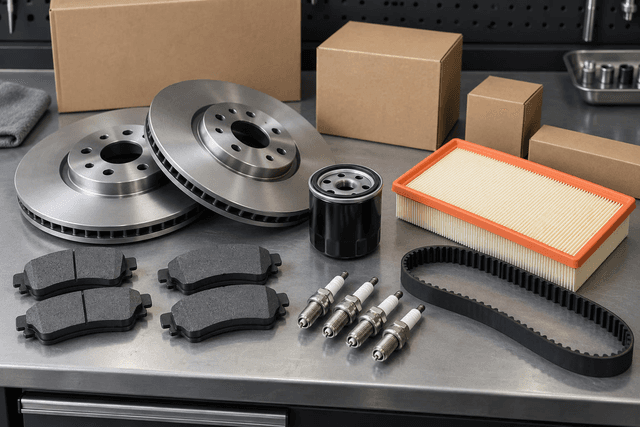
- Brakes: pads, discs and hoses; use brake fluid of the specification stated in the owner's manual, and you can review the types of brake fluid and the uses of each type.
- Steering: the steering rack, tie rods and their ends, since any play or breakage directly affects control of the car.
- Suspension: shock absorbers, control arms and ball joints, which affect the car's stability and grip; poor ones may wear quickly or break.
- Airbags and seat belts: do not buy them from an unknown source, and leave their inspection and replacement to a specialist technician.
- Tyres: buy them new from a trusted source in the size, load index and speed rating recommended for your car, and check their manufacture date.
The same applies to parts whose failure can cause major damage to the engine or gearbox, such as the timing belt, where fitted, and the water pump.
When are aftermarket parts a reasonable choice?
An aftermarket part is not necessarily poor, as quality varies from one manufacturer to another, and it is often a reasonable choice for consumables that are replaced periodically and are easy to check, such as:
- Oil, air and cabin filters: choose a filter that matches the size and specification, and learn the signs that your car needs a new air filter.
- Wipers and bulbs: check the wiper length and the bulb base type and wattage suitable for your car.
- Spark plugs: their type and specifications must match what the carmaker specifies, so read about spark plug types and when to replace them.
- Interior trim and plastic covers that do not affect safety.
In every case, insist on three things: a known manufacturer with clear data on the box, a part number that matches yours or is an approved replacement for it, and a seller who gives you an invoice. Because these parts follow fixed intervals, tie their purchase to your periodic car maintenance schedule instead of waiting until they fail.
Are used salvage parts a safe choice?
Salvage parts may be genuine originally, but they carry the age and usage of the car they came from, so they suit some cases and not others:
- Often suitable: exterior body parts such as fenders, mirrors and covers, cabin parts, and rare or discontinued parts, after confirming their condition and fit.
- Not suitable: wearing brake, steering and suspension parts, airbags and seat belts, tyres of unknown age, and filters and rubber parts.
- Engine or gearbox: do not buy either without a technical inspection; ask about its source and about a trial or return period, and record its number on the invoice.
Before buying, inspect the part yourself: signs of impact, welding or rust, signs of flooding or fire, or cracks in rubber and plastic, and match its number with your part's number.
How do you spot counterfeit spare parts?
A counterfeit copies the look, box and brand of the genuine part but not its specification, and may seem convincing at first glance. Warning signs include:
- The box: faded printing or unusual colours, spelling mistakes, a poorly made logo, a broken seal, or missing manufacturer name, country of manufacture and part number.
- The part itself: a rough finish, noticeably lighter weight than the old part, a missing engraved number and logo, or a different shape and mounting points.
- The price: a price far below the market for a part offered as genuine.
- The seller: a shop that gives no invoice, does not name the manufacturer and country of manufacture, or refuses returns if the part does not fit.
- Verification codes: if the box carries a verification code or security label from the manufacturer, check it through the manufacturer's official channels.
The same regulation requires each package to show the manufacturer's name or trademark, the country of origin, and the part's designation or number as classified in the manufacturer's catalogue; missing data is a warning sign in itself.
How do you confirm the part number before buying?
The part number is the most precise way to make sure a part fits your car, because parts for the same model can differ by model year, trim and engine type.
- Photograph the part number engraved or labelled on the old part if it is visible.
- Have the vehicle identification number (VIN) from your registration card ready, as it helps the dealer and shops identify the correct part.
- Ask the dealer for the original part number, then compare any aftermarket alternative with it, as many aftermarket manufacturers list the original numbers their parts correspond to.
- If you are told the part has a newer replacement number, ask for proof that it is an approved replacement for the old number.
- Compare the new part with the old one before fitting: dimensions, mounting points and connections.
What should you ask of the seller and the workshop?
Proper paperwork and correct fitting matter as much as the part itself:
- A detailed invoice stating the part name, number and type (genuine, aftermarket or used), the country of manufacture, and any warranty and return terms.
- Old parts: ask the workshop to return them to you or show them to you, so you can confirm the replacement was actually made.
- Warranty: the seller's warranty on the part is different from the carmaker's warranty on the car; if your car is under warranty, read its terms or ask the dealer before fitting non-genuine parts or servicing elsewhere, and keep all invoices.
- A qualified workshop: brake, steering and suspension parts need the right tools and tightening torque, some require bleeding the brakes or a wheel alignment after fitting, and airbags need a specialist technician.
- After fitting: test the car with the technician, and make sure no warning lights appear on the dashboard and there are no strange noises.
Frequently asked questions about car spare parts
- Are aftermarket parts always lower quality? No, their quality varies by manufacturer; some come close to genuine and some are poor. What matters is the manufacturer's reputation, matching the specification and the part number, not the word aftermarket alone.
- Does fitting a non-genuine part void the car's warranty? It depends on your car's warranty terms, so do not assume the answer; check the warranty booklet or ask the dealer before fitting, and keep the part and workshop invoices.
- Should I buy spare parts online? You can, from known stores that clearly state the manufacturer, the part number and the return policy, while being wary of very low prices for parts offered as genuine.
- Can I fit an airbag from a salvage yard? We do not recommend it, because you know neither its history nor its condition, and it is one of the most important means of protection in a crash; ask for a new part suitable for your car, and leave fitting to a specialist technician.
- What should I do if I discover a part is counterfeit? Stop using it if it is a safety part, keep it and the invoice, and go back to the seller. If you suspect commercial fraud, you can report it through the official channels of the Ministry of Commerce; procedures may be updated, so confirm the latest steps on its official platforms.
The difference between genuine, aftermarket and used parts lies in the specification, the source and the paperwork, not the name: choose the best for safety parts, use good aftermarket parts for consumables, treat salvage parts with caution, and avoid counterfeits completely. To plan your car's maintenance, read how to choose the right maintenance to cut car costs and faults.

Vehicle Ownership Transfer on Absher: Steps and Conditions
Table Of Contents:
|
Vehicle ownership transfer in Saudi Arabia is done electronically through the vehicle sale service on the Absher platform, without visiting traffic offices: the seller enters the buyer's ID number and date of birth, the agreed sale price and the seller's bank account; the buyer then receives a notification of the request within one hour and accepts or declines it, transfers the price through Absher's secure payment system, insures the vehicle and pays the fees, and once the car is received, checked and the delivery is confirmed on Absher, ownership is officially transferred. Both parties must be registered on Absher, the vehicle registration (istimara), periodic inspection and insurance must be valid, and there must be no violations on the buyer or the vehicle.
What is the vehicle ownership transfer service on Absher?
The Ministry of Interior offers the vehicle sale service through the Absher platform, and the National Platform describes it as a service that enables individuals to sell their private vehicles and transfer ownership electronically after its dues are cleared, after reaching an agreement with the buyer and completing all required procedures, including vehicle inspection to ensure compliance with conditions, registering the vehicle under the buyer's identity, and issuing the vehicle registration license.
- Target audience: individuals, both citizens and residents.
- Service channels: the Absher website and its mobile app.
- Service duration according to the National Platform: immediate.
- Payment method: the car's price is transferred through Absher's secure payment system, and the service page on Absher explains that payment goes to an intermediary account dedicated to the service, which ensures the amounts are documented and the vehicle is received.
Procedures and conditions may be updated from time to time, so confirm the latest steps on the Absher platform or the National Platform before you start.
What are the conditions for selling a vehicle on Absher?
Before the seller starts the request, both parties should review the conditions listed on the service page on Absher, as failing to meet any of them may stop the sale:
- Both the seller and the buyer must be registered on the Absher platform.
- The vehicle must be in sound condition and not suspended, lost, wanted or impounded.
- The vehicle registration license (istimara) must be valid.
- The vehicle must have a valid periodic inspection.
- The vehicle must have valid insurance.
- There must be no violations on the buyer or on the vehicle.
- The agreed price must fall within the limits set by the service, and the vehicle must be of a type the service allows to be sold.
- Government fees are paid through the government payment system (SADAD).
The page also mentions limits on the number of vehicles of certain types that a resident may own, so review them on Absher if the buyer is a resident. If the periodic inspection is close to expiring, prepare the car early using the checklist on how to prepare your car for the periodic inspection.
What are the seller's steps to transfer car ownership on Absher?
After agreeing with the buyer on the price and other terms, the seller starts the request with these steps, as set out by the National Platform:
- Log in to the Absher platform.
- Go to vehicle services, then choose the vehicle sale service.
- Select the vehicle you want to transfer from the list displayed.
- Enter the buyer's information: ID number and date of birth.
- Enter the agreed-upon sale price.
- Add the seller's bank account details where the proceeds of the sale will be deposited.
- Carefully review the entered information, then confirm the request.
- Wait for the buyer's response: the buyer receives a notification of the transfer request within one hour and can accept or decline it.
- Once the buyer accepts the sale, both parties complete the delivery of the vehicle and the payment through Absher's secure payment system before the transfer is confirmed.
What does the buyer do to complete the sale?
Ownership does not pass to the buyer until they complete their steps on the platform, which according to the National Platform are:
- Review the Absher notification about the vehicle transfer request, and accept it within one hour if you agree.
- Carefully review the vehicle information and sale price before confirming your acceptance.
- Transfer the agreed amount to the seller's account through Absher's secure payment system.
- Insure the vehicle before the ownership transfer is completed.
- Pay the government fees and the Absher fees.
- Receive the vehicle and check it, then confirm delivery through Absher.
- Upon confirmation, the vehicle ownership is officially transferred from the seller to the buyer.
How do the seller's and buyer's tasks differ?
The table below summarises the role of each party at every stage of the sale:
| Stage | Seller | Buyer |
| Before starting | Agree on the price and terms, and check the istimara, periodic inspection and insurance are valid | Register on Absher and make sure there are no violations on them |
| Creating the request | Enter the buyer's ID, date of birth, price and bank account, then confirm | Wait for the Absher notification |
| Responding | Wait for acceptance or refusal | Review the details and accept or decline the request within one hour |
| Payment | Receive the price in the bank account entered in the request | Transfer the price through Absher's secure payment system |
| Insurance and fees | The platform lists no step for the seller at this stage | Insure the vehicle and pay the government fees and Absher fees |
| Delivery | Hand the vehicle over to the buyer after they accept the sale | Receive and check the vehicle, then confirm delivery on Absher |
How do you transfer car ownership between family members?
If you are handing your car over to a family member, Absher has a separate service called vehicle ownership transfer between family members, which allows vehicle ownership to be waived between family members electronically once the current owner and the new owner agree. The National Platform lists its steps as follows:
- Log in to the Absher platform, then select the required vehicle and the service dedicated to this.
- Select a first-degree family member: father, mother, brother, sister, husband, wife, son or daughter.
- Enter the confirmation code sent to the new owner's phone.
- Pay the service fees.
- The vehicle ownership is transferred to the new owner in the traffic systems after all requirements are met.
What practical checks protect the seller and buyer before the sale?
The platform organises the procedure, but it does not replace inspecting the car yourself; the service page on Absher states that the sale takes place after the vehicle has been viewed and inspected and the seller and buyer have agreed. Here are practical tips before accepting the request:
- Match the chassis number (VIN) on the car with the istimara and the vehicle details shown in the request; the article on what the VIN characters mean explains where to find it.
- Inspect the car in daylight and try the engine, transmission, air conditioning and tyres, or ask for a pre-purchase inspection at an independent inspection centre; you will find a wider list in vehicle inspection tips before buying a used car.
- Look for signs of accidents and differences in paint shade between panels, and read what it means when a car has been repaired before you decide.
- Check for violations through official channels such as Absher before starting the request, because the service requires no violations on the buyer or the vehicle.
- Agree in advance on what the sale includes, such as the spare key, accessories and the service record if there is one.
- Keep a private record of the agreement for yourself: the agreed price, the request date and screenshots of the request, and do not share these details publicly.
What are the common mistakes in car ownership transfer?
- Starting the request before clearly agreeing on the price and other terms.
- Entering the buyer's ID number, date of birth or the sale price without careful review before confirming.
- Creating the request at a time when the buyer is not available, although the steps ask the buyer to review and accept it within one hour.
- Overlooking the expiry date of the istimara, periodic inspection or insurance until the request stalls after the deal is agreed.
- Transferring the price outside Absher's secure payment system, although the service steps state that payment is made through it.
- Confirming delivery on Absher before actually receiving and checking the car.
Frequently asked questions about car ownership transfer
- Do I need to visit the traffic department to transfer car ownership? According to the National Platform, the vehicle sale service is completed electronically through Absher without the need to visit General Traffic Department offices.
- How long does the ownership transfer take? The National Platform describes the service duration as immediate; the buyer receives the request notification within one hour, and the sale is complete once both parties finish their steps and the buyer confirms delivery.
- Who pays the ownership transfer fees? The National Platform lists paying the government fees and Absher fees among the buyer's steps; check their current amount on the platform before you start.
- Can the sale be cancelled after the request is created? The buyer can decline the request when the notification arrives, and the service page on Absher states that in case of disagreement or unwillingness to continue, the sale can be cancelled before it is completed, according to the stage set by the platform.
- Does the buyer need insurance for the car? Yes. One of the buyer's steps is to insure the vehicle before the ownership transfer is completed.
Transferring car ownership through Absher is a clear process if you prepare for it: check the conditions, agree on the price, inspect the car before accepting, pay through the platform's secure payment system, and do not confirm delivery before checking the car. If you are looking for your next car, you can browse the cars available at Saleh Cars Group.

Saudi Traffic Violations: How to Check, Pay and Dispute
Table Of Contents:
|
To check traffic violations in Saudi Arabia, open the Query Traffic Violations page on the Absher platform and enter your ID number together with the violation number or your date of birth. To pay, sign in to the Efaa platform through the National Single Sign-On, choose the violations you want to pay, then pay through the SADAD system, a mada card or a credit card. To object, use the Dispute Traffic Violations service that the Ministry of Interior provides online. These procedures may be updated from time to time, so confirm the latest steps on the official platform before you act.
What are traffic violations and who issues them?
Traffic violations are violations related to the Traffic Law and its implementing regulations. As the description of the dispute service on the National Platform explains, they are issued by the General Department of Traffic or by any other authority authorised to apply the Traffic Law and its implementing regulations. In practice, you deal with them through three main services:
- Inquiry: to find out which violations are registered against you, through the Query Traffic Violations page on the Absher platform.
- Payment: through the Efaa platform, as part of a Ministry of Finance service for paying government violations registered against individuals.
- Dispute: through the Dispute Traffic Violations service provided by the Ministry of Interior, if you have something showing that the violation is incorrect.
It helps to distinguish traffic violations from other government violations, such as Ministry of Transport violations or municipal violations, because each authority has its own services; you will find a summary in the table below.
How do you check traffic violations on Absher?
The Absher platform provides a dedicated page called Query Traffic Violations, which asks for specific search details. The steps usually go as follows:
- Open the Query Traffic Violations page from the official Absher website.
- Enter your ID number in its field.
- Choose the search type: by violation number or by date of birth.
- Enter the violation number or the date of birth, depending on the type you chose.
- Complete the verification code shown on the page, then display the result.
If you want to see the violations registered against you by different government entities in one place, the Efaa platform steps start with signing in through the National Single Sign-On (Nafath) and then viewing the registered violations, which we explain in the next section.
How do you pay traffic violations through the Efaa platform?
The service for paying government violations registered against individuals enables citizens, residents and visitors to view and pay all the violations registered against them by government entities, including traffic, smoking, government fines and other violations. The service page on the National Platform lists the payment steps as follows:
- Go to the Efaa platform.
- Choose to sign in through the National Single Sign-On.
- View the violations registered against you.
- Select the violations you want to pay.
- Continue to the electronic payment page.
- Complete the payment through the SADAD system, a mada card or a credit card.
According to the service description, the platform aims to unify and simplify violation procedures through a single digital platform that the relevant entities are linked to, so violations are issued and managed centrally. The National Platform also states that the service itself is free, meaning there is no charge for using it; this does not mean the violation amount is waived.
How do you dispute a traffic violation?
The Dispute Traffic Violations service provided by the Ministry of Interior allows you to dispute traffic violations issued by the General Department of Traffic and any other authority authorised to apply the Traffic Law and its implementing regulations. The service is provided online through the web portal and the mobile apps, and its path as shown on the service page is:
- Go to My Services.
- Choose Traffic.
- Choose Dispute Traffic Violations, then follow the instructions shown to complete the request.
We have not listed deadlines or detailed conditions for disputes here because they do not appear in the service description on the National Platform; read the conditions and instructions shown to you inside the service before submitting, and do not delay your dispute if you believe the violation is incorrect. Before you start, the following helps:
- Make sure the violation really concerns your vehicle or your licence, and that its details match what happened.
- Write the reason for your dispute clearly and briefly, stating facts rather than impressions.
- If you have documents that support your position, prepare them in advance, and provide the details the service asks for.
- Keep proof that you submitted the request until you receive the decision.
What is the difference between violation services on the official platforms?
Several entities register violations, and each service has a specific purpose. The table below summarises the services listed in the official sources we relied on:
| Service | Entity or platform | What it lets you do |
| Query Traffic Violations | Absher platform | Search by ID number with the violation number or date of birth |
| Payment of government violations registered against individuals | Ministry of Finance through the Efaa platform | View violations registered by government entities and choose which to pay |
| Dispute Traffic Violations | Ministry of Interior | Dispute violations from the traffic department and authorities authorised to apply the Traffic Law |
| Violations inquiry at the Ministry of Transport | Ministry of Transport and Logistic Services | Display violation details by searching with the violation number or the identification number |
| Municipal violations inquiry | Qassim Region Municipality as an example | View registered violations and the details of each one after signing in through the National Single Sign-On |
If a violation is registered with an entity other than the traffic department, look for that entity's inquiry service on the National Platform; for example, the Ministry of Transport and Logistic Services offers an inquiry through its web portal via the Ministry Services link and then the Violations Inquiry service in the list of inquiry services.
What are the most common causes of traffic violations you can avoid?
The best way to deal with violations is not to commit them in the first place, and most of their common causes can be avoided with simple habits that protect you and others on the road:
- Exceeding the speed limit: watch the road signs, because the limit changes between highways, inner streets and school areas, and cruise control helps you hold a steady speed on long roads.
- Not wearing a seat belt: make it a habit before moving off, for you and all passengers, however short the trip.
- Using the phone while driving: set navigation and calls before moving off, and leave messages until you stop in a safe, permitted place.
- Expired documents: track the expiry dates of your driving licence, the vehicle registration (istimara) and the insurance policy, and renew them before they are due.
- An expired periodic inspection: note its date in your phone calendar, and prepare the car beforehand with this checklist for preparing your car for the periodic inspection.
- Running a red light or stopping in prohibited places: slow down when approaching a signal, be ready to stop when it changes, and park only in permitted spaces.
- Neglecting the car's condition: make sure the lights and indicators work, and do not ignore warning lights; read about dashboard warning light meanings to know when to stop immediately.
Remember that driver assistance systems such as lane departure warning and adaptive cruise control help you, but they do not replace your attention, and they do not take over your responsibility to follow the rules.
What practical tips should you follow before paying or disputing?
- Check your violations regularly so they do not pile up without your knowledge.
- Read the details of each violation before deciding, then choose whether to pay it or dispute it.
- Reach the official platforms by typing their address yourself or through their official apps, and do not pay through links sent to you in messages from unknown sources.
- Do not share your verification code, login details or card details with anyone.
- Keep proof of payment until you are sure the violation status has been updated.
- If you face a technical problem, contact the entity that provides the service through its official channels.
Frequently asked questions about traffic violations
- Do I need to visit a government office to settle a violation? Usually not; the inquiry, payment and dispute services mentioned are provided online through the official portals and apps, and the dispute service page shows a branches link for anyone who needs it.
- Can I pay more than one violation at the same time? The Efaa platform steps include viewing the registered violations and then selecting the violations you want to pay before continuing to payment, so you decide what to pay.
- Does the Efaa platform include non-traffic violations? Yes. The service description states that it covers traffic, smoking, government fines and other violations registered by government entities.
- Can I dispute a traffic violation registered by an entity other than the traffic department? According to the service description, disputes cover traffic violations issued by the General Department of Traffic and any other authority authorised to apply the Traffic Law and its implementing regulations.
- Who do I call if I face a problem? The service pages on the National Platform list the Ministry of Finance number 19990 for the payment service and the Ministry of Interior number 966114011111 for the dispute service, as well as each entity's official email address.
Dealing with traffic violations is easier than it looks: check them on Absher, pay them on the Efaa platform, dispute them through the Ministry of Interior service if you have a clear reason, and always review the updated steps on the official platforms. Most importantly, avoid their common causes from the start: keep to the speed limit, fasten your seat belt, keep your phone out of your hand, and renew your documents before they expire.

New Car Buying Guide: Steps and Tips Before You Sign
Table Of Contents:
|
To buy a new car with confidence and without surprises, set your full budget rather than just the car's price, choose the body type and trim that suit your daily use, take a test drive yourself, ask for a written quotation that clearly states the warranty and everything the price includes, and inspect the car carefully before taking delivery. In this guide we explain these steps in order, from planning to the first service, keeping in mind the needs of drivers in the Kingdom, from summer heat to long highway trips between cities.
How do you set your budget before buying a new car?
A realistic budget does not stop at the car's showroom price; it includes everything you will pay to own and run it during the first years.
- The price of the car itself, making sure whether it includes tax, registration, and plates or not.
- Insurance, whose cost varies with the type of car and the type of cover you choose.
- Monthly fuel consumption based on the distance you usually drive and the size and type of the engine.
- Scheduled maintenance, oil changes, tires, and battery replacement over the medium term.
- Extras you may want, such as window tint, paint protection, and floor mats.
- The payment method: paying in cash differs from paying in installments in the total you end up paying, so calculate the full cost in both cases.
What type of car suits your use?
Start from how you will use the car, not from how it looks; the right car for an employee commuting within the city differs from the right car for a large family that often travels between cities.
- A sedan usually suits daily use in the city, is easy to park, and its fuel consumption is typically moderate.
- SUVs offer more space and ground clearance, suit families and trips, and some come with four-wheel drive for those who head out to the desert.
- A pickup suits those who need to carry cargo or do field work, but it is usually less comfortable for everyday city driving.
- The number of seats matters if your family is large; some cars offer a third row of seats, so check the trunk space when it is in use.
- Powertrain: petrol, hybrid, or electric, each with its pros and cons; learn about the difference between hybrid and electric cars before you decide.
- If saving fuel is a priority for you, check our list of the best fuel-efficient cars to narrow down your options.
How do you compare a car's trims and specifications?
A single model usually comes in several trims that differ in equipment and engine, and the gap between them can be significant in both price and everyday use.
- Ask for the specification sheet of the exact trim you will buy, and do not rely on photos or ads of a higher trim.
- Put safety systems ahead of luxuries: airbags, ABS, stability and traction control, the reversing camera, and parking sensors.
- Check the strength of the AC and whether there are rear AC vents if you carry passengers in the back seats, as this matters in the Kingdom's summer.
- Compare the transmission type and engine size with what suits your driving on highways and inclines.
- Pay attention to the size of the rims and tires; larger sizes may look better but can cost more to replace, and make sure there is a spare tire.
- Do not pay for features you will not use; choose the trim that covers your actual needs.
What should you check during a test drive?
- Adjust the seat, steering wheel, and mirrors, and make sure visibility in all directions is comfortable and clear.
- Drive the car on a road you usually use, in the city and on a highway if possible.
- Notice how smoothly the transmission shifts and how the accelerator responds when speeding up and overtaking.
- Test the brakes and steering at low speeds and when parking, and listen for any unusual noises or vibrations.
- Run the AC at full power and notice how quickly it cools and how noisy the cabin is.
- Bring your family along if you can so they can try the rear seats, ease of getting in and out, and fitting child seats.
What should you read in the quotation and warranty before signing?
- Ask for a written quotation that states the model, trim, model year, and color, and everything the price includes.
- Make sure agreed extras such as tint or floor mats are written into the quotation, and do not settle for verbal promises.
- Read the warranty terms: its duration and the distance it covers, the parts included and excluded, and the conditions for keeping it valid, such as sticking to the service schedule.
- Ask about free service packages if any, roadside assistance, and the service centers near you.
- Confirm the expected delivery date, and who handles registration, plates, and insurance.
- Check the current car offers before signing, as you may find extra benefits on the model you want.
What should you inspect on a new car before taking delivery?
Even a new car can pick up a scratch or a minor defect during shipping or storage, so set aside enough time to inspect it before signing for delivery.
- Inspect the paint in daylight for scratches or color differences, and check that the gaps between doors and fenders are even.
- Match the vehicle identification number (VIN) on the car with the number written on the documents.
- Make sure the odometer reading is low and consistent with a new car.
- Test all electrical systems: lights, windows, screen, camera, sensors, and AC.
- Check the manufacturing date and condition of the tires, and that the spare tire and tool kit are present.
- Make sure you receive the owner's manual, the warranty booklet, and the spare key, and that no warning light stays on in the dashboard after starting.
What are the common mistakes when buying a new car?
- Buying on emotion or because of an ad before making sure the car suits your actual needs.
- Focusing only on the monthly installment and ignoring the total you will pay.
- Ignoring running costs such as fuel, insurance, and maintenance.
- Signing before reading the full contract and warranty terms.
- Skipping the test drive or settling for a short loop around the showroom.
- Taking delivery at night or in a hurry without inspecting the car properly.
How do you care for your new car in the first months?
- Read the owner's manual, and follow any recommendations for the early driving period if the manufacturer mentions them.
- Keep to the first service appointment and the regular maintenance schedule to keep the warranty valid.
- Keep all maintenance invoices and records; they matter for the warranty and for the car's value when you sell it later.
- Park in the shade or use a sunshade to protect the paint and cabin from the heat of the sun.
- Check tire pressure regularly, especially before trips and during very hot periods.
Frequently asked questions about buying a new car
- Is it better to buy a new or a used car? A new car gives you a warranty, a clean history, and peace of mind, while a used car usually costs less but needs a careful inspection; if you choose used, read our important tips before buying a used car.
- Does a new car need an inspection before delivery? Yes, a simple but careful check at delivery reveals any scratch or missing accessory before you sign.
- Does servicing outside the dealership affect the warranty? It depends on the written warranty terms, so ask about them before buying and always keep a maintenance record.
- Are extras such as tint and paint protection necessary? They are optional and can be useful in the Kingdom's climate, but decide based on your needs and ask for them to be written clearly in the quotation.
- How long should the decision to buy a new car take? There is no fixed period, but give yourself enough time to compare, test drive, and read the quotation instead of deciding in a single visit.
Buying a new car is a big decision, and good planning saves you a lot of money and regret. Set your full budget, choose what suits your use, and test, read, and inspect before you sign. When you are ready, browse the cars available at Saleh Cars and compare models and trims at your own pace.
When to Replace Car Tyres: Tread, Cracks and Warning Signs
Table Of Contents:
|
If you are asking when to replace car tyres, the short answer is: replace a tyre when the surface of the tread reaches the level of the raised wear indicators inside the grooves, when a bulge, a deep cut or clear cracks appear in its sidewall, or when the rubber has aged to the point at which the tyre or car manufacturer recommends replacement, even if the tread looks good. In this guide we explain how to check your tyres, what the wear pattern reveals, and how to choose the right replacement.
When should you replace car tyres? The key signs in brief
Replacement is not tied to a single distance for every car, but to the tyre's condition and its maker's recommendations. The main signs are:
- The tread surface has reached the level of the wear indicators in any part of the tyre, not just on average.
- A bulge or bubble in the sidewall, a deep cut, or exposed cords or internal fabric.
- Clear cracks in the sidewall or between the tread blocks, showing that the rubber has aged and hardened.
- Uneven wear that has left part of the tyre smooth even though the rest of its surface is sound.
- A persistent vibration that does not go away after balancing, or repeated pressure loss in the same tyre with no visible cause.
How do you check tread depth using the TWI wear indicators?
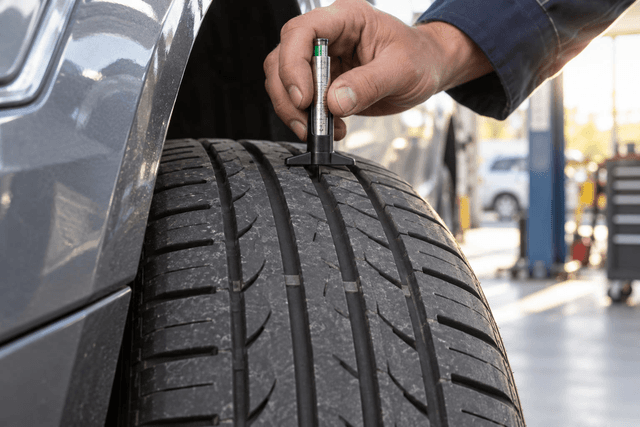
Inside the grooves are small raised bars called wear indicators, whose location is marked by the letters TWI or a small triangle on the tyre's shoulder, and when the tread surface is level with them, the tyre has reached the end of its usable life. To check:
- Park the car on level ground and turn the steering wheel to one side so you can see the front tyres clearly.
- Look for the TWI mark or triangle on the tyre's shoulder, then look into the groove next to it to find the raised bar.
- Compare the level of the tread surface with the bar; the closer they are to level, the closer the replacement date.
- Repeat the check on the inner edge, the centre and the outer edge, and at several points around the tyre's circumference.
- For a more precise reading, use a tread depth gauge, available at tyre shops, and record the reading for each tyre.
- Some drivers use a coin as a rough gauge, but it is no substitute for a proper gauge or a look by a qualified technician.
Do not wait until they are exactly level if you travel often or drive in the rain, as water clearance and grip weaken gradually as the tread gets shallower.
What do tyre cracks and sidewall bulges mean?
The sidewall flexes with every turn of the wheel and carries the car's weight, so any damage to it is more dangerous than tread wear:
- Fine surface cracks: an early sign of rubber ageing caused by heat and sun, which calls for the tyre to be inspected by a specialist and monitored.
- Deep cracks: if they widen or reach the tyre's inner layers, it is time to replace it.
- A bulge or bubble: damage to the tyre's internal structure, usually after hitting a pothole or kerb, which requires immediate replacement and no travelling on it.
- Cuts and gashes: a deep cut in the sidewall weakens the tyre even if no air is leaking from it yet.
What does the tyre wear pattern reveal?
The wear pattern reveals the cause of the problem, and if you do not fix it, new tyres will wear the same way:
| Wear pattern | Likely cause | What to do |
| Both edges more than the centre | Pressure lower than recommended | Set the pressure according to the driver's door sticker and check it regularly |
| Centre more than the edges | Pressure higher than recommended | Set the recommended pressure, not the maximum pressure printed on the tyre |
| One inner or outer edge | Wheel alignment or suspension fault | Check the alignment and suspension parts |
| Diagonal, feather-like wear | Incorrect toe between the two wheels | Have the alignment set at an equipped workshop |
| Repeated patches or scallops | Unbalanced wheels or worn shock absorbers | Balance the wheels and check the shock absorbers |
| A single flat spot | Hard braking with a locked wheel, or standing a long time without moving | Have a specialist assess the tyre |
If you see wear on both edges, start by reviewing the causes, signs and solutions for low tyre pressure, and if the wear is on one edge or comes with the car pulling to one side, read about the difference between wheel balancing and alignment.
How do Saudi heat and sand affect tyre life?
Rubber ages over time even if the car is used little, and you will find how to tell a tyre's age from the DOT code in our article on how to read tyre size and manufacture date. There is no single lifespan for all tyres, so refer to the tyre and car makers' recommendations. In the Kingdom's climate, some factors speed up deterioration:
- Direct sun and high heat speed up the hardening and cracking of rubber, especially for cars standing for long periods in open car parks, so park in the shade whenever possible.
- Hot asphalt raises tyre temperature, and the effect grows with low pressure or overloading on long trips.
- Sandy, gravel and desert tracks expose the tread and sidewall to cuts from sharp stones, so inspect the tyres after every desert trip.
- If you lower tyre pressure (deflating) to drive on sand, restore it to the recommended value before returning to asphalt, because highway driving at low pressure raises tyre temperature.
Should you replace tyres in pairs or all four together?
Ideally all four tyres match, but replacing them all together is not always necessary:
- Replace both tyres on the same axle together at least, so grip does not differ between the two sides when braking or cornering.
- When replacing only one pair, many tyre makers recommend fitting the newer pair on the rear axle for better stability, unless the owner's manual says otherwise.
- In four-wheel-drive or all-wheel-drive cars, the owner's manual may require the four tyres to be close in size and degree of wear to protect the drive system, so check it before replacing only two.
What about the spare tyre?
The spare forgotten in the boot ages just like the other tyres, even if it is never used:
- Check its pressure regularly and before every trip, because a flat spare will not help you when you get a puncture.
- Read its manufacture date and inspect its sidewall, as it may be older than the tyres on the car.
- A small temporary spare is designed for a limited distance and speed stated in the owner's manual or on the tyre's side, so use it only to reach the nearest tyre shop.
- If your car comes with a repair kit instead of a spare, check its expiry and how to use it.
How do you choose the right replacement tyre: size, load and speed?
Choose what your car was designed for, not just what the shop has in stock, and check the following:
- Size: copy it from the sticker on the driver's door frame or from the owner's manual, not from the tyre currently fitted, which may be different.
- Load index and speed symbol: choose values equal to or higher than the car manufacturer's recommendation, never lower.
- Manufacture date: ask for recently made tyres with close dates, especially on the same axle.
- Type of use: a driver who often travels on highways has different needs from one who drives in the desert or carries heavy loads, so ask about the tyre designed for your use.
- Changing the size: do not change the size of your tyres or rims without consulting a specialist; to learn the effect, read our article on whether the wrong rims make your car use more fuel.
- After fitting: balance the wheels, set the pressure according to the driver's door sticker, and check the alignment if the old tyres were worn unevenly.
What is the tyre energy efficiency label in Saudi Arabia?
The Saudi Standards, Metrology and Quality Organization offers the Energy Efficiency Label for Tires service, and explains that the label serves as a guide for consumers before purchasing the product to increase their awareness of its energy efficiency before buying it.
The organization lists tyres among the products subject to the efficiency label regulations, and the aims of these labels include reducing energy consumption for the consumer, enabling the consumer to know a product's efficiency before buying, and protecting consumer safety and health and the environment. In practice:
- When comparing tyres of the same size, ask to see the energy efficiency label for each one and read its details.
- Do not make the label your only criterion; size, load index, speed symbol, manufacture date and the tyre's suitability for your use come first.
- Requirements and procedures may be updated from time to time, so check the latest information on the organization's website.
Frequently asked questions about replacing car tyres
- Should I replace a tyre that is old even if its tread is good? Tread depth alone is not enough, as rubber hardens over time; have it checked by a specialist and follow the tyre maker's recommendation.
- Can a puncture in the side of the tyre be repaired? Repairing holes in the sidewall or shoulder is not usually recommended, while for a hole in the tread area the technician decides whether it can be repaired based on its size and position.
- Can I fit two tyres of different types? This is not recommended on the same axle, and it is best for all four tyres to match in type and tread pattern, especially in four-wheel-drive cars.
- Are small cracks between the tread blocks dangerous? They are a sign of ageing that may not require immediate replacement, but have a specialist monitor them, and if they deepen, replace the tyre.
- How often should I check my tyres? Check their pressure and appearance regularly, for example when refuelling, before every trip, and after hitting a pothole or kerb or after a desert trip.
Checking your tyres takes only minutes: look at the wear indicators, inspect the sidewall, notice the wear pattern and read the manufacture date. If a danger sign appears, do not postpone the change; choose a replacement with the recommended size, load and speed ratings, then fix the cause of any uneven wear.
Buying a Car With Financing or Cash: Which Is Better?
Table Of Contents:
|
Should you buy your car in cash or with financing? Paying cash usually means you pay the lowest total amount and own the car immediately with no monthly commitments, but it can drain your savings. Financing lets you get the car now and spread its price over installments, but what you pay in the end is usually higher because of the financing cost and fees. The right decision depends on your savings, the stability of your income, and the total cost of each option, not on the monthly installment alone. In this article we compare the two methods and explain how to calculate the cost, compare offers, and read the contract before signing.
What is the difference between buying a car in cash and with financing?
When you buy in cash, you pay the full price of the car at the time of purchase and the financial relationship with the seller ends. When you buy with financing or installments, you pay part of the price as a down payment, the rest is split into monthly installments over a period set by the contract, and the financing cost is added to it.
- Cash: one amount paid once, with no monthly installments and no financing cost.
- Financing: a down payment smaller than the car's price, followed by monthly installments that are usually fixed until the end of the term.
- Some finance contracts include a final payment larger than the installments at the end of the term; it lowers the monthly installment but does not cancel the amount.
- In both cases, you still carry the same running costs, such as fuel, insurance, and scheduled maintenance.
What are the pros and cons of buying a car in cash?
- You usually pay the lowest possible total, because you carry no financing cost or related fees.
- You own the car immediately and can sell or trade it in whenever you like without going back to any party.
- There is no monthly commitment putting pressure on your budget if your income changes or unexpected expenses come up.
- Paying cash may give you a better chance to negotiate, or to benefit from cash-payment offers if available.
- On the other hand, buying in cash can drain your savings and leave you without enough of an emergency reserve.
- The amount you have may also push you toward a car that is less than you need, or make you delay the purchase until your savings are complete.
What are the pros and cons of buying a car with financing?
- You get the car now without waiting until you have saved its full price.
- You keep part of your savings for emergencies or other priorities in your life.
- The price is spread over installments known in advance, making it easier to plan your monthly budget.
- On the other hand, the total you pay is higher than the car's cash price in most cases, because of the financing cost and fees.
- The installment commits you for years, and any change in your income can turn it into a heavy burden.
- Financing may require a certain type of insurance throughout the term, and there may be restrictions on selling the car before full payment, depending on the contract.
How do you calculate the total cost of the car in both cases?
Do not compare the cash price with the monthly installment; compare the total amount that will come out of your pocket with each option.
- For cash: add the car's price to the registration fees, the extras you will buy, and the cost of insurance.
- For financing: add the down payment, the monthly installment multiplied by the number of months, the final payment if any, the administrative fees, and the cost of insurance for the whole term of the contract.
- Subtract the car's cash price from the financing total; the difference is the real cost of getting the car now instead of waiting.
- Add the expected running costs of fuel and maintenance; they are similar under both options, but they affect your ability to pay the installment. If fuel consumption matters for your budget, check our list of the best fuel-efficient cars.
- Work out how much of your savings will remain after each option, and make sure it is enough for emergencies.
How do you compare car finance offers?
- Ask each provider for a written offer for the same car, with the same term and the same down payment, so the comparison is fair.
- Compare the total amount paid and the overall financing cost, and do not settle for comparing the monthly installment.
- Ask about all fees linked to the contract, such as administrative fees, the cost of insurance, and any other charges.
- Pay attention to the effect of the term: a longer term lowers the installment, but it usually raises the total you pay.
- Pay attention to the effect of the down payment and the final payment on both the installment and the total amount.
- Ask about early settlement terms and the possibility of paying off the remaining amount before the end of the term.
- Check the current car offers, as some offers include special benefits on financing or on cash payment.
What should you read in the finance contract before signing?
- The car details in the contract: model, trim, model year, color, and VIN when available, and that they match what you agreed on.
- The down payment amount, the number of installments, the value and due date of each installment, and the final payment if any.
- The total amount you will pay until the end of the contract, clearly written.
- What happens if an installment is late or you default on payments, and the consequences of that.
- Insurance terms: its type, who bears its cost, and who receives the compensation in the event of an accident.
- When ownership of the car passes to you, and whether you can sell or trade it in before the contract ends.
- Early settlement terms and any fees or discounts linked to it.
- Do not sign any paper with blank spaces, ask about every clause you do not understand, and keep a full copy of the contract and the installment schedule.
When is cash better for you, and when is financing better?
- Cash is better if you have the car's price available and still keep enough of an emergency reserve afterwards.
- Cash is also better if you prefer not to commit to installments, or if your income is not steady.
- Financing is better if you need the car now for your work or your family and do not want to drain all your savings.
- Financing suits you if your income is stable and the installment leaves comfortable room in your budget for fuel, maintenance, and emergencies.
- There is a middle option: a larger down payment from your savings with a shorter term, which lowers the total financing cost without draining everything you have.
- If your budget is limited either way, consider a less expensive car or a used car in good condition; before that, read our important tips before buying a used car.
What are the common mistakes when buying a car with financing?
- Choosing the car based only on the monthly installment, without calculating the total amount.
- Stretching the finance term to lower the installment, then paying a larger total in the end.
- Ignoring the final payment and not preparing for it as the end of the contract approaches.
- Forgetting the costs of insurance, fuel, and maintenance when working out your ability to pay.
- Putting all your savings into the down payment and leaving no emergency reserve.
- Signing quickly under the pressure of an offer, without reading the contract or comparing other offers.
Frequently asked questions about buying a car in cash or with financing
- Is financing always more expensive than cash? Usually yes, because of the financing cost and fees, but some promotional offers may narrow the gap, so compare the total amount in each case.
- Is a larger down payment better? It reduces the amount financed, and therefore usually reduces the installment and the financing cost, as long as it does not drain your emergency reserve.
- Can I pay off the financing before the end of the term? That depends on the contract terms, so ask about early settlement and any fees or discounts linked to it before signing.
- Can I sell a financed car before the installments end? The contract determines this, and it usually requires settling the remaining amount first or getting the finance provider's approval.
- What matters more when comparing: the installment or the total amount? The total amount matters most; then make sure the installment fits comfortably in your monthly budget.
There is no single best option for everyone; cash saves you the financing cost, and installments give you flexibility. Calculate the total amount in both cases, keep an emergency reserve for yourself, and read the whole contract before signing. Once you have set your budget, browse the cars available at Saleh Cars and choose what suits your needs.