New Car Buying Guide: Steps and Tips Before You Sign
Table Of Contents:
|
To buy a new car with confidence and without surprises, set your full budget rather than just the car's price, choose the body type and trim that suit your daily use, take a test drive yourself, ask for a written quotation that clearly states the warranty and everything the price includes, and inspect the car carefully before taking delivery. In this guide we explain these steps in order, from planning to the first service, keeping in mind the needs of drivers in the Kingdom, from summer heat to long highway trips between cities.
How do you set your budget before buying a new car?
A realistic budget does not stop at the car's showroom price; it includes everything you will pay to own and run it during the first years.
- The price of the car itself, making sure whether it includes tax, registration, and plates or not.
- Insurance, whose cost varies with the type of car and the type of cover you choose.
- Monthly fuel consumption based on the distance you usually drive and the size and type of the engine.
- Scheduled maintenance, oil changes, tires, and battery replacement over the medium term.
- Extras you may want, such as window tint, paint protection, and floor mats.
- The payment method: paying in cash differs from paying in installments in the total you end up paying, so calculate the full cost in both cases.
What type of car suits your use?
Start from how you will use the car, not from how it looks; the right car for an employee commuting within the city differs from the right car for a large family that often travels between cities.
- A sedan usually suits daily use in the city, is easy to park, and its fuel consumption is typically moderate.
- SUVs offer more space and ground clearance, suit families and trips, and some come with four-wheel drive for those who head out to the desert.
- A pickup suits those who need to carry cargo or do field work, but it is usually less comfortable for everyday city driving.
- The number of seats matters if your family is large; some cars offer a third row of seats, so check the trunk space when it is in use.
- Powertrain: petrol, hybrid, or electric, each with its pros and cons; learn about the difference between hybrid and electric cars before you decide.
- If saving fuel is a priority for you, check our list of the best fuel-efficient cars to narrow down your options.
How do you compare a car's trims and specifications?
A single model usually comes in several trims that differ in equipment and engine, and the gap between them can be significant in both price and everyday use.
- Ask for the specification sheet of the exact trim you will buy, and do not rely on photos or ads of a higher trim.
- Put safety systems ahead of luxuries: airbags, ABS, stability and traction control, the reversing camera, and parking sensors.
- Check the strength of the AC and whether there are rear AC vents if you carry passengers in the back seats, as this matters in the Kingdom's summer.
- Compare the transmission type and engine size with what suits your driving on highways and inclines.
- Pay attention to the size of the rims and tires; larger sizes may look better but can cost more to replace, and make sure there is a spare tire.
- Do not pay for features you will not use; choose the trim that covers your actual needs.
What should you check during a test drive?
- Adjust the seat, steering wheel, and mirrors, and make sure visibility in all directions is comfortable and clear.
- Drive the car on a road you usually use, in the city and on a highway if possible.
- Notice how smoothly the transmission shifts and how the accelerator responds when speeding up and overtaking.
- Test the brakes and steering at low speeds and when parking, and listen for any unusual noises or vibrations.
- Run the AC at full power and notice how quickly it cools and how noisy the cabin is.
- Bring your family along if you can so they can try the rear seats, ease of getting in and out, and fitting child seats.
What should you read in the quotation and warranty before signing?
- Ask for a written quotation that states the model, trim, model year, and color, and everything the price includes.
- Make sure agreed extras such as tint or floor mats are written into the quotation, and do not settle for verbal promises.
- Read the warranty terms: its duration and the distance it covers, the parts included and excluded, and the conditions for keeping it valid, such as sticking to the service schedule.
- Ask about free service packages if any, roadside assistance, and the service centers near you.
- Confirm the expected delivery date, and who handles registration, plates, and insurance.
- Check the current car offers before signing, as you may find extra benefits on the model you want.
What should you inspect on a new car before taking delivery?
Even a new car can pick up a scratch or a minor defect during shipping or storage, so set aside enough time to inspect it before signing for delivery.
- Inspect the paint in daylight for scratches or color differences, and check that the gaps between doors and fenders are even.
- Match the vehicle identification number (VIN) on the car with the number written on the documents.
- Make sure the odometer reading is low and consistent with a new car.
- Test all electrical systems: lights, windows, screen, camera, sensors, and AC.
- Check the manufacturing date and condition of the tires, and that the spare tire and tool kit are present.
- Make sure you receive the owner's manual, the warranty booklet, and the spare key, and that no warning light stays on in the dashboard after starting.
What are the common mistakes when buying a new car?
- Buying on emotion or because of an ad before making sure the car suits your actual needs.
- Focusing only on the monthly installment and ignoring the total you will pay.
- Ignoring running costs such as fuel, insurance, and maintenance.
- Signing before reading the full contract and warranty terms.
- Skipping the test drive or settling for a short loop around the showroom.
- Taking delivery at night or in a hurry without inspecting the car properly.
How do you care for your new car in the first months?
- Read the owner's manual, and follow any recommendations for the early driving period if the manufacturer mentions them.
- Keep to the first service appointment and the regular maintenance schedule to keep the warranty valid.
- Keep all maintenance invoices and records; they matter for the warranty and for the car's value when you sell it later.
- Park in the shade or use a sunshade to protect the paint and cabin from the heat of the sun.
- Check tire pressure regularly, especially before trips and during very hot periods.
Frequently asked questions about buying a new car
- Is it better to buy a new or a used car? A new car gives you a warranty, a clean history, and peace of mind, while a used car usually costs less but needs a careful inspection; if you choose used, read our important tips before buying a used car.
- Does a new car need an inspection before delivery? Yes, a simple but careful check at delivery reveals any scratch or missing accessory before you sign.
- Does servicing outside the dealership affect the warranty? It depends on the written warranty terms, so ask about them before buying and always keep a maintenance record.
- Are extras such as tint and paint protection necessary? They are optional and can be useful in the Kingdom's climate, but decide based on your needs and ask for them to be written clearly in the quotation.
- How long should the decision to buy a new car take? There is no fixed period, but give yourself enough time to compare, test drive, and read the quotation instead of deciding in a single visit.
Buying a new car is a big decision, and good planning saves you a lot of money and regret. Set your full budget, choose what suits your use, and test, read, and inspect before you sign. When you are ready, browse the cars available at Saleh Cars and compare models and trims at your own pace.
Buying a Car With Financing or Cash: Which Is Better?
Table Of Contents:
|
Should you buy your car in cash or with financing? Paying cash usually means you pay the lowest total amount and own the car immediately with no monthly commitments, but it can drain your savings. Financing lets you get the car now and spread its price over installments, but what you pay in the end is usually higher because of the financing cost and fees. The right decision depends on your savings, the stability of your income, and the total cost of each option, not on the monthly installment alone. In this article we compare the two methods and explain how to calculate the cost, compare offers, and read the contract before signing.
What is the difference between buying a car in cash and with financing?
When you buy in cash, you pay the full price of the car at the time of purchase and the financial relationship with the seller ends. When you buy with financing or installments, you pay part of the price as a down payment, the rest is split into monthly installments over a period set by the contract, and the financing cost is added to it.
- Cash: one amount paid once, with no monthly installments and no financing cost.
- Financing: a down payment smaller than the car's price, followed by monthly installments that are usually fixed until the end of the term.
- Some finance contracts include a final payment larger than the installments at the end of the term; it lowers the monthly installment but does not cancel the amount.
- In both cases, you still carry the same running costs, such as fuel, insurance, and scheduled maintenance.
What are the pros and cons of buying a car in cash?
- You usually pay the lowest possible total, because you carry no financing cost or related fees.
- You own the car immediately and can sell or trade it in whenever you like without going back to any party.
- There is no monthly commitment putting pressure on your budget if your income changes or unexpected expenses come up.
- Paying cash may give you a better chance to negotiate, or to benefit from cash-payment offers if available.
- On the other hand, buying in cash can drain your savings and leave you without enough of an emergency reserve.
- The amount you have may also push you toward a car that is less than you need, or make you delay the purchase until your savings are complete.
What are the pros and cons of buying a car with financing?
- You get the car now without waiting until you have saved its full price.
- You keep part of your savings for emergencies or other priorities in your life.
- The price is spread over installments known in advance, making it easier to plan your monthly budget.
- On the other hand, the total you pay is higher than the car's cash price in most cases, because of the financing cost and fees.
- The installment commits you for years, and any change in your income can turn it into a heavy burden.
- Financing may require a certain type of insurance throughout the term, and there may be restrictions on selling the car before full payment, depending on the contract.
How do you calculate the total cost of the car in both cases?
Do not compare the cash price with the monthly installment; compare the total amount that will come out of your pocket with each option.
- For cash: add the car's price to the registration fees, the extras you will buy, and the cost of insurance.
- For financing: add the down payment, the monthly installment multiplied by the number of months, the final payment if any, the administrative fees, and the cost of insurance for the whole term of the contract.
- Subtract the car's cash price from the financing total; the difference is the real cost of getting the car now instead of waiting.
- Add the expected running costs of fuel and maintenance; they are similar under both options, but they affect your ability to pay the installment. If fuel consumption matters for your budget, check our list of the best fuel-efficient cars.
- Work out how much of your savings will remain after each option, and make sure it is enough for emergencies.
How do you compare car finance offers?
- Ask each provider for a written offer for the same car, with the same term and the same down payment, so the comparison is fair.
- Compare the total amount paid and the overall financing cost, and do not settle for comparing the monthly installment.
- Ask about all fees linked to the contract, such as administrative fees, the cost of insurance, and any other charges.
- Pay attention to the effect of the term: a longer term lowers the installment, but it usually raises the total you pay.
- Pay attention to the effect of the down payment and the final payment on both the installment and the total amount.
- Ask about early settlement terms and the possibility of paying off the remaining amount before the end of the term.
- Check the current car offers, as some offers include special benefits on financing or on cash payment.
What should you read in the finance contract before signing?
- The car details in the contract: model, trim, model year, color, and VIN when available, and that they match what you agreed on.
- The down payment amount, the number of installments, the value and due date of each installment, and the final payment if any.
- The total amount you will pay until the end of the contract, clearly written.
- What happens if an installment is late or you default on payments, and the consequences of that.
- Insurance terms: its type, who bears its cost, and who receives the compensation in the event of an accident.
- When ownership of the car passes to you, and whether you can sell or trade it in before the contract ends.
- Early settlement terms and any fees or discounts linked to it.
- Do not sign any paper with blank spaces, ask about every clause you do not understand, and keep a full copy of the contract and the installment schedule.
When is cash better for you, and when is financing better?
- Cash is better if you have the car's price available and still keep enough of an emergency reserve afterwards.
- Cash is also better if you prefer not to commit to installments, or if your income is not steady.
- Financing is better if you need the car now for your work or your family and do not want to drain all your savings.
- Financing suits you if your income is stable and the installment leaves comfortable room in your budget for fuel, maintenance, and emergencies.
- There is a middle option: a larger down payment from your savings with a shorter term, which lowers the total financing cost without draining everything you have.
- If your budget is limited either way, consider a less expensive car or a used car in good condition; before that, read our important tips before buying a used car.
What are the common mistakes when buying a car with financing?
- Choosing the car based only on the monthly installment, without calculating the total amount.
- Stretching the finance term to lower the installment, then paying a larger total in the end.
- Ignoring the final payment and not preparing for it as the end of the contract approaches.
- Forgetting the costs of insurance, fuel, and maintenance when working out your ability to pay.
- Putting all your savings into the down payment and leaving no emergency reserve.
- Signing quickly under the pressure of an offer, without reading the contract or comparing other offers.
Frequently asked questions about buying a car in cash or with financing
- Is financing always more expensive than cash? Usually yes, because of the financing cost and fees, but some promotional offers may narrow the gap, so compare the total amount in each case.
- Is a larger down payment better? It reduces the amount financed, and therefore usually reduces the installment and the financing cost, as long as it does not drain your emergency reserve.
- Can I pay off the financing before the end of the term? That depends on the contract terms, so ask about early settlement and any fees or discounts linked to it before signing.
- Can I sell a financed car before the installments end? The contract determines this, and it usually requires settling the remaining amount first or getting the finance provider's approval.
- What matters more when comparing: the installment or the total amount? The total amount matters most; then make sure the installment fits comfortably in your monthly budget.
There is no single best option for everyone; cash saves you the financing cost, and installments give you flexibility. Calculate the total amount in both cases, keep an emergency reserve for yourself, and read the whole contract before signing. Once you have set your budget, browse the cars available at Saleh Cars and choose what suits your needs.

Car Brand Logos and Names: A Guide to Badges in Saudi Arabia
Table Of Contents:
|
Car brand logos are the badges and names each manufacturer places on the front grille, the boot lid and the centre of the steering wheel, and the easiest way to learn them is to group them by country of origin: Japanese badges such as Toyota's three ovals, Korean ones such as Hyundai's slanted H, and Chinese brands, many of which spell out their full name in Latin letters, alongside German, European and American badges. In this guide you will find each brand's name as it is written and said, a short description of its badge, its meaning where it is documented, and a table for quick comparison.
What are car brand logos and where do you find them on a car?
A car badge (the logo or emblem) is the trademark that identifies the manufacturer, and it usually appears in several places:
- The centre of the front grille or the bonnet, the most visible spot for the logo.
- The boot lid, where the model name and sometimes the trim are usually written next to it.
- The centre of the steering wheel, the wheel caps and the car key.
Badges fall into two types: a standalone symbol such as a star, rings or a lion, or a name spelled out in letters, as with many American and new Chinese brands, and knowing this difference helps you recognise a car from a distance.
What are the best-known Japanese car brand logos?
Japanese badges are very familiar on the Kingdom's roads, and most are simple symbols that are easy to remember:
- Toyota: three ovals that form the letter T; the company says the two overlapping ovals represent mutual trust between the customer and the company, and the outer oval represents the global expansion of its technology.
- Lexus: a curved letter L inside an oval; it is Toyota's luxury vehicle division.
- Nissan: the name NISSAN across a thin circle; the name began as an abbreviation of the Japanese holding company Nihon Sangyo.
- Honda: a wide, upright letter H inside a frame with rounded corners.
- Mitsubishi: three red diamonds meeting at the centre, chosen by founder Iwasaki Yataro because they recalled the emblem of the Tosa clan that employed him and his own family crest.
- Mazda: a stretched letter M shaped like wings inside a circle; according to the company's website, the name is also linked to its founder, Jujiro Matsuda.
- Suzuki: a red letter S with sharp lines.
- Isuzu: the name ISUZU in bold letters; the name comes from the Isuzu River and means fifty bells.
What are the Korean car brand logos?
- Hyundai: a slanted letter H inside an oval; the Korean word means modernity.
- Kia: the word KIA in a sharp, angular script; according to the company, the name means rising from Asia.
- Genesis: two spread wings with a shield in the middle; it is the luxury brand of Hyundai Motor Group.
Which Chinese car brand logos are common in Saudi Arabia?
Chinese cars have become familiar in the Saudi market, and their best-known badges include:
- Changan: a shape like the letter V inside a circle; the name comes from the Chongqing Changan Arsenal and literally means long-lasting peace.
- Chery: an oval with a symbol resembling the letter A in the middle.
- Geely: the name GEELY is written in Latin letters on the rear of many of its models.
- Haval: the name HAVAL in large letters; it is a brand specialising in SUVs, owned by Great Wall Motor, which is named after the Great Wall of China.
- MG: the letters MG inside an octagon; it is a British marque founded in Oxford and owned today by the Chinese company SAIC Motor.
- BYD: the letters BYD in a bold typeface; the name had no particular meaning, and the company later adopted Build Your Dreams as a slogan matching its letters.
- Hongqi: a vertical red strip running from the bonnet to the grille on many of its models; the name means red banner, and it is the oldest Chinese passenger car brand, owned by FAW Group.
How do you recognise the new Chinese car brands?
Many Chinese brands have appeared in recent years, some cannot be recognised from the badge alone, and here are practical ways to tell them apart:
- Read the written name: many new brands spell out their full name on the grille or the boot instead of a standalone symbol, such as Jetour, Omoda, Jaecoo and Deepal.
- Know the parent company: Jetour, Omoda and Jaecoo belong to Chery, Deepal to Changan, Haval to Great Wall and Lynk & Co to Geely, and brands within one group may share some models or platforms.
- Learn what the name means: Jetour combines the words jet and tour, signifying a convenient journey according to the brand; the O in Omoda comes from oxygen and moda means modern, according to Chery; Jaecoo comes from the German word Jäger, meaning hunter, and the English word cool; and Deepal's Chinese name means deep blue.
- Do not rely on the badge alone: some brands have changed their logo more than once, and its look may differ from one model year to another, so confirm the manufacturer and model on the car's registration card.
- Check the VIN: its first characters identify the manufacturer, and it is recorded on the registration card and stamped on the car's body.
What are the German and European car brand logos?
European badges often rely on old symbols with well-known stories:
- Mercedes-Benz: a three-pointed star inside a circle, which for the original Daimler company symbolised Gottlieb Daimler's aim of motorisation on land, water and in the air.
- BMW: a circle divided into blue and white quarters inside a black ring bearing the company name; its colours recall the flag of Bavaria, while the idea that it is an aircraft propeller is a myth.
- Audi: four interlinked rings, each representing one of the four companies that joined to form Auto Union, Audi's predecessor.
- Volkswagen: the letters V and W inside a circle; the German name means people's car.
- Skoda: a winged arrow inside a circle; the arrow represents speed, the wings progress and freedom, and the eye precision; it is a Czech brand.
- Peugeot: a lion; the original logo was a lion walking on an arrow, symbolising the speed, strength and flexibility of Peugeot's saw blades; it is a French brand.
- Renault: a diamond-shaped lozenge that the French company has placed on the front of its cars since the nineteen-twenties.
- Land Rover: a green oval carrying the name of the British brand.
- Rolls-Royce: two interlocking letters R and the Spirit of Ecstasy mascot on the bonnet; the British company is a wholly owned subsidiary of the BMW group.
- Lamborghini: a raging bull, chosen by founder Ferruccio Lamborghini after he admired the fighting bulls at the Miura ranch in Spain; it is an Italian brand.
What are the American car brand logos?
American badges tend towards written names and simple shapes:
- Ford: a blue oval with the name Ford in white script.
- Chevrolet: the gold bowtie, whose origin is unsettled; the company's account says William Durant took it from a wallpaper pattern in a French hotel.
- GMC: the letters GMC, usually in red; it is a General Motors brand.
- Jeep: the word JEEP in plain letters, and many people know it by its grille with vertical slots.
- Dodge: the name DODGE in large letters on the grille or the rear.
- Lincoln: a four-point star inside a frame; it is a luxury brand owned by Ford and named after US President Abraham Lincoln.
Car brand logos table: brand, country of origin and badge description
A quick summary of each brand's badge:
| Brand | Country of origin | Badge description |
| Toyota | Japan | Three ovals |
| Nissan | Japan | Name inside a thin circle |
| Honda | Japan | Upright letter H |
| Mitsubishi | Japan | Three red diamonds |
| Hyundai | Korea | Slanted H in an oval |
| Kia | Korea | The word KIA in a sharp script |
| Changan | China | V shape inside a circle |
| Chery | China | A-like symbol in an oval |
| Jetour | China | Name in Latin letters |
| Haval | China | HAVAL in large letters |
| MG | Britain (Chinese owner) | MG inside an octagon |
| BYD | China | The letters BYD |
| Mercedes-Benz | Germany | Three-pointed star in a circle |
| BMW | Germany | Circle with blue and white quarters |
| Audi | Germany | Four interlinked rings |
| Volkswagen | Germany | VW letters in a circle |
| Peugeot | France | Lion |
| Ford | USA | Blue oval |
| Chevrolet | USA | Gold bowtie |
| GMC | USA | Red GMC letters |
Frequently asked questions about car brand logos
- How do I tell the Hyundai logo from the Honda logo? The Hyundai logo is a slanted letter H inside an oval, while the Honda logo is a wide, upright letter H inside a frame with rounded corners.
- Which car has a horse, bull or lion logo? The black prancing horse on a yellow background is the logo of Italy's Ferrari, the horse inside a coloured shield belongs to Germany's Porsche, the raging bull to Lamborghini and the lion to Peugeot.
- Is a brand's country of origin the country where the car is made? Not always; the country of origin is the brand's home, and its models may be built in other countries, so check the manufacturing details in the VIN and the registration card.
- Why do companies change their logos? Usually when they renew their identity, as Nissan, Kia and BYD have done in recent years, so you may see two logos for the same brand on cars from different years.
- How can I confirm a car's brand if its badge has been replaced? Some owners fit modified badges or the badge of another model, so rely on the registration card and the VIN rather than the badge, especially when buying a used car.
Car brand logos become easier to remember when you link each badge to its country and parent company, read the name written on the boot when in doubt, and check the registration card and the VIN before any purchase decision. You can browse the cars available at Saleh Cars Group to get to know the different brands and models.
Genuine vs Aftermarket vs Used Car Parts: How to Choose
Table Of Contents:
|
Car spare parts fall into three main types: genuine parts (dealer parts) that carry the carmaker's brand or are made by its supplier to the same specification, aftermarket parts made by other companies with varying quality, and used parts from salvage yards (tashleeh) removed from other cars, while counterfeit parts that imitate the look and brand of genuine parts should be avoided completely. The practical rule: choose genuine or trusted high-quality aftermarket parts for safety items such as brakes, steering, suspension, airbags and tyres, accept good aftermarket parts for consumables like filters, wipers and bulbs, and always confirm the part number, keep the invoice and have the part fitted at a qualified workshop.
What are the types of car spare parts and how do they differ?
Parts may look alike, but they differ in their maker, specification and source; the table below summarises the types found in shops and workshops:
| Type | What it means | What sets it apart | What to watch for |
| Genuine (dealer) | A part carrying the carmaker's brand, sold through the dealer or its distributors | Matches factory specifications and has a clear source | Usually costs more and may need to be ordered |
| Original supplier (OES) | A part made by the supplier that supplies the carmaker, sold in its own box and brand | May match the genuine part's specifications | Do not assume a match; ask and compare the part number |
| Aftermarket | A part made by other companies to fit several models | More choice and often lower cost | Quality varies widely by manufacturer |
| Used (salvage) | A part removed from another car, possibly genuine originally | A solution for rare or discontinued parts | Unknown age and history, and it may carry no warranty |
| Counterfeit | A part that imitates the look, box and brand of the genuine part | No real advantage; the tempting price is the bait | A safety risk and commercial fraud |
The Technical Regulation for Auto Spare Parts issued by the Saudi Standards, Metrology and Quality Organization defines original parts as parts designed and manufactured to the vehicle manufacturer's specifications, made either by the vehicle manufacturer itself or by a manufacturer working to the same specification and quality control system, while commercial parts are replacement parts made to international standards, country-of-origin standards or the parts manufacturer's own standards, so that they meet the vehicle manufacturer's performance requirements.
Because market terms are not standardised, and some sellers use the word genuine or the abbreviation OEM for parts that do not come from the dealer, ask clearly: who made the part? What is its number? What warranty does it carry?
Which parts should be genuine or high quality?
Some parts are what stops the car, steers it or protects you in a crash, and they can fail suddenly. For these parts, do not make price the first criterion; choose genuine or an aftermarket part from a known manufacturer that meets the carmaker's specifications:
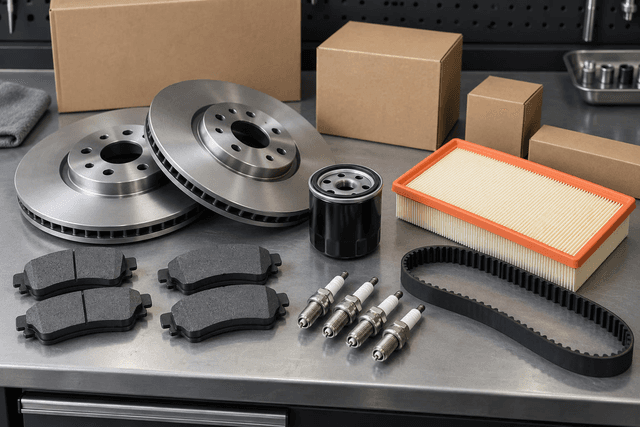
- Brakes: pads, discs and hoses; use brake fluid of the specification stated in the owner's manual, and you can review the types of brake fluid and the uses of each type.
- Steering: the steering rack, tie rods and their ends, since any play or breakage directly affects control of the car.
- Suspension: shock absorbers, control arms and ball joints, which affect the car's stability and grip; poor ones may wear quickly or break.
- Airbags and seat belts: do not buy them from an unknown source, and leave their inspection and replacement to a specialist technician.
- Tyres: buy them new from a trusted source in the size, load index and speed rating recommended for your car, and check their manufacture date.
The same applies to parts whose failure can cause major damage to the engine or gearbox, such as the timing belt, where fitted, and the water pump.
When are aftermarket parts a reasonable choice?
An aftermarket part is not necessarily poor, as quality varies from one manufacturer to another, and it is often a reasonable choice for consumables that are replaced periodically and are easy to check, such as:
- Oil, air and cabin filters: choose a filter that matches the size and specification, and learn the signs that your car needs a new air filter.
- Wipers and bulbs: check the wiper length and the bulb base type and wattage suitable for your car.
- Spark plugs: their type and specifications must match what the carmaker specifies, so read about spark plug types and when to replace them.
- Interior trim and plastic covers that do not affect safety.
In every case, insist on three things: a known manufacturer with clear data on the box, a part number that matches yours or is an approved replacement for it, and a seller who gives you an invoice. Because these parts follow fixed intervals, tie their purchase to your periodic car maintenance schedule instead of waiting until they fail.
Are used salvage parts a safe choice?
Salvage parts may be genuine originally, but they carry the age and usage of the car they came from, so they suit some cases and not others:
- Often suitable: exterior body parts such as fenders, mirrors and covers, cabin parts, and rare or discontinued parts, after confirming their condition and fit.
- Not suitable: wearing brake, steering and suspension parts, airbags and seat belts, tyres of unknown age, and filters and rubber parts.
- Engine or gearbox: do not buy either without a technical inspection; ask about its source and about a trial or return period, and record its number on the invoice.
Before buying, inspect the part yourself: signs of impact, welding or rust, signs of flooding or fire, or cracks in rubber and plastic, and match its number with your part's number.
How do you spot counterfeit spare parts?
A counterfeit copies the look, box and brand of the genuine part but not its specification, and may seem convincing at first glance. Warning signs include:
- The box: faded printing or unusual colours, spelling mistakes, a poorly made logo, a broken seal, or missing manufacturer name, country of manufacture and part number.
- The part itself: a rough finish, noticeably lighter weight than the old part, a missing engraved number and logo, or a different shape and mounting points.
- The price: a price far below the market for a part offered as genuine.
- The seller: a shop that gives no invoice, does not name the manufacturer and country of manufacture, or refuses returns if the part does not fit.
- Verification codes: if the box carries a verification code or security label from the manufacturer, check it through the manufacturer's official channels.
The same regulation requires each package to show the manufacturer's name or trademark, the country of origin, and the part's designation or number as classified in the manufacturer's catalogue; missing data is a warning sign in itself.
How do you confirm the part number before buying?
The part number is the most precise way to make sure a part fits your car, because parts for the same model can differ by model year, trim and engine type.
- Photograph the part number engraved or labelled on the old part if it is visible.
- Have the vehicle identification number (VIN) from your registration card ready, as it helps the dealer and shops identify the correct part.
- Ask the dealer for the original part number, then compare any aftermarket alternative with it, as many aftermarket manufacturers list the original numbers their parts correspond to.
- If you are told the part has a newer replacement number, ask for proof that it is an approved replacement for the old number.
- Compare the new part with the old one before fitting: dimensions, mounting points and connections.
What should you ask of the seller and the workshop?
Proper paperwork and correct fitting matter as much as the part itself:
- A detailed invoice stating the part name, number and type (genuine, aftermarket or used), the country of manufacture, and any warranty and return terms.
- Old parts: ask the workshop to return them to you or show them to you, so you can confirm the replacement was actually made.
- Warranty: the seller's warranty on the part is different from the carmaker's warranty on the car; if your car is under warranty, read its terms or ask the dealer before fitting non-genuine parts or servicing elsewhere, and keep all invoices.
- A qualified workshop: brake, steering and suspension parts need the right tools and tightening torque, some require bleeding the brakes or a wheel alignment after fitting, and airbags need a specialist technician.
- After fitting: test the car with the technician, and make sure no warning lights appear on the dashboard and there are no strange noises.
Frequently asked questions about car spare parts
- Are aftermarket parts always lower quality? No, their quality varies by manufacturer; some come close to genuine and some are poor. What matters is the manufacturer's reputation, matching the specification and the part number, not the word aftermarket alone.
- Does fitting a non-genuine part void the car's warranty? It depends on your car's warranty terms, so do not assume the answer; check the warranty booklet or ask the dealer before fitting, and keep the part and workshop invoices.
- Should I buy spare parts online? You can, from known stores that clearly state the manufacturer, the part number and the return policy, while being wary of very low prices for parts offered as genuine.
- Can I fit an airbag from a salvage yard? We do not recommend it, because you know neither its history nor its condition, and it is one of the most important means of protection in a crash; ask for a new part suitable for your car, and leave fitting to a specialist technician.
- What should I do if I discover a part is counterfeit? Stop using it if it is a safety part, keep it and the invoice, and go back to the seller. If you suspect commercial fraud, you can report it through the official channels of the Ministry of Commerce; procedures may be updated, so confirm the latest steps on its official platforms.
The difference between genuine, aftermarket and used parts lies in the specification, the source and the paperwork, not the name: choose the best for safety parts, use good aftermarket parts for consumables, treat salvage parts with caution, and avoid counterfeits completely. To plan your car's maintenance, read how to choose the right maintenance to cut car costs and faults.

Car Trim Levels Explained: How to Choose the Right Trim
Table Of Contents:
|
The difference between car trim levels is the difference in the equipment a manufacturer fits to the same model: the engine, transmission and drivetrain, safety and driver assistance systems, comfort and air conditioning, wheel and tyre size, and the screen and infotainment. Labels such as “standard” and “fully loaded” are not consistent between manufacturers, so a fair comparison depends on the official trim name, the model year and the written specification sheet. Here we explain where trims differ and how to compare them with a table, without paying for features you will not use.
What are car trim levels and why do their names vary?
A trim is a version of the same model with an equipment package set by the manufacturer; a model usually starts with a base trim, each higher trim adds a group of features, and trims may also differ in the engine or exterior styling.
- Standard, mid-spec and fully loaded are rough sales descriptions, and each manufacturer has official names for its trims.
- A fully loaded version of one model may lack a feature found on the mid-range trim of another, so never compare by the label alone.
- A trim's contents can change from one model year to the next and may differ by market, so a brochure from another country does not prove the car offered to you has the feature.
If you are at the start of the buying process, begin with our new car buying guide to set your budget and choose the type of car, then return to this article to compare trims in detail.
Do trims differ in engine, transmission and drivetrain?
On many models every trim shares the same engine, but some offer a larger, turbocharged or hybrid engine on higher trims. When the mechanical components differ, they matter more than any cosmetic extra, because they affect performance, fuel consumption and maintenance for as long as you own the car.
- Engine: record its size and type, and do not assume the larger engine suits you best if most of your trips are in the city.
- Transmission: the type may differ between trims, so read how a car transmission works and its main types before you compare.
- Drivetrain: two-wheel drive is usually enough in the city, while four-wheel drive helps if you head into the desert and sandy roads, but it adds weight and parts that need maintenance.
- Fuel consumption: it may differ between trims of the same model, so ask to see the fuel economy label for the version you are considering; the Saudi Standards, Metrology and Quality Organization explains that this label is a guide for consumers before purchase, to raise their awareness of energy efficiency.
How do safety and driver assistance systems differ between trims?
A phrase such as “comprehensive safety features” is not enough; ask for the names of the systems fitted to each trim and understand what each one does: does it only warn the driver, or does it intervene with braking or steering?
- Airbags: how many there are and where, plus child-seat anchor points if you travel with children.
- Forward collision warning only alerts you, while automatic emergency braking may apply the brakes if you do not react.
- Lane departure warning only warns, while lane keeping assist makes a limited steering correction.
- Blind spot monitoring and rear cross-traffic alert are useful on highways and when reversing out of busy parking spaces.
- Adaptive cruise control keeps a set distance from the car ahead and is comfortable on long trips between cities.
- A reversing camera and parking sensors, or a surround-view camera on some higher trims.
These systems assist the driver and do not replace attention, and dust on the sensors can affect how they work.
Which comfort and air conditioning features change from trim to trim?
Some comfort features help you every day in the Saudi climate, while others you may rarely use even though they raise the trim's price.
- Air conditioning: manual or automatic, single-zone or dual-zone, with or without vents for rear passengers.
- Seats: fabric or leather, manual or power adjustment, and ventilated seats that ease the summer heat.
- Keyless entry and push-button start, and a powered tailgate.
- A sunroof is appealing, but many drivers do not use it in summer, so weigh its value to you.
How do wheels and tyres affect comfort and running costs?
Higher trims often come with larger wheels and tyres with a lower sidewall, which gives a sportier look but does not necessarily mean more comfort.
- A lower sidewall usually absorbs bumps less, so the ride feels firmer on uneven roads.
- Check the spare: full-size, temporary, or a repair kit instead of a spare.
- Large or less common sizes may cost more to replace, so ask about the availability of the size on the trim you will buy.
Is the screen and infotainment worth paying for a higher trim?
A large screen is one of the most visible differences between trims, but its real value lies in how easy it is to use while driving.
- Test how quickly the screen responds and how clear it is in sunlight, and how easily you can reach the air conditioning settings without taking your eyes off the road.
- A digital instrument cluster, an upgraded sound system and wireless charging are pleasant extras, but not essential for every driver.
- Physical buttons for air conditioning and audio can be easier than touch control alone, so try both.
Does a higher trim hold its value at resale?
There is no fixed rule; resale value depends on market demand for the model and trim, and on the car's condition and service history.
- Expensive extras rarely recover their full cost, so do not buy a higher trim hoping to recoup the difference when you sell.
- Equipment that many buyers look for, such as a camera, sensors and safety systems, may make the car easier to sell.
- Browse used listings for the same model in different trims to gauge demand.
How do you compare car trims using a table?
Put the trims you are considering in one table and write against each item what is confirmed on the specification sheet, not what you heard or saw in an advert. Here is a template you can copy:
| Item | What to record for each trim | Question to check |
|---|---|---|
| Identification | Official trim name and model year | Does the car on offer match the written quotation? |
| Mechanical | Engine, transmission and drivetrain | Does fuel consumption differ? |
| Safety | System names and what each one does | Is the feature standard or part of an optional package? |
| Comfort | Air conditioning, seats and keyless entry | Will you use it every day? |
| Wheels and tyres | Tyre size and spare | Is the size easy to find? |
| Infotainment | Screen and phone connection | Have you tried it yourself? |
| Offer | Price difference between trims | Which confirmed features do you get for that difference? |
- Classify each feature: essential and non-negotiable, desirable, or unimportant to you.
- Rule out any trim that lacks even one essential feature.
- Start with the lowest trim that covers all your essential needs.
- Compare the price difference to the next trim only with the desirable features it adds.
How do you avoid paying for features you will not use?
The money you save on luxuries may be more useful for maintenance, insurance or a smaller finance amount.
- Do not be swayed by the display car: the car on show or the advertising photos may be of a higher trim, so ask to see and drive the trim that fits your budget.
- Watch out for packages: a feature you want may be bundled with features you do not need, so ask whether it is available on a lower trim or in a smaller package.
- Distinguish factory equipment from accessories fitted later, such as window tint, and ask who provides their warranty and what it covers.
- When buying with financing, the price difference between two trims becomes part of the finance amount and you carry its cost for the whole contract; read our comparison of buying a car with financing or cash before you decide.
- Ask about each feature: how often will I actually use it? If the answer is rarely, it is not reason enough to upgrade.
Frequently asked questions about car trim levels
Does fully loaded mean the same equipment on every car?
No. It is a sales description that varies from model to model and from year to year; ask for the official trim name and its detailed equipment list, and check every feature that matters to you.
Is the top trim of a smaller model better than the base trim of a larger model?
If space and seating are the priority, the larger model suits you better; if equipment matters more and the space is enough, the top trim of the smaller model may suit you.
Can higher-trim features be added after purchase?
Some accessories can be fitted later, but many driver assistance systems depend on factory sensors and software and are not easy to add, so ask how any modification affects the warranty.
Are videos and brochures enough for a comparison?
They help you understand the general idea and prepare your questions, but verify the specifications of the car offered to you, because the model year, market or trim may differ.
The right trim is neither the cheapest nor the most expensive; it is the lowest trim that covers your essential needs with written, confirmed specifications. Put the mechanical components and safety first, then the comfort you will use every day, and leave luxuries at the bottom of the list. When your table is ready, you can browse the cars available at Saleh Cars Group and compare their trims in the same way.
Fuel Economy Label: How to Read It and Calculate Fuel Use
Table Of Contents:
|
To read a fuel economy label, start with the km/L value: the number of kilometres the car travels on one litre of fuel. The higher the number, the more economical the car. Next, make sure the label belongs to the exact model, model year and engine capacity you intend to buy, verify it through the Taakad app, and then divide your annual distance by the figure to estimate how many litres you will need each year. This guide explains the label's fields, how to compare and calculate with an illustrative example, and why your car's real-world consumption may differ from the printed figure.
What is a vehicle fuel economy label?
A fuel economy label is a sticker you will find on new cars. It shows the model's fuel economy value in kilometres per litre, together with a level that rates this value. According to the Saudi Press Agency report on the Letabqa energy conservation campaign, the label classifies cars into seven levels: Excellent+, Excellent, Very Good, Good, Average, Poor and Very Poor. The top levels appear in dark green and the lowest in red.
There are two types of label, depending on how the vehicle is used: one for passenger cars such as sedans and minivans, and one for light trucks such as four-wheel drives, pickups and cargo vans. Pay attention to the label type when comparing, and compare cars of similar size and use wherever possible.
What information does the fuel economy label show?
The label combines the vehicle's basic information with its fuel economy result. According to the same source, it includes:
- The manufacturer's name and the vehicle's trade name (model).
- Engine capacity and model year.
- Vehicle type: passenger car or light truck.
- The fuel economy value in kilometres per litre, and its corresponding level.
- The required fuel type: 91 petrol, 95 petrol or diesel.
- The logo of the Saudi Standards, Metrology and Quality Organization (SASO), the label's regulatory statement, and a QR code.
Before focusing on the number, match these fields with the car in front of you, especially the model year, engine capacity and fuel type. A single model may come with more than one engine or trim, and each may have a different value. Take a clear photo of every label so the details do not get mixed up if you visit several showrooms.
How do you read the km/L figure and compare two cars?
The km/L figure tells you how far the car travels on one litre. A value of 18 km/L, for example, means the car covers 18 kilometres per litre according to the label value. With this unit, the higher number is better. When comparing:
- Read the value itself rather than relying on the colour alone; two cars at the same level may have different values.
- Make sure both labels are of the same type, passenger car or light truck.
- Pay attention to fuel type; if one car needs 95 petrol and the other 91 petrol, calculate each car's cost using the price of its own fuel.
- Do not carry a value from one trim or engine to another version just because the trade name or exterior looks the same.
- Treat fuel economy as one factor alongside space, comfort, safety and maintenance; our guide to the best fuel-efficient cars can help you narrow your options.
How do you verify the label with the Taakad app?
The Saudi Standards, Metrology and Quality Organization provides the Taakad app for checking fuel economy label and energy efficiency label information, and it can be downloaded free for iOS and Android devices. The steps, as described on the app's page and in the previous source, are:
- Open the app, choose the vehicles section, and point the camera at the QR code on the label.
- If the vehicle is registered in SASO's database, its details will appear, such as manufacturer, engine capacity, model year, fuel type, body type, drive type, transmission, fuel economy value and level.
- Compare the details shown in the app with the label on the car, field by field.
- If there is no QR code on the label, use the app's search feature.
- If the details do not match, use the report feature, which takes you to the Commercial Report app.
How do you calculate the fuel you need each year?
The formula is simple: annual distance in kilometres ÷ fuel economy in km/L = estimated fuel in litres. To estimate your annual distance accurately, compare the dashboard odometer readings on two service records about a year apart, or take a typical week's distance and multiply it by the number of weeks in a year, then add the trips you know you will make.
Illustrative example: an annual distance of 20,000 km and two cars, the first rated at 15 km/L and the second at 20 km/L. These are hypothetical teaching figures only, not specifications of cars offered for sale.
| Item | First car | Second car |
|---|---|---|
| Assumed fuel economy | 15 km/L | 20 km/L |
| Annual distance | 20,000 km | 20,000 km |
| Calculation | 20,000 ÷ 15 | 20,000 ÷ 20 |
| Estimated quantity | About 1,333 litres | 1,000 litres |
The difference in this example is about 333 litres a year. To turn it into an amount of money, multiply each car's quantity by the price per litre of the fuel it needs at the time of comparison, then subtract the two results.
How do you convert km/L to litres per 100 km?
Some brochures, websites and dashboard displays show consumption in litres per 100 km, where the lower number is better. To convert, divide 100 by the km/L value; to convert back, divide 100 by the L/100 km value:
- 15 km/L: 100 ÷ 15 = about 6.67 litres per 100 km.
- 20 km/L: 100 ÷ 20 = 5 litres per 100 km.
- In reverse: 5 litres per 100 km means 100 ÷ 5 = 20 km/L.
This unit reveals something many people overlook: the same increase in km/L saves more fuel when the starting value is low. In another illustrative example over 20,000 km, moving from 10 to 12 km/L saves about 333 litres, while moving from 20 to 22 km/L saves only about 91 litres. Do not compare a km/L figure with a figure in another unit, such as miles per gallon, before converting to the same unit.
Why does your real consumption differ from the label figure?
The label figure is a reference value that helps you compare models, but it does not describe your own driving style or road conditions. The main things that change real-world consumption are:
- Driving style: sudden acceleration and braking, and high speeds on highways.
- Heavy traffic and frequent stops, and leaving the engine running for long periods while parked.
- Running the air conditioning for long periods in summer heat.
- Excess load and low tyre pressure.
- Maintenance condition, such as the air filter, spark plugs and engine oil.
Use the label for an initial comparison, then monitor your car's consumption over several refills. If consumption rises clearly and persistently above your usual level, read about the common causes of higher fuel consumption and arrange an inspection when needed, rather than assuming the label is wrong. If your car offers an economy driving mode, learn about the ECO system and whether it really saves fuel.
How do you measure your car's consumption yourself?
The most accurate home method is the full-tank method, and all you need is the dashboard trip meter and your fuel receipt:
- Fill the tank until the pump nozzle clicks off automatically, then reset the trip meter.
- Drive the car as usual until you need to refuel.
- Fill the tank again until the automatic click-off, and note the litres added and the distance on the trip meter.
- Divide the distance by the litres; if, for example, you drove 500 km and added 40 litres, your consumption is 12.5 km/L.
- Repeat over several refills and in different conditions, in the city and on the highway, then take the average.
The consumption reading on the trip computer is useful for daily monitoring, but it is an estimate and may differ slightly from the manual calculation, so rely on the manual calculation for long-term comparison.
Frequently asked questions about the fuel economy label
- Is a higher number on the label always better? Yes when the unit is km/L; with litres per 100 km, the lower number is better.
- Does the label guarantee the consumption I will get? No. It is a value for comparison, and your real consumption depends on driving style, roads, load and the car's condition.
- Does a larger tank mean better economy? No. Tank capacity determines the distance between refills, while fuel economy describes distance per litre.
- Can I compare a sedan with a four-wheel drive using the label? The unit is the same, so you can compare the two values, but each has a different label type, and the fairest comparison is between cars of similar size and use.
- What should I do if the label does not match the Taakad app? Ask the seller for an explanation, and use the app's report feature if the difference remains.
The fuel economy label is a quick comparison tool if you read it in the right order: match the details, verify them through the Taakad app, then turn the figure into litres that fit your distance. When you compare cars at Saleh Cars Group, ask for the label of the version that interests you and calculate your own needs before deciding.