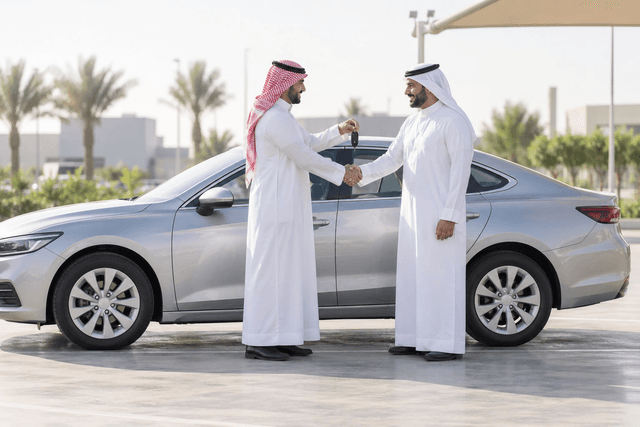
Vehicle Ownership Transfer on Absher: Steps and Conditions
Table Of Contents:
|
Vehicle ownership transfer in Saudi Arabia is done electronically through the vehicle sale service on the Absher platform, without visiting traffic offices: the seller enters the buyer's ID number and date of birth, the agreed sale price and the seller's bank account; the buyer then receives a notification of the request within one hour and accepts or declines it, transfers the price through Absher's secure payment system, insures the vehicle and pays the fees, and once the car is received, checked and the delivery is confirmed on Absher, ownership is officially transferred. Both parties must be registered on Absher, the vehicle registration (istimara), periodic inspection and insurance must be valid, and there must be no violations on the buyer or the vehicle.
What is the vehicle ownership transfer service on Absher?
The Ministry of Interior offers the vehicle sale service through the Absher platform, and the National Platform describes it as a service that enables individuals to sell their private vehicles and transfer ownership electronically after its dues are cleared, after reaching an agreement with the buyer and completing all required procedures, including vehicle inspection to ensure compliance with conditions, registering the vehicle under the buyer's identity, and issuing the vehicle registration license.
- Target audience: individuals, both citizens and residents.
- Service channels: the Absher website and its mobile app.
- Service duration according to the National Platform: immediate.
- Payment method: the car's price is transferred through Absher's secure payment system, and the service page on Absher explains that payment goes to an intermediary account dedicated to the service, which ensures the amounts are documented and the vehicle is received.
Procedures and conditions may be updated from time to time, so confirm the latest steps on the Absher platform or the National Platform before you start.
What are the conditions for selling a vehicle on Absher?
Before the seller starts the request, both parties should review the conditions listed on the service page on Absher, as failing to meet any of them may stop the sale:
- Both the seller and the buyer must be registered on the Absher platform.
- The vehicle must be in sound condition and not suspended, lost, wanted or impounded.
- The vehicle registration license (istimara) must be valid.
- The vehicle must have a valid periodic inspection.
- The vehicle must have valid insurance.
- There must be no violations on the buyer or on the vehicle.
- The agreed price must fall within the limits set by the service, and the vehicle must be of a type the service allows to be sold.
- Government fees are paid through the government payment system (SADAD).
The page also mentions limits on the number of vehicles of certain types that a resident may own, so review them on Absher if the buyer is a resident. If the periodic inspection is close to expiring, prepare the car early using the checklist on how to prepare your car for the periodic inspection.
What are the seller's steps to transfer car ownership on Absher?
After agreeing with the buyer on the price and other terms, the seller starts the request with these steps, as set out by the National Platform:
- Log in to the Absher platform.
- Go to vehicle services, then choose the vehicle sale service.
- Select the vehicle you want to transfer from the list displayed.
- Enter the buyer's information: ID number and date of birth.
- Enter the agreed-upon sale price.
- Add the seller's bank account details where the proceeds of the sale will be deposited.
- Carefully review the entered information, then confirm the request.
- Wait for the buyer's response: the buyer receives a notification of the transfer request within one hour and can accept or decline it.
- Once the buyer accepts the sale, both parties complete the delivery of the vehicle and the payment through Absher's secure payment system before the transfer is confirmed.
What does the buyer do to complete the sale?
Ownership does not pass to the buyer until they complete their steps on the platform, which according to the National Platform are:
- Review the Absher notification about the vehicle transfer request, and accept it within one hour if you agree.
- Carefully review the vehicle information and sale price before confirming your acceptance.
- Transfer the agreed amount to the seller's account through Absher's secure payment system.
- Insure the vehicle before the ownership transfer is completed.
- Pay the government fees and the Absher fees.
- Receive the vehicle and check it, then confirm delivery through Absher.
- Upon confirmation, the vehicle ownership is officially transferred from the seller to the buyer.
How do the seller's and buyer's tasks differ?
The table below summarises the role of each party at every stage of the sale:
| Stage | Seller | Buyer |
| Before starting | Agree on the price and terms, and check the istimara, periodic inspection and insurance are valid | Register on Absher and make sure there are no violations on them |
| Creating the request | Enter the buyer's ID, date of birth, price and bank account, then confirm | Wait for the Absher notification |
| Responding | Wait for acceptance or refusal | Review the details and accept or decline the request within one hour |
| Payment | Receive the price in the bank account entered in the request | Transfer the price through Absher's secure payment system |
| Insurance and fees | The platform lists no step for the seller at this stage | Insure the vehicle and pay the government fees and Absher fees |
| Delivery | Hand the vehicle over to the buyer after they accept the sale | Receive and check the vehicle, then confirm delivery on Absher |
How do you transfer car ownership between family members?
If you are handing your car over to a family member, Absher has a separate service called vehicle ownership transfer between family members, which allows vehicle ownership to be waived between family members electronically once the current owner and the new owner agree. The National Platform lists its steps as follows:
- Log in to the Absher platform, then select the required vehicle and the service dedicated to this.
- Select a first-degree family member: father, mother, brother, sister, husband, wife, son or daughter.
- Enter the confirmation code sent to the new owner's phone.
- Pay the service fees.
- The vehicle ownership is transferred to the new owner in the traffic systems after all requirements are met.
What practical checks protect the seller and buyer before the sale?
The platform organises the procedure, but it does not replace inspecting the car yourself; the service page on Absher states that the sale takes place after the vehicle has been viewed and inspected and the seller and buyer have agreed. Here are practical tips before accepting the request:
- Match the chassis number (VIN) on the car with the istimara and the vehicle details shown in the request; the article on what the VIN characters mean explains where to find it.
- Inspect the car in daylight and try the engine, transmission, air conditioning and tyres, or ask for a pre-purchase inspection at an independent inspection centre; you will find a wider list in vehicle inspection tips before buying a used car.
- Look for signs of accidents and differences in paint shade between panels, and read what it means when a car has been repaired before you decide.
- Check for violations through official channels such as Absher before starting the request, because the service requires no violations on the buyer or the vehicle.
- Agree in advance on what the sale includes, such as the spare key, accessories and the service record if there is one.
- Keep a private record of the agreement for yourself: the agreed price, the request date and screenshots of the request, and do not share these details publicly.
What are the common mistakes in car ownership transfer?
- Starting the request before clearly agreeing on the price and other terms.
- Entering the buyer's ID number, date of birth or the sale price without careful review before confirming.
- Creating the request at a time when the buyer is not available, although the steps ask the buyer to review and accept it within one hour.
- Overlooking the expiry date of the istimara, periodic inspection or insurance until the request stalls after the deal is agreed.
- Transferring the price outside Absher's secure payment system, although the service steps state that payment is made through it.
- Confirming delivery on Absher before actually receiving and checking the car.
Frequently asked questions about car ownership transfer
- Do I need to visit the traffic department to transfer car ownership? According to the National Platform, the vehicle sale service is completed electronically through Absher without the need to visit General Traffic Department offices.
- How long does the ownership transfer take? The National Platform describes the service duration as immediate; the buyer receives the request notification within one hour, and the sale is complete once both parties finish their steps and the buyer confirms delivery.
- Who pays the ownership transfer fees? The National Platform lists paying the government fees and Absher fees among the buyer's steps; check their current amount on the platform before you start.
- Can the sale be cancelled after the request is created? The buyer can decline the request when the notification arrives, and the service page on Absher states that in case of disagreement or unwillingness to continue, the sale can be cancelled before it is completed, according to the stage set by the platform.
- Does the buyer need insurance for the car? Yes. One of the buyer's steps is to insure the vehicle before the ownership transfer is completed.
Transferring car ownership through Absher is a clear process if you prepare for it: check the conditions, agree on the price, inspect the car before accepting, pay through the platform's secure payment system, and do not confirm delivery before checking the car. If you are looking for your next car, you can browse the cars available at Saleh Cars Group.
Mojaz Report: How to Read Used Car History and Its Limits
Table Of Contents:
|
A Mojaz report helps you read a used car’s history through the records available; it does not deliver a final verdict on its condition. Start by matching the vehicle’s identity, then read mileage, accident and maintenance records chronologically and compare them with documents and the car’s current condition. No accident record does not mean accident-free, and missing mileage readings do not validate the odometer. Use the report to identify seller questions and professional inspection priorities before deciding to buy, not as a replacement for inspection.
What does a Mojaz report show, and what are its limits?
The official Mojaz homepage (in Arabic) says it brings together key historical vehicle data from official sources in one report. Its report outline lists vehicle information, odometer reading history, accident records, maintenance and repairs, warranty information, spare parts, vehicle reputation and related images.
These are section names presented by the service, not a promise that every section contains data for every car. Read what is actually available, and do not turn a blank field into a positive or negative finding. Likewise, do not infer a specific rating or acceptance standard from the vehicle reputation heading; use any accompanying explanation and ask about unclear descriptions before relying on them.
Start by matching the car and the report version
Before discussing findings, establish that the report belongs to the actual car being offered. Ask to see the full version rather than a cropped image of a reassuring section, and match its identification details to the vehicle documents and the car. Do not rely on a similar colour or general description, or dismiss an identification mismatch as a minor error without checking.
- Check the VIN if shown, comparing every character with the documents and its designated location on the car; seek professional help if anything is unclear.
- Note the report date if visible, distinguishing it from the event dates inside; a recent report may contain only an older record.
- Write down any data mismatch and ask for an explanation before evaluating mileage or accidents or concluding the agreement.
For identification details and their locations, see the guide to vehicle identification numbers, while paying attention to the name of each identifier in the document you are reading.
How do you read odometer records chronologically?
Read the date of each distance reading, not just the last number. Put the available readings in order from oldest to newest, then compare the latest with the car’s odometer during the viewing. Check measurement units first; do not directly compare figures expressed in different units. Your aim is to understand the sequence and identify questions, not estimate true mileage from cabin appearance alone.
- Write the date and reading exactly as shown, distinguishing report information from something the seller says or a figure on an invoice.
- If a later reading is lower than an earlier one, request a documented explanation and discuss possibilities with a professional; the inconsistency warrants a pause but is not a standalone diagnosis of tampering.
- If there is a long gap, ask for documents covering that period; do not assume the car was unused throughout it.
- If there are no readings at all, note that mileage has not been verified through this method instead of automatically accepting the current figure.
If the seller mentions an odometer replacement, ask for the work record and evidence of readings before and after replacement, if available. Do not fill a missing sequence with estimates or treat consistent readings alone as a guarantee that the entire usage history is known.
How should you interpret accident records and available images?
If an accident record appears, read its details as written and compare them with repair documents supplied by the seller. Do not reduce the assessment to a record count or label damage minor or severe without supporting information. A report may describe a historical event, while repair quality and present condition need an independent inspection.
If related images appear, check their connection to the event, the vehicle and their date whenever that information is available. A photograph does not reveal everything behind visible parts, and missing images do not rule out damage. Where structural repairs are suspected, request a specialist inspection. The guide to signs of bodywork and structural repairs can help you frame questions, not make your own technical verdict.
If no accident record appears, the accurate wording is: no event is visible in the data you are reading. Do not replace that with the car has never had an accident, or let that inference cancel the inspection or the request for repair documents.
How do you relate maintenance and repairs to current condition?
Read available maintenance and repair entries with their dates, comparing them with the seller’s invoices. Distinguish a record of past work from proof that the relevant system works well today. If a repair description recurs, ask what was done and what happened afterwards, without automatically assuming a particular fault or an unsuccessful repair.
Warranty information alone does not mean cover is active or transferable to you; verify the document and terms with the relevant provider. Equally, do not infer from a spare parts section that every component is genuine or in good condition. A missing maintenance record does not prove neglect, but leaves a question requiring documents and inspection.
Compare documented work with the appropriate owner’s manual requirements alongside a professional. Do not derive a new servicing schedule from the report or assume one completed job means all other scheduled work was done or related components are sound.
A reading checklist: information and limits of inference
Use this table to organise your notes; it is not a real sample vehicle report. Always distinguish what you read, what you still do not know and the next step needed to close that gap.
| What you read | What it does not prove alone | Next step |
| Consecutive odometer readings | Complete mileage history | Compare with the odometer and documents |
| No odometer readings | Accuracy of current mileage | Seek more evidence and document the gap |
| An accident record | Current repair quality | Repair documents and specialist inspection |
| No visible accident record | An accident-free car | Professional body and paint inspection |
| Recorded maintenance work | The component’s condition today | Compare with the current inspection |
| Warranty information | Active cover for the buyer | Verify terms with the relevant provider |
Which questions should you ask the seller?
Start with an open question about the car’s usage history, then address unclear report entries. Request specific answers that can be connected to documents; personal trust or numerous photographs are not substitutes for verification. Keep your notes separate from the original report so your interpretations do not become confused with its records.
- Is this the full version for this exact vehicle? Which documents support the details or explain a visible discrepancy?
- Has the odometer been repaired or replaced? Are invoices or saved readings available for periods with no visible record?
- Are you aware of body repairs, repainting or accidents not shown here? What work was done and which documents are available?
- Where was the most recent service performed, what was actually done, and which recommended jobs remain outstanding?
- Will you allow an independent inspection and a review of findings before agreement? How can your explanation of a record mismatch be documented?
What still needs inspecting before you decide to buy?
Give the professional your report and notes before inspection, and request an assessment of the current structure, mechanical and electrical systems and safety components. Do not simply seek confirmation of an existing impression: ask what was checked and what could not be verified. To organise the rest of the viewing, see the used car inspection tips before purchase.
If a material identity or mileage discrepancy appears, or a significant repair remains unexplained, postpone the decision until it is clarified. If the gap cannot be closed, treat it as unknown information rather than proof of sound condition. Once the technical assessment is settled, review the vehicle ownership transfer steps on Absher separately; a history report does not replace the sale procedures.
Frequently asked questions about reading a Mojaz report
- Does no accident record mean the car is sound? No. It means an accident record is not visible in the available data you read. Body condition and repair quality still need inspection.
- Does the report validate the car’s mileage? Available reading sequences help comparisons but do not guarantee a complete history. If readings are missing, mileage cannot be accepted on the report alone.
- Is every section available for every car? Do not assume this from the section names on the website. Read the actual content and ask about missing information or unclear wording.
- What if the report contradicts the seller? Identify the conflicting entry, ask for a document explaining it and show it to a professional. Neither ignore the conflict nor automatically turn it into an accusation.
- Does a Mojaz report replace a technical inspection? No. A history report presents available historical information, whereas an inspection assesses current condition within its scope. Combine both with documents before deciding.
In short, read a Mojaz report as available evidence and open questions, not a certificate that the car has no defects. Match its identity, review the timeline and connect the findings with documents and an independent inspection. A stronger decision clearly distinguishes what is established from what remains unknown.
Nano Ceramic Coating, PPF or Wax: Choosing Paint Protection
Table of Contents:
|
If you are weighing wax, a nano ceramic coating and transparent paint protection film (PPF), the short answer is this: wax is a temporary layer that adds gloss and light protection; a nano ceramic coating is a chemical layer that adds gloss, repels water and makes washing easier, but it does not stop stone chips; PPF is a thick film that resists stone chips and light scratches on the areas it covers. The right choice depends on how you use the car and the condition of its paint, and many owners combine film on the front with ceramic on the rest of the body. This guide explains the differences, preparation, aftercare and the questions to ask the installer.
How Do Wax, Nano Ceramic Coating and PPF Differ?
All three protect the clear coat to different degrees, but they are not interchangeable. The table summarises the practical difference before the details:
| Option | What It Is | What It Offers | What It Does Not Offer |
| Wax | A thin, temporary layer on top of the paint | Gloss, limited water beading and easy application | Does not last long and does not prevent scratches or stone chips |
| Nano ceramic coating | A liquid chemical layer that bonds to the paint surface | Gloss, water repellence and noticeably easier washing | Does not prevent stone chips or scratches and does not replace washing |
| PPF | A thick transparent film applied to the panels | Resistance to stone chips and light scratches on covered areas | Does not protect uncovered parts, and its quality depends on installation |
When comparing offers, the "does not offer" column matters more than the list of benefits; much disappointment comes from expecting protection the product was never designed to give.
When Is Wax Enough?
Wax suits you if you want gloss and light protection with little effort and can reapply it regularly. It is a reasonable choice for a car that is washed often and parked in the shade, or as a temporary step before a bigger decision you have not yet made.
However, wax wears away gradually with washing and heat, so do not expect long-lasting resistance. To understand the difference between polish, which treats the surface, and wax, which covers it, read when your car needs polish and how it differs from wax.
What Does Nano Ceramic Coating Offer, and What Are Its Limits?
A nano ceramic coating is a liquid applied to clean, prepared paint that then cures into a thin layer more resistant than wax to mild chemical contaminants. Its main practical benefits are:
- Deeper gloss and clearer paint colour, especially after paint correction.
- Water repellence and easier release of dirt, so washing is quicker and easier.
- Less adhesion of bird droppings, insects and water spots, although they still need prompt removal.
- Helping to reduce weathering and dulling of the paint compared with bare paint.
Its limits are clear: it does not prevent stone chips, does not prevent scratches caused by poor washing or wiping dust off with a dry cloth, and does not replace regular washing. It also highlights existing paint defects underneath rather than hiding them.
When Should You Choose Paint Protection Film (PPF)?
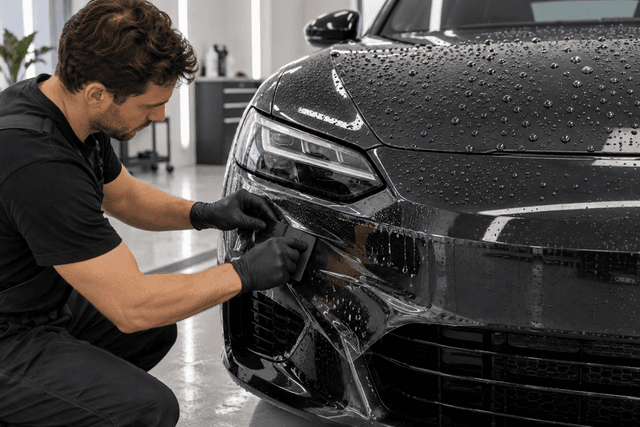
PPF is a thick transparent layer applied to the panels so that it takes the impact instead of the paint. It therefore suits drivers who cover long distances on highways, often drive behind vehicles that throw up gravel, or own a new car and want to preserve the original paint on the most exposed areas.
Some manufacturers state that their films recover from fine surface marks with heat; ask about this for the specific product offered to you rather than assuming it. Remember that film protects only what it covers, and installation quality shows in the edges, seams and the absence of bubbles or debris underneath.
Is Combining PPF and Ceramic Coating Worthwhile?
A common approach is to fit PPF on the front areas most exposed to gravel, such as the bumper, bonnet and mirrors, then apply ceramic coating to the rest of the paint to make washing easier and maintain gloss. Ceramic can also be applied over the film itself if the product is designed for films and the installer approves it.
This gives you impact resistance where chips are frequent and easier care on the rest of the car, without wrapping the whole body in film if you do not need it.
Why Does Paint Preparation Determine the Result?
Ceramic coating and film lock in the condition of the paint beneath them; swirl marks and stains that remain will show through the new layer. Good preparation therefore goes through three stages:
- A thorough, safe wash to remove dust and dirt.
- Removal of bonded contamination such as tar residue and iron particles until the surface feels smooth.
- Paint correction by polishing where needed to remove surface scratches before application.
For the tools and stages, see how to polish your car step by step. Deep scratches that reach the colour layer need repair before any protection, not covering up.
How Do Saudi Conditions Affect Your Choice?
Strong sun, dust and sand in many parts of the Kingdom expose paint to fading and fine scratches. Dust alone does not usually scratch, but wiping it off dry does, and blowing sand on open roads leaves small marks on the front of the car.
In these conditions, ceramic coating makes dust easier to rinse away, and PPF on the front helps drivers who travel often between cities. Parking in the shade and using a suitable car cover remain among the simplest measures; for more, read the summer car care guide for Saudi heat.
How Should You Care for the Car After Application?
- Follow the installer instructions on curing time and the first wash, as they vary by product.
- Wash with water and a gentle car shampoo, using clean microfibre mitts and towels.
- Avoid wiping dust off dry and avoid harsh brushes in automatic car washes.
- When using a pressure washer, keep the nozzle away from film edges so they do not lift.
- Remove bird droppings and water spots promptly, and dry the car after washing rather than leaving it to dry in the sun.
- Check film edges and water beading from time to time, and return to the installer if you notice a lifting edge or a clear drop in performance.
What Questions Should You Ask the Installer?
Before paying, ask for clear, written answers to the following points:
- Which product type is used, and is the ceramic offered suitable for application over film if you combine them?
- Exactly which areas are covered: the front only, additional parts, or the whole car?
- How are edges handled: is the film wrapped around panel edges, and is it cut on the car with a blade or with pre-cut patterns?
- Is there a written warranty? What does it cover and exclude, and what care conditions are required to keep it valid?
- What effect will removing the film later have on panels that have been repainted?
- Does the job include paint preparation and correction, or is that agreed separately?
The repainted panel question matters for used cars, because non-original paint may have weaker adhesion and can be affected when film is removed. If you are unsure of the car history, read how to tell whether a car has been repaired before installation.
When Is Paint Protection Not Worth the Cost?
- If the paint is deeply damaged or peeling, repairing it comes first.
- If the car is mostly parked indoors and used for short trips, wax and correct washing may be enough.
- If you are not ready to commit to a correct washing routine, you will lose much of the benefit.
- If the car needs essential mechanical maintenance, prioritise that over paint protection.
- If the offer relies on exaggerated promises such as "protection from all scratches" or "no need to wash".
Frequently Asked Questions About Nano Ceramic, PPF and Wax
Does nano ceramic coating prevent scratches?
No. It may reduce dirt adhesion and make cleaning easier, but it does not prevent scratches or stone chips. Impact resistance is the job of PPF on the areas it covers.
Can I stop washing the car after ceramic coating?
No. Ceramic coating makes washing easier and quicker, but dust and dirt still build up on it, and leaving them dulls the finish and raises the risk of scratches when they are wiped off.
Can ceramic coating be applied over PPF?
Usually yes, provided a film-compatible product is used and the installer approves it, so that it does not conflict with the warranty terms.
Does PPF damage the paint when removed?
When removed correctly from sound original paint the risk is lower, but repainted panels or weak paint may be affected. Ask the installer about this before installation.
What is the difference between nano ceramic paint coating and ceramic window tint?
Nano ceramic paint coating protects the exterior body, while ceramic tint is a film for the glass intended to reduce heat and glare. To learn about tint types, read how to choose the right window tint for your car.
Conclusion: Choose Protection to Match Your Use
Wax is for gloss and light, renewable protection; nano ceramic coating is for easier washing and gloss without impact protection; and PPF is for resisting gravel and light scratches where it is fitted. Whatever you choose, good preparation, a clear written warranty and correct washing are what make the difference.
Car Brand Logos and Names: A Guide to Badges in Saudi Arabia
Table Of Contents:
|
Car brand logos are the badges and names each manufacturer places on the front grille, the boot lid and the centre of the steering wheel, and the easiest way to learn them is to group them by country of origin: Japanese badges such as Toyota's three ovals, Korean ones such as Hyundai's slanted H, and Chinese brands, many of which spell out their full name in Latin letters, alongside German, European and American badges. In this guide you will find each brand's name as it is written and said, a short description of its badge, its meaning where it is documented, and a table for quick comparison.
What are car brand logos and where do you find them on a car?
A car badge (the logo or emblem) is the trademark that identifies the manufacturer, and it usually appears in several places:
- The centre of the front grille or the bonnet, the most visible spot for the logo.
- The boot lid, where the model name and sometimes the trim are usually written next to it.
- The centre of the steering wheel, the wheel caps and the car key.
Badges fall into two types: a standalone symbol such as a star, rings or a lion, or a name spelled out in letters, as with many American and new Chinese brands, and knowing this difference helps you recognise a car from a distance.
What are the best-known Japanese car brand logos?
Japanese badges are very familiar on the Kingdom's roads, and most are simple symbols that are easy to remember:
- Toyota: three ovals that form the letter T; the company says the two overlapping ovals represent mutual trust between the customer and the company, and the outer oval represents the global expansion of its technology.
- Lexus: a curved letter L inside an oval; it is Toyota's luxury vehicle division.
- Nissan: the name NISSAN across a thin circle; the name began as an abbreviation of the Japanese holding company Nihon Sangyo.
- Honda: a wide, upright letter H inside a frame with rounded corners.
- Mitsubishi: three red diamonds meeting at the centre, chosen by founder Iwasaki Yataro because they recalled the emblem of the Tosa clan that employed him and his own family crest.
- Mazda: a stretched letter M shaped like wings inside a circle; according to the company's website, the name is also linked to its founder, Jujiro Matsuda.
- Suzuki: a red letter S with sharp lines.
- Isuzu: the name ISUZU in bold letters; the name comes from the Isuzu River and means fifty bells.
What are the Korean car brand logos?
- Hyundai: a slanted letter H inside an oval; the Korean word means modernity.
- Kia: the word KIA in a sharp, angular script; according to the company, the name means rising from Asia.
- Genesis: two spread wings with a shield in the middle; it is the luxury brand of Hyundai Motor Group.
Which Chinese car brand logos are common in Saudi Arabia?
Chinese cars have become familiar in the Saudi market, and their best-known badges include:
- Changan: a shape like the letter V inside a circle; the name comes from the Chongqing Changan Arsenal and literally means long-lasting peace.
- Chery: an oval with a symbol resembling the letter A in the middle.
- Geely: the name GEELY is written in Latin letters on the rear of many of its models.
- Haval: the name HAVAL in large letters; it is a brand specialising in SUVs, owned by Great Wall Motor, which is named after the Great Wall of China.
- MG: the letters MG inside an octagon; it is a British marque founded in Oxford and owned today by the Chinese company SAIC Motor.
- BYD: the letters BYD in a bold typeface; the name had no particular meaning, and the company later adopted Build Your Dreams as a slogan matching its letters.
- Hongqi: a vertical red strip running from the bonnet to the grille on many of its models; the name means red banner, and it is the oldest Chinese passenger car brand, owned by FAW Group.
How do you recognise the new Chinese car brands?
Many Chinese brands have appeared in recent years, some cannot be recognised from the badge alone, and here are practical ways to tell them apart:
- Read the written name: many new brands spell out their full name on the grille or the boot instead of a standalone symbol, such as Jetour, Omoda, Jaecoo and Deepal.
- Know the parent company: Jetour, Omoda and Jaecoo belong to Chery, Deepal to Changan, Haval to Great Wall and Lynk & Co to Geely, and brands within one group may share some models or platforms.
- Learn what the name means: Jetour combines the words jet and tour, signifying a convenient journey according to the brand; the O in Omoda comes from oxygen and moda means modern, according to Chery; Jaecoo comes from the German word Jäger, meaning hunter, and the English word cool; and Deepal's Chinese name means deep blue.
- Do not rely on the badge alone: some brands have changed their logo more than once, and its look may differ from one model year to another, so confirm the manufacturer and model on the car's registration card.
- Check the VIN: its first characters identify the manufacturer, and it is recorded on the registration card and stamped on the car's body.
What are the German and European car brand logos?
European badges often rely on old symbols with well-known stories:
- Mercedes-Benz: a three-pointed star inside a circle, which for the original Daimler company symbolised Gottlieb Daimler's aim of motorisation on land, water and in the air.
- BMW: a circle divided into blue and white quarters inside a black ring bearing the company name; its colours recall the flag of Bavaria, while the idea that it is an aircraft propeller is a myth.
- Audi: four interlinked rings, each representing one of the four companies that joined to form Auto Union, Audi's predecessor.
- Volkswagen: the letters V and W inside a circle; the German name means people's car.
- Skoda: a winged arrow inside a circle; the arrow represents speed, the wings progress and freedom, and the eye precision; it is a Czech brand.
- Peugeot: a lion; the original logo was a lion walking on an arrow, symbolising the speed, strength and flexibility of Peugeot's saw blades; it is a French brand.
- Renault: a diamond-shaped lozenge that the French company has placed on the front of its cars since the nineteen-twenties.
- Land Rover: a green oval carrying the name of the British brand.
- Rolls-Royce: two interlocking letters R and the Spirit of Ecstasy mascot on the bonnet; the British company is a wholly owned subsidiary of the BMW group.
- Lamborghini: a raging bull, chosen by founder Ferruccio Lamborghini after he admired the fighting bulls at the Miura ranch in Spain; it is an Italian brand.
What are the American car brand logos?
American badges tend towards written names and simple shapes:
- Ford: a blue oval with the name Ford in white script.
- Chevrolet: the gold bowtie, whose origin is unsettled; the company's account says William Durant took it from a wallpaper pattern in a French hotel.
- GMC: the letters GMC, usually in red; it is a General Motors brand.
- Jeep: the word JEEP in plain letters, and many people know it by its grille with vertical slots.
- Dodge: the name DODGE in large letters on the grille or the rear.
- Lincoln: a four-point star inside a frame; it is a luxury brand owned by Ford and named after US President Abraham Lincoln.
Car brand logos table: brand, country of origin and badge description
A quick summary of each brand's badge:
| Brand | Country of origin | Badge description |
| Toyota | Japan | Three ovals |
| Nissan | Japan | Name inside a thin circle |
| Honda | Japan | Upright letter H |
| Mitsubishi | Japan | Three red diamonds |
| Hyundai | Korea | Slanted H in an oval |
| Kia | Korea | The word KIA in a sharp script |
| Changan | China | V shape inside a circle |
| Chery | China | A-like symbol in an oval |
| Jetour | China | Name in Latin letters |
| Haval | China | HAVAL in large letters |
| MG | Britain (Chinese owner) | MG inside an octagon |
| BYD | China | The letters BYD |
| Mercedes-Benz | Germany | Three-pointed star in a circle |
| BMW | Germany | Circle with blue and white quarters |
| Audi | Germany | Four interlinked rings |
| Volkswagen | Germany | VW letters in a circle |
| Peugeot | France | Lion |
| Ford | USA | Blue oval |
| Chevrolet | USA | Gold bowtie |
| GMC | USA | Red GMC letters |
Frequently asked questions about car brand logos
- How do I tell the Hyundai logo from the Honda logo? The Hyundai logo is a slanted letter H inside an oval, while the Honda logo is a wide, upright letter H inside a frame with rounded corners.
- Which car has a horse, bull or lion logo? The black prancing horse on a yellow background is the logo of Italy's Ferrari, the horse inside a coloured shield belongs to Germany's Porsche, the raging bull to Lamborghini and the lion to Peugeot.
- Is a brand's country of origin the country where the car is made? Not always; the country of origin is the brand's home, and its models may be built in other countries, so check the manufacturing details in the VIN and the registration card.
- Why do companies change their logos? Usually when they renew their identity, as Nissan, Kia and BYD have done in recent years, so you may see two logos for the same brand on cars from different years.
- How can I confirm a car's brand if its badge has been replaced? Some owners fit modified badges or the badge of another model, so rely on the registration card and the VIN rather than the badge, especially when buying a used car.
Car brand logos become easier to remember when you link each badge to its country and parent company, read the name written on the boot when in doubt, and check the registration card and the VIN before any purchase decision. You can browse the cars available at Saleh Cars Group to get to know the different brands and models.
Vehicle Driving Authorization on Absher: Conditions and Steps
Table of Contents:
|
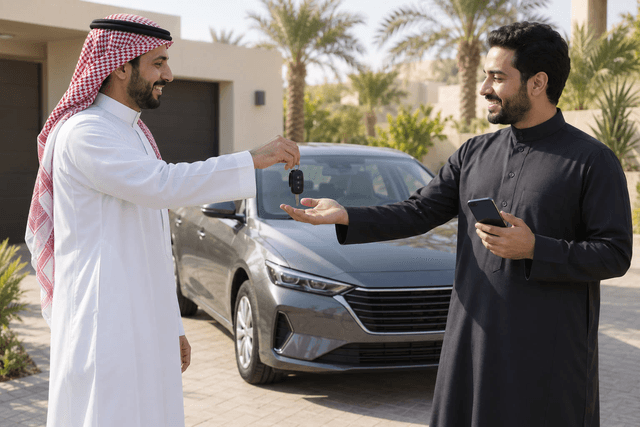
Vehicle driving authorization on Absher is an electronic service that lets a vehicle owner add an authorized person to drive the vehicle inside or outside the Kingdom, depending on the type of authorization selected. The owner starts from Vehicles, then Manage Vehicles, selects the vehicle, chooses Authorize Vehicles and then Issue Authorization. Before that, the vehicle registration must be valid with active insurance, and both parties must have Absher accounts. This guide covers the conditions, steps, period limits, the difference from ownership transfer and what the owner should check first.
What Is Vehicle Driving Authorization on Absher?
The official Issue an Authorization service page on the National Portal says the service allows you electronically to add an authorized person to drive a vehicle inside or outside the Kingdom, depending on the selected type of authorization. The service belongs to the Ministry of Interior, targets individuals, both citizens and residents, and lists its channels as the website portal and the iOS and Android apps.
The authorization is therefore permission to drive, not a sale or a transfer of ownership. The vehicle owner issues the authorization, and the authorized person is added to drive within the selected type and period. Read the service name in your account carefully and do not confuse it with other vehicle services in the same menu.
What Are the Vehicle Authorization Conditions and Required Documents?
The Prerequisites tab of the official service page lists the following conditions, as shown at the time of writing:
- The vehicle registration license must be valid and have active insurance.
- The authorization period must not exceed the validity of the vehicle registration license.
- The authorization period must not exceed the validity of the authorized person’s driving license.
- Authorization cannot be granted to someone holding a final exit visa.
- The authorization period must not exceed the duration of the exit and re-entry visa if the authorized person holds one.
The Required Documents tab lists the following:
- The authorizer must be the vehicle owner.
- The vehicle must have valid insurance.
- Both the authorizer and the authorized person must have active Absher accounts.
- For an external authorization, the authorized person must hold an exit and re-entry visa whose duration is linked to the authorization period.
The text we reviewed adds no other conditions, so follow what the service requests for your case rather than lists circulating in forums or messages.
What Are the Steps to Authorize a Vehicle on Absher?
The following steps come from the official service page. Menus may look different in the portal and the app, so look for the same names:
- Log in to Absher with the vehicle owner’s account.
- Select "Vehicles".
- Click on "Manage Vehicles".
- Select the vehicle you want to authorize and check its details.
- Choose "Authorize Vehicles".
- Click on "Issue Authorization", enter the required information and select the type of authorization.
The page describes the service duration as immediate, but do not rely on pressing the issue button alone; review what the service displays after submission to confirm the transaction is complete. If a message prevents issuing the authorization, return to the conditions above and start with the item the message refers to, such as insurance validity or the validity of one of the licenses, instead of retrying without changing anything.
Driving Authorization Inside and Outside the Kingdom: What Differs?
The page states that the authorization applies inside or outside the Kingdom depending on the type of authorization you select in the final step. Decide the purpose before you start: will the authorized person drive only inside the Kingdom, or do they need to drive the vehicle abroad?
For an external authorization, the Required Documents tab requires the authorized person to hold an exit and re-entry visa. The page links the visa duration to the authorization period, but the Prerequisites wording (the authorization period must not exceed the visa duration) runs in the opposite direction to the Required Documents wording (the visa must not exceed the authorization period), so follow what the service accepts for your case. A holder of a final exit visa cannot be added as an authorized person.
The service page does not address the requirements of other countries or border crossings when travelling by car, so ask the competent authorities about this before relying on the authorization alone.
How Long Does the Authorization Last and How Is It Cancelled?
The service page does not set a fixed authorization period; it sets upper limits instead. The period must not exceed the validity of the vehicle registration, the validity of the authorized person’s driving license, or the duration of their exit and re-entry visa if they hold one. In practice, whichever of these dates expires first limits the period you can choose.
As for cancellation, the pages we reviewed do not explain the steps. Start from the Authorize Vehicles screen in the owner’s account and review the options shown to you. If nothing fits your case, ask the official Ministry of Interior support channels, and do not rely on an unofficial explanation that mentions a specific button or period.
If the vehicle registration is about to expire, review the vehicle registration renewal steps on Absher before choosing the authorization period, because the period may not exceed the registration validity.
How Does Authorization Differ From Ownership Transfer?
Some people confuse allowing someone to drive the car with selling it to them. As the service describes it, authorization adds an authorized driver and is issued by the vehicle owner, while ownership transfer is a separate procedure that changes the owner. The table summarises the difference:
| Item | Driving Authorization | Ownership Transfer |
| Purpose | Add an authorized person to drive the vehicle | Transfer vehicle ownership to another owner |
| Who starts it | The vehicle owner, according to the service page | According to the sale service conditions |
| Does the owner change? | The service describes no change of ownership | Yes, that is the purpose of the procedure |
| Period limits | Not beyond the registration and the authorized person’s driving license validity | Follows the transfer service conditions |
If your aim is to sell or buy the car, authorization is not a substitute for a sale; review the Absher ownership transfer steps and sale conditions to complete the correct procedure.
What Should the Owner Check Before Issuing the Authorization?
The official conditions determine whether the authorization can be issued, but they do not answer every practical question. Before issuing it, review the following points:
- Registration: confirm it is valid and note its expiry date, because that date limits the authorization period.
- Insurance: confirm the policy is valid for the same vehicle, then read its terms or ask the insurer about someone other than the owner driving, and do not assume any particular cover simply because the authorization was issued. To distinguish policy types, read about comprehensive versus third-party car insurance.
- Authorized person: confirm their driving license is valid, that they have an Absher account and, for a resident, their visa status.
- Purpose and period: choose the authorization type and period according to your actual need, not longer.
If an accident happens while the authorized person is driving, learn the steps to take after a car accident and Najm reporting. The service page does not address how responsibility for accidents or violations is shared between the owner and the authorized person, so do not build assumptions on it; ask the competent authority or your insurer about your case.
Frequently Asked Questions About Vehicle Driving Authorization
Must the person issuing the authorization be the car owner?
Yes. The Required Documents tab states that the authorizer must be the vehicle owner. The authorization is therefore not issued from the account of someone who does not own the vehicle, even if they usually drive it.
Does the authorized person need an Absher account?
Yes. The page requires both the authorizer and the authorized person to have Absher accounts. Confirm this before starting so the process does not stop when you enter the details.
Can someone holding a final exit visa be authorized?
No. The prerequisites state that authorization cannot be granted to someone holding a final exit visa. For a holder of an exit and re-entry visa, the authorization period is tied to the visa duration.
Can I authorize if the registration or insurance has expired?
The published condition is a valid vehicle registration with active insurance. If either has expired, resolve it first and then return to the authorization service.
Does authorization mean the insurance covers the authorized person?
The service page mentions insurance only as a condition for issuing the authorization. Review your policy and its terms with your insurer before allowing another person to drive.
Conclusion
Vehicle driving authorization on Absher starts from the owner’s account and requires a valid registration, active insurance and Absher accounts for both parties, with its period limited by the validity of the licenses and visa. Choose the right authorization type, review your insurance policy and do not use authorization as a substitute for ownership transfer.
When to Replace Car Tyres: Tread, Cracks and Warning Signs
Table Of Contents:
|
If you are asking when to replace car tyres, the short answer is: replace a tyre when the surface of the tread reaches the level of the raised wear indicators inside the grooves, when a bulge, a deep cut or clear cracks appear in its sidewall, or when the rubber has aged to the point at which the tyre or car manufacturer recommends replacement, even if the tread looks good. In this guide we explain how to check your tyres, what the wear pattern reveals, and how to choose the right replacement.
When should you replace car tyres? The key signs in brief
Replacement is not tied to a single distance for every car, but to the tyre's condition and its maker's recommendations. The main signs are:
- The tread surface has reached the level of the wear indicators in any part of the tyre, not just on average.
- A bulge or bubble in the sidewall, a deep cut, or exposed cords or internal fabric.
- Clear cracks in the sidewall or between the tread blocks, showing that the rubber has aged and hardened.
- Uneven wear that has left part of the tyre smooth even though the rest of its surface is sound.
- A persistent vibration that does not go away after balancing, or repeated pressure loss in the same tyre with no visible cause.
How do you check tread depth using the TWI wear indicators?
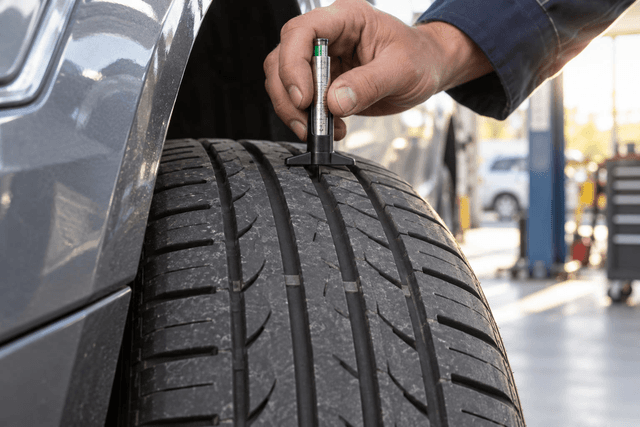
Inside the grooves are small raised bars called wear indicators, whose location is marked by the letters TWI or a small triangle on the tyre's shoulder, and when the tread surface is level with them, the tyre has reached the end of its usable life. To check:
- Park the car on level ground and turn the steering wheel to one side so you can see the front tyres clearly.
- Look for the TWI mark or triangle on the tyre's shoulder, then look into the groove next to it to find the raised bar.
- Compare the level of the tread surface with the bar; the closer they are to level, the closer the replacement date.
- Repeat the check on the inner edge, the centre and the outer edge, and at several points around the tyre's circumference.
- For a more precise reading, use a tread depth gauge, available at tyre shops, and record the reading for each tyre.
- Some drivers use a coin as a rough gauge, but it is no substitute for a proper gauge or a look by a qualified technician.
Do not wait until they are exactly level if you travel often or drive in the rain, as water clearance and grip weaken gradually as the tread gets shallower.
What do tyre cracks and sidewall bulges mean?
The sidewall flexes with every turn of the wheel and carries the car's weight, so any damage to it is more dangerous than tread wear:
- Fine surface cracks: an early sign of rubber ageing caused by heat and sun, which calls for the tyre to be inspected by a specialist and monitored.
- Deep cracks: if they widen or reach the tyre's inner layers, it is time to replace it.
- A bulge or bubble: damage to the tyre's internal structure, usually after hitting a pothole or kerb, which requires immediate replacement and no travelling on it.
- Cuts and gashes: a deep cut in the sidewall weakens the tyre even if no air is leaking from it yet.
What does the tyre wear pattern reveal?
The wear pattern reveals the cause of the problem, and if you do not fix it, new tyres will wear the same way:
| Wear pattern | Likely cause | What to do |
| Both edges more than the centre | Pressure lower than recommended | Set the pressure according to the driver's door sticker and check it regularly |
| Centre more than the edges | Pressure higher than recommended | Set the recommended pressure, not the maximum pressure printed on the tyre |
| One inner or outer edge | Wheel alignment or suspension fault | Check the alignment and suspension parts |
| Diagonal, feather-like wear | Incorrect toe between the two wheels | Have the alignment set at an equipped workshop |
| Repeated patches or scallops | Unbalanced wheels or worn shock absorbers | Balance the wheels and check the shock absorbers |
| A single flat spot | Hard braking with a locked wheel, or standing a long time without moving | Have a specialist assess the tyre |
If you see wear on both edges, start by reviewing the causes, signs and solutions for low tyre pressure, and if the wear is on one edge or comes with the car pulling to one side, read about the difference between wheel balancing and alignment.
How do Saudi heat and sand affect tyre life?
Rubber ages over time even if the car is used little, and you will find how to tell a tyre's age from the DOT code in our article on how to read tyre size and manufacture date. There is no single lifespan for all tyres, so refer to the tyre and car makers' recommendations. In the Kingdom's climate, some factors speed up deterioration:
- Direct sun and high heat speed up the hardening and cracking of rubber, especially for cars standing for long periods in open car parks, so park in the shade whenever possible.
- Hot asphalt raises tyre temperature, and the effect grows with low pressure or overloading on long trips.
- Sandy, gravel and desert tracks expose the tread and sidewall to cuts from sharp stones, so inspect the tyres after every desert trip.
- If you lower tyre pressure (deflating) to drive on sand, restore it to the recommended value before returning to asphalt, because highway driving at low pressure raises tyre temperature.
Should you replace tyres in pairs or all four together?
Ideally all four tyres match, but replacing them all together is not always necessary:
- Replace both tyres on the same axle together at least, so grip does not differ between the two sides when braking or cornering.
- When replacing only one pair, many tyre makers recommend fitting the newer pair on the rear axle for better stability, unless the owner's manual says otherwise.
- In four-wheel-drive or all-wheel-drive cars, the owner's manual may require the four tyres to be close in size and degree of wear to protect the drive system, so check it before replacing only two.
What about the spare tyre?
The spare forgotten in the boot ages just like the other tyres, even if it is never used:
- Check its pressure regularly and before every trip, because a flat spare will not help you when you get a puncture.
- Read its manufacture date and inspect its sidewall, as it may be older than the tyres on the car.
- A small temporary spare is designed for a limited distance and speed stated in the owner's manual or on the tyre's side, so use it only to reach the nearest tyre shop.
- If your car comes with a repair kit instead of a spare, check its expiry and how to use it.
How do you choose the right replacement tyre: size, load and speed?
Choose what your car was designed for, not just what the shop has in stock, and check the following:
- Size: copy it from the sticker on the driver's door frame or from the owner's manual, not from the tyre currently fitted, which may be different.
- Load index and speed symbol: choose values equal to or higher than the car manufacturer's recommendation, never lower.
- Manufacture date: ask for recently made tyres with close dates, especially on the same axle.
- Type of use: a driver who often travels on highways has different needs from one who drives in the desert or carries heavy loads, so ask about the tyre designed for your use.
- Changing the size: do not change the size of your tyres or rims without consulting a specialist; to learn the effect, read our article on whether the wrong rims make your car use more fuel.
- After fitting: balance the wheels, set the pressure according to the driver's door sticker, and check the alignment if the old tyres were worn unevenly.
What is the tyre energy efficiency label in Saudi Arabia?
The Saudi Standards, Metrology and Quality Organization offers the Energy Efficiency Label for Tires service, and explains that the label serves as a guide for consumers before purchasing the product to increase their awareness of its energy efficiency before buying it.
The organization lists tyres among the products subject to the efficiency label regulations, and the aims of these labels include reducing energy consumption for the consumer, enabling the consumer to know a product's efficiency before buying, and protecting consumer safety and health and the environment. In practice:
- When comparing tyres of the same size, ask to see the energy efficiency label for each one and read its details.
- Do not make the label your only criterion; size, load index, speed symbol, manufacture date and the tyre's suitability for your use come first.
- Requirements and procedures may be updated from time to time, so check the latest information on the organization's website.
Frequently asked questions about replacing car tyres
- Should I replace a tyre that is old even if its tread is good? Tread depth alone is not enough, as rubber hardens over time; have it checked by a specialist and follow the tyre maker's recommendation.
- Can a puncture in the side of the tyre be repaired? Repairing holes in the sidewall or shoulder is not usually recommended, while for a hole in the tread area the technician decides whether it can be repaired based on its size and position.
- Can I fit two tyres of different types? This is not recommended on the same axle, and it is best for all four tyres to match in type and tread pattern, especially in four-wheel-drive cars.
- Are small cracks between the tread blocks dangerous? They are a sign of ageing that may not require immediate replacement, but have a specialist monitor them, and if they deepen, replace the tyre.
- How often should I check my tyres? Check their pressure and appearance regularly, for example when refuelling, before every trip, and after hitting a pothole or kerb or after a desert trip.
Checking your tyres takes only minutes: look at the wear indicators, inspect the sidewall, notice the wear pattern and read the manufacture date. If a danger sign appears, do not postpone the change; choose a replacement with the recommended size, load and speed ratings, then fix the cause of any uneven wear.